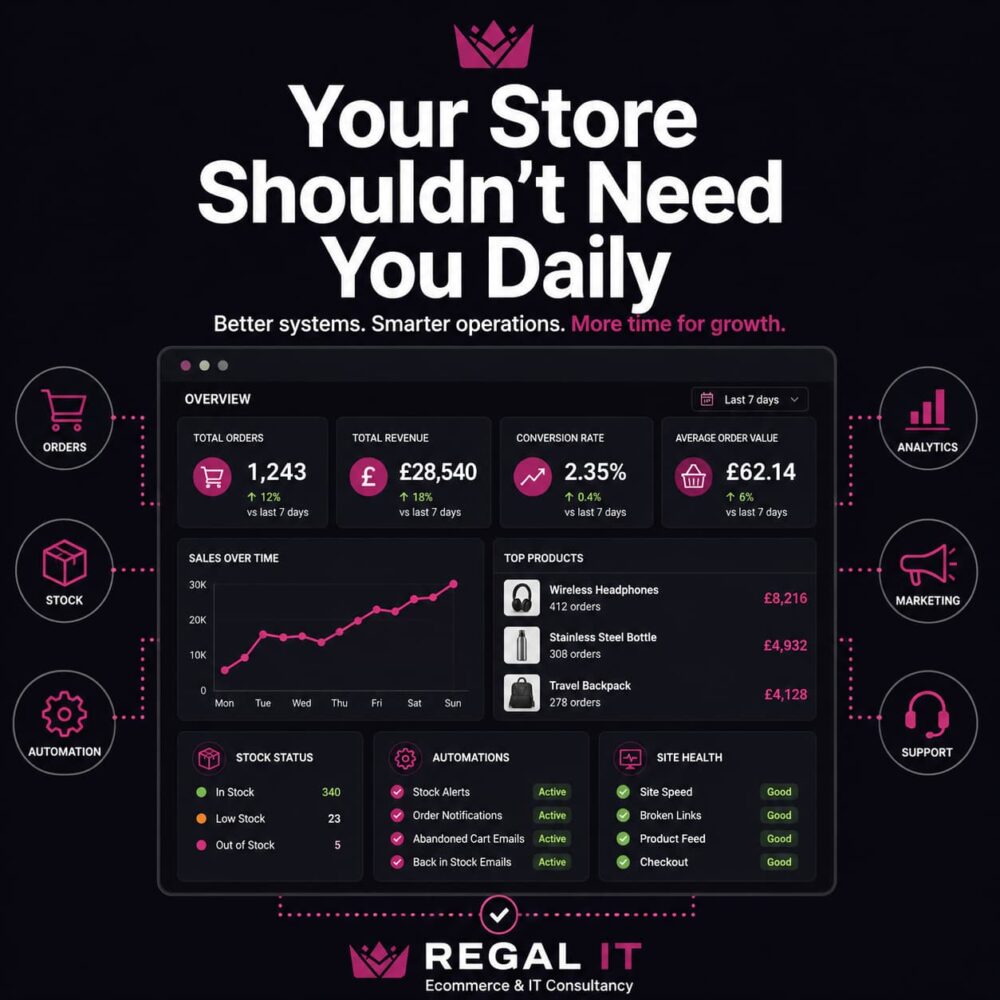
ecommerce store management dashboard showing automation, orders, stock and reporting

If Your Store Needs You Every Day, You’re Doing It Wrong

If your online store needs you every day just to keep moving, that is not commitment. It is a system failure wearing a founder’s hoodie. Good ecommerce store management should reduce daily firefighting, not turn you into a full-time product editor, app tester, stock checker, report builder and checkout detective.

Growth gets difficult when the founder becomes the operating system. Orders still come in, campaigns still run, customers still browse, but every small issue lands on the same person. Product data needs fixing. A discount code breaks. Stock does not sync properly. A collection page converts badly. Nobody quite trusts the numbers. The store works, technically, but only because someone is constantly poking it with a stick.

Read More

Your Business Is Scaling. Your Systems Aren’t.

Growth feels good until everything starts breaking

At first, growth is exciting.

More orders.
More traffic.
More customers.

You feel momentum. Progress. Validation that what you’re doing is working.

Then something shifts.

The site slows down.
Operations feel messy.
Support increases.
Marketing becomes harder to manage.

Growth is still happening, but it doesn’t feel smooth anymore.

That’s the moment most founders misread the situation.

The problem isn’t growth.
The problem is your systems haven’t kept up with it.

Read More

You Didn’t Start a Business to Spend Your Life in the Admin Panel

You Didn’t Start a Business to Spend Your Life in the Admin Panel

The dream was freedom. The reality is browser tabs.

When most founders start an ecommerce business, they imagine building something exciting. A brand. A product. A community. Something that grows.

What they rarely imagine is spending half their life inside the platform admin panel.

Checking orders.
Updating plugins.
Fixing product pages.
Tweaking shipping rules.
Debugging checkout issues.
Looking at analytics dashboards.

Yet that’s exactly where many founders end up.

Not because they want to be there. Because the business quietly pulled them in.

Read More

What Professional Ecommerce Management Actually Removes from Your Day

It’s not about adding more. It’s about removing the drag.

Most founders assume hiring ecommerce management means adding another layer. Another meeting. Another report. Another opinion.

That’s backwards.

The real value isn’t what gets added to your business. It’s what quietly disappears from your day.

Because growth doesn’t stall due to lack of ideas. It stalls due to constant friction.

Let’s talk about what actually gets removed.

Read More

The Real Job of an Ecommerce Manager (Hint: It’s Not Just Fixing Things)

If all they do is fix problems, you hired too late

Most businesses only bring in help when something breaks.

The site goes down.
Checkout stops converting.
Tracking fails.
Updates cause chaos.

At that point, an ecommerce manager looks like a firefighter. Someone brought in to put out flames and keep things alive.

But that is not the real job. That is what happens when the real job was missing for too long.

Read More

The Founder Trap: When Being Hands-On Starts Killing Growth

What got you here will not get you there

Being hands-on is usually the reason an ecommerce business exists in the first place. You built it, shaped it, fixed it, and pushed it forward when no one else could. That level of involvement is often the difference between an idea and a functioning store.

But there is a point where that same behaviour quietly turns from an advantage into a liability.

That point is the founder trap.

Read More

When Growth Exposes the Cracks You’ve Been Ignoring

Growth does not create problems. It reveals them

Most founders blame growth when things start breaking.

Traffic goes up and the site slows down.
Orders increase and fulfilment becomes messy.
Ad spend scales and tracking falls apart.
Revenue grows and suddenly nothing feels stable.

Growth did not cause these issues.
It simply applied pressure to weaknesses that were already there.

Read More

Why Most Stores Collapse After 18 Months of DIY Tweaks

It never breaks all at once

Most ecommerce stores do not fail dramatically. There is no single outage, no fatal mistake, no obvious turning point.

Instead, performance quietly degrades.
The site gets slower.
Conversions flatten.
Updates feel risky.
Marketing becomes unpredictable.

By the time founders realise something is wrong, the damage has already been done.

And almost always, the cause is the same.
Eighteen months of DIY tweaks.

Read More

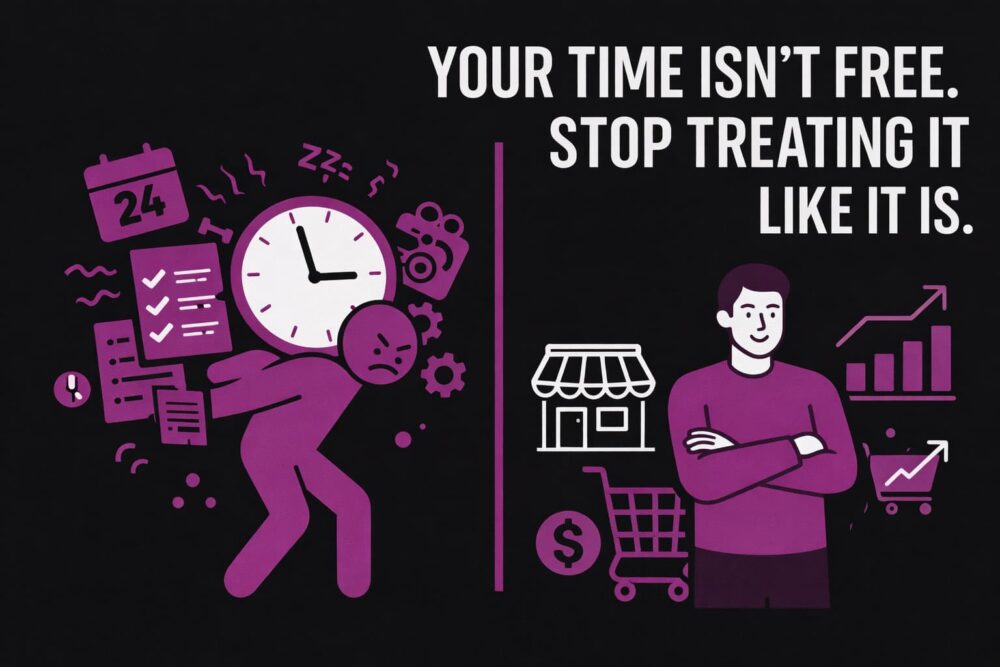
Your Time Isn’t Free. Stop Treating It Like It Is.

The most expensive thing in your business is pretending your time costs nothing

Most ecommerce founders obsess over costs. App fees. Ad spend. Hosting. Shipping. Margins.

But the single most expensive resource in the business is treated as if it is unlimited and worthless.

Your time.

If you are not pricing your time properly, you are making decisions that feel sensible and quietly destroy growth.

Read More

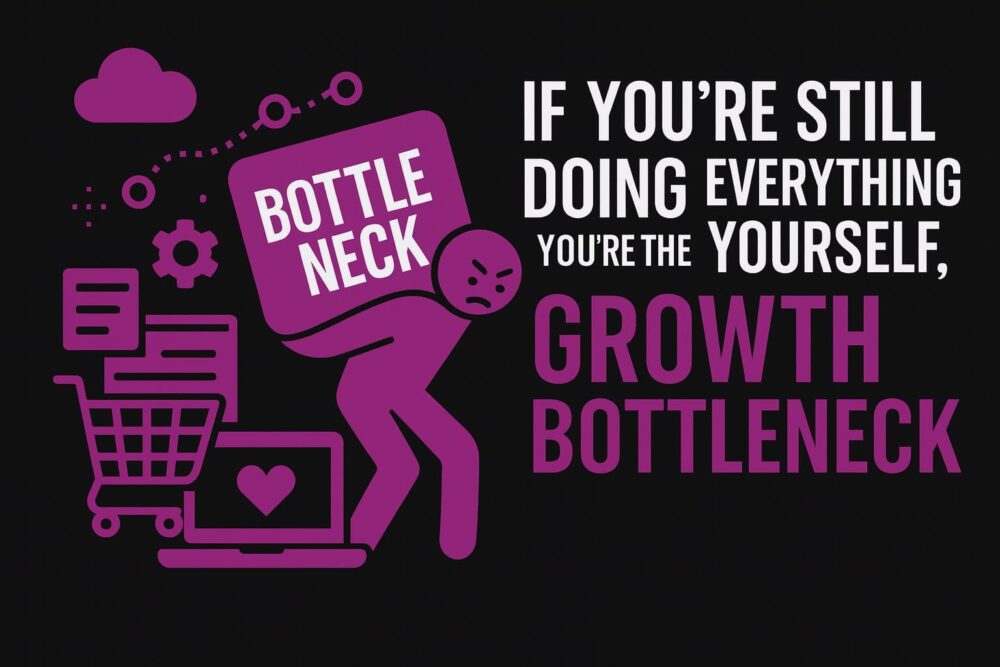
If You’re Still Doing Everything Yourself, You’re the Growth Bottleneck

This is the part nobody likes admitting

You built the store. You set up the products. You chose the apps. You fixed the first bugs. You probably still know more about the site than anyone else.

That used to be a strength.
Now it is the thing holding the business back.

If everything still flows through you, growth has a ceiling. And that ceiling is your time.

Read More