
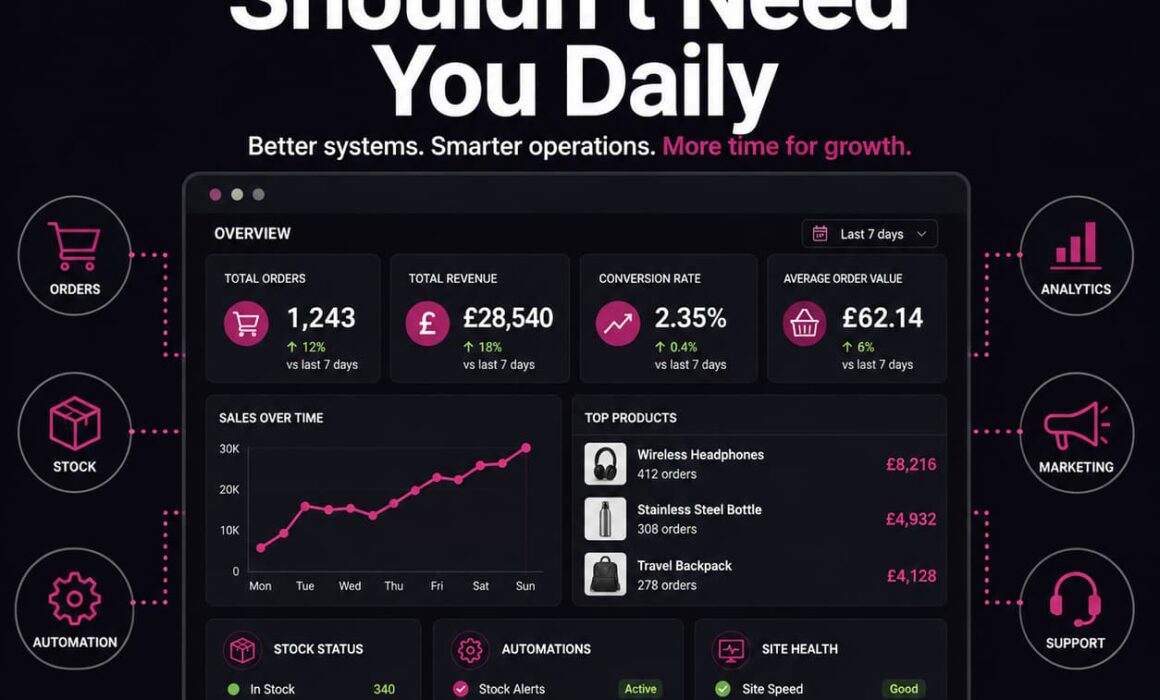
If Your Store Needs You Every Day, You’re Doing It Wrong
If your online store needs you every day just to keep moving, that is not commitment. It is a system failure wearing a founder’s hoodie. Good ecommerce store management should reduce daily firefighting, not turn you into a full-time product editor, app tester, stock checker, report builder and checkout detective.
Growth gets difficult when the founder becomes the operating system. Orders still come in, campaigns still run, customers still browse, but every small issue lands on the same person. Product data needs fixing. A discount code breaks. Stock does not sync properly. A collection page converts badly. Nobody quite trusts the numbers. The store works, technically, but only because someone is constantly poking it with a stick.
ecommerce store management is not just keeping the lights on
There is a difference between having an ecommerce website and having an ecommerce operation. A website can take orders. An operation can take pressure.
Many Shopify and WooCommerce stores start lean, which is sensible. The founder uploads products, handles customer queries, checks payments, edits banners, fixes the odd plugin issue and keeps an eye on ads. At first, that is efficient. Then the store grows. More products, more apps, more stock movements, more campaigns, more customer expectations and more reports. Suddenly the same hands-on approach becomes expensive.
The cost is not just time. It is missed decisions. If you spend Monday morning fixing product variants, you are not reviewing conversion data. If you spend Tuesday sorting stock discrepancies, you are not planning your next campaign. If you spend Wednesday trying to work out why sales dropped, you are probably looking at yesterday’s problem with last week’s data.
That is where ecommerce management support becomes commercially useful. Not because founders are incapable. Quite the opposite. It is useful because capable founders are usually the most expensive people in the business to have buried in admin.
The simple test: if your store cannot comfortably run for a few days without you checking products, orders, apps, reports and customer-facing pages, the issue is not effort. The issue is structure.
Why growing ecommerce stores become too dependent on the founder
Most ecommerce bottlenecks do not appear overnight. They build slowly, usually behind a perfectly acceptable sales graph.
A store launches with a few collections, simple fulfilment and a manageable customer base. Then products expand. Ads start driving more traffic. Email marketing gets added. Reviews, subscriptions, stock apps, loyalty tools, bundles, feeds, pixels, analytics and checkout extensions all join the party. Before long, the business is no longer one website. It is a stack of connected systems that all need to behave.
The founder often remains the only person who understands how everything fits together. That creates a hidden risk. Every operational decision becomes dependent on memory, habit or a spreadsheet called something deeply reassuring like “final-final-stock-cleaned-v3.xlsx”.
The common founder bottlenecks
- Product admin: fixing titles, variants, images, SKUs, tags, descriptions and collection rules.
- Stock control: checking whether the website, warehouse, supplier and spreadsheet all agree.
- Reporting: trying to understand sales, conversion, traffic, customer behaviour and stock movement without a clean weekly view.
- Website fixes: dealing with layout issues, broken pages, slow sections, checkout friction and plugin or app conflicts.
- Campaign support: building landing pages, checking product feeds, updating offers and making sure ads do not point at weak pages.
- SEO and content: improving collection structure, internal links, metadata, product copy and AI-friendly content.
None of these tasks are glamorous. That is rather the point. They are the operational details that quietly decide whether marketing spend turns into profit or just keeps the Meta dashboard feeling wanted.
One-off fixes do not solve daily operational drag
One-off fixes are useful when one thing is clearly broken. They are less useful when the store’s entire rhythm depends on reactive work.
For example, a WooCommerce checkout issue may need a quick technical fix. Fine. But if the same store also has slow product pages, inconsistent stock messaging, weak collection copy, missing conversion tracking and no useful weekly report, the checkout issue is only one symptom. The wider problem is that nobody is managing the store as a commercial system.
| Area | One-off fixes | Ongoing ecommerce store management |
|---|---|---|
| Website issues | Fixes the visible problem when someone reports it. | Checks patterns, causes and commercial impact before they become repeat problems. |
| Product data | Updates individual products manually. | Improves structure, naming, collections, attributes and workflows so updates are cleaner. |
| Reporting | Looks at numbers when something feels wrong. | Provides regular reporting so decisions are based on trends, not panic. |
| Conversion | Tweaks pages occasionally. | Connects product pages, collection structure, checkout, speed, content and customer experience. |
| Founder workload | Removes one task temporarily. | Reduces the daily dependency on the founder over time. |
The better question is not “what needs fixing today?” It is “why does this store keep needing someone to fix things manually?”
Good ecommerce operations make growth less chaotic
Marketing gets most of the attention because it is visible. Operations often do the quiet work that decides whether that marketing makes money.
A store can have strong traffic and still leak revenue. Product pages may not answer the questions customers actually have. Collection pages may be messy. Search filters may be unhelpful. Shipping information may be buried. Checkout may create tiny moments of doubt. Analytics may be too patchy to show where the problem sits.
None of those issues necessarily stop orders. That is what makes them dangerous. They just shave a little off conversion every day. A little off customer confidence. A little off repeat purchase. A little off margin. Lovely. Death by a thousand admin cuts.
A practical example
Imagine a Shopify store spending £4,000 a month on ads. Traffic is up, but conversion is weak. The founder assumes the ads are poor. They might be. But the actual problem could be the landing collection: unclear product sorting, weak product titles, no size guidance, slow images and thin copy that gives search engines and AI answer engines very little to understand.
Fixing that properly is not just a design task. It needs ecommerce thinking. The collection should support conversion, SEO, AIO, merchandising and reporting. The ads, page structure, product data and customer journey need to work together.
This is where web optimisation services and practical store management overlap. The website is not a brochure. It is the sales floor, stock room, till system, reporting desk and customer service assistant all squeezed into one very judgemental browser tab.
Automation should remove admin, not create another system to babysit
Automation is only useful when it reduces workload without reducing control.
Plenty of ecommerce businesses add apps to solve individual problems. A stock app here. A feed app there. A review app, loyalty app, upsell app, reporting app and maybe three abandoned checkout tools because someone on YouTube sounded confident. The result can be more complexity, not less.
Good automation starts with the workflow, not the tool. What is being done manually? Why is it manual? Does it need approval? What happens when something fails? Who gets notified? What should be reported weekly?
Useful ecommerce automation examples
- Stock alerts: highlighting low stock, dead stock and fast-moving products before campaigns push the wrong items.
- Product workflows: cleaner processes for adding new products, updating attributes and keeping collections consistent.
- Customer service support: reducing repetitive replies with better order, return and delivery visibility.
- Reporting routines: pulling key weekly metrics into a format that shows what changed and what to do next.
- Operational checks: monitoring broken links, tracking gaps, app issues, checkout problems and feed errors.
The commercial point is simple. Every useful automation either saves time, reduces errors, improves customer experience or helps the business act faster. If it does none of those things, it is probably just a shiny dashboard with commitment issues.
Reporting is what stops decisions being based on vibes
Founders usually know their business well. That instinct matters. But ecommerce has too many moving parts to rely on instinct alone.
Sales can be up while margin is weaker. Conversion can be down because traffic quality changed. Returning customer rate can look worse because new customer acquisition improved. A product can appear popular but only because it had more visibility. A campaign can look successful while pushing items with poor stock depth.
Useful reporting connects the numbers to action. It should not be a screenshot dump. Nobody needs twelve charts and a nervous breakdown before lunch.
What a useful weekly ecommerce report should answer
- What changed this week?
- Was the change meaningful or just noise?
- Which products, collections or channels drove performance?
- Where did conversion improve or weaken?
- Are stock levels supporting current demand?
- What should be fixed, tested or prioritised next?
For a growing store, this is where ongoing ecommerce management services can be more valuable than isolated tasks. The work becomes connected. Reporting informs merchandising. Merchandising informs campaigns. Campaigns inform landing page improvements. Landing pages inform SEO and AIO priorities. The store starts behaving like a joined-up business instead of a collection of tabs.
SEO and AIO need clean store structure to work properly
Search visibility is not just about writing more content. For ecommerce stores, structure matters.
Product names, collection pages, internal links, metadata, headings, schema, image alt text, FAQs and buying guidance all help search engines understand the store. Increasingly, they also help AI answer engines understand what the business sells, who it serves and which pages are useful for specific queries.
A weak collection page can cause problems beyond rankings. It can confuse customers, dilute internal links, make product discovery harder and give paid traffic a poor landing experience. The same page may be expected to support SEO, PPC, email campaigns, navigation and conversion. That is a lot of responsibility for a page someone last edited during a sale at 11:48pm.
What SEO and AIO work looks like in ecommerce management
- Improving collection descriptions so they help customers choose, not just fill space.
- Adding internal links between relevant products, collections and buying guides.
- Making product pages clearer with better specifications, use cases, sizing, delivery and return information.
- Structuring content so search engines and AI systems can identify topics, entities and intent.
- Fixing technical issues that block crawling, indexing or performance.
Regal IT’s SEO and AIO support is built around that practical reality. The aim is not to decorate the website with keywords. It is to make the store easier to find, easier to understand and easier to buy from.
For broader guidance on how Google approaches ecommerce discovery and structured website content, Google Search Central’s ecommerce documentation is a useful reference: Google Search Central ecommerce guidance.
Technical issues quietly damage revenue before anyone notices
Not every ecommerce problem announces itself with a dramatic error message. Some just sit there, politely costing money.
A slow collection page can reduce conversion. A broken product feed can limit ad performance. Duplicate tracking can make reporting unreliable. A checkout field can create friction. A plugin update can break a feature. A theme change can affect mobile layout. A cookie banner can interfere with analytics. A stock sync issue can oversell products or hide available inventory.
The store may still “work”. Customers can still place orders. That is why these issues often survive for weeks.
Common quiet revenue leaks
- Mobile layout problems: buttons, filters or product options that are awkward on smaller screens.
- Slow page speed: especially on image-heavy product and collection pages.
- Tracking gaps: missing events, duplicate conversions or unreliable attribution.
- Checkout friction: unclear delivery costs, awkward payment options or confusing fields.
- App conflicts: features that work alone but clash when themes, plugins or scripts change.
- Weak product feeds: poor titles, missing attributes or rejected items affecting paid campaigns.
This is where ecommerce-focused support matters. Basic website support may fix the visible bug. Ecommerce support asks what the bug affected commercially, whether it is part of a wider pattern and what needs to be monitored afterwards.
Shopify and WooCommerce both need regular management
Shopify and WooCommerce are very different platforms, but neither removes the need for proper management.
Shopify gives businesses a hosted, streamlined environment with strong app access and a relatively controlled technical base. That does not mean the store manages itself. Theme changes, app conflicts, product feeds, checkout settings, collection structure, analytics, page speed and content still need attention.
WooCommerce offers more flexibility and ownership, but that comes with more moving parts. Hosting, caching, plugins, theme compatibility, payment gateways, security, updates and custom functionality all need sensible oversight. The flexibility is powerful. It can also become a cupboard full of cables if nobody is keeping it tidy.
Regal IT works across both platforms, which is useful because the real issue is rarely just “Shopify” or “WooCommerce”. The issue is how the store is managed, measured and improved. Platform knowledge matters, but commercial context matters more.
Better ecommerce store management gives founders their focus back
The goal is not to remove the founder from the business. That would be ridiculous. The goal is to stop the founder being required for every operational wobble.
A well-managed store gives founders more time for the work only they can do: product direction, supplier relationships, brand positioning, partnerships, hiring, finance and growth strategy. It also gives the team a clearer operating rhythm. Tasks are prioritised. Reports are understood. Issues are spotted earlier. Improvements are implemented properly.
That shift changes the feel of the business. Instead of reacting to whatever shouts loudest, the store has a practical improvement cycle.
A healthier ecommerce rhythm looks like this
- Weekly reporting shows what changed and why it matters.
- Product and collection improvements are planned, not rushed.
- Automation removes repeat admin where it makes sense.
- Technical issues are monitored and fixed with commercial context.
- SEO, AIO, conversion and customer experience improve together.
That is the difference between owning a store and being owned by one.
How Regal IT helps stores run without daily firefighting
Regal IT is built for ecommerce businesses that are past the “we just need a website” stage.
The work is practical because ecommerce is practical. Products need managing. Systems need checking. Reports need interpreting. Pages need improving. SEO and AIO need structure. Apps need sense-checking. Technical issues need fixing without breaking something else in the process. A store is not improved by one grand strategy document that nobody opens again. It is improved by consistent, commercially aware action.
That can include ecommerce management, Shopify and WooCommerce support, automation, reporting, SEO, AIO, web optimisation and day-to-day operational support. The exact mix depends on the store, but the principle stays the same: reduce unnecessary founder dependency and make the business easier to run, measure and grow.
If your store needs you every day, the problem is not that you care too much. The problem is that too much operational knowledge, admin and decision-making is stuck with you. Regal IT helps move that weight into better systems, clearer reporting and practical ongoing support.
For serious ecommerce businesses that want the store to run more smoothly, convert more reliably and stop dragging the founder into every tiny operational drama, explore Regal IT’s ecommerce management support. Your store should need leadership, not constant babysitting.