
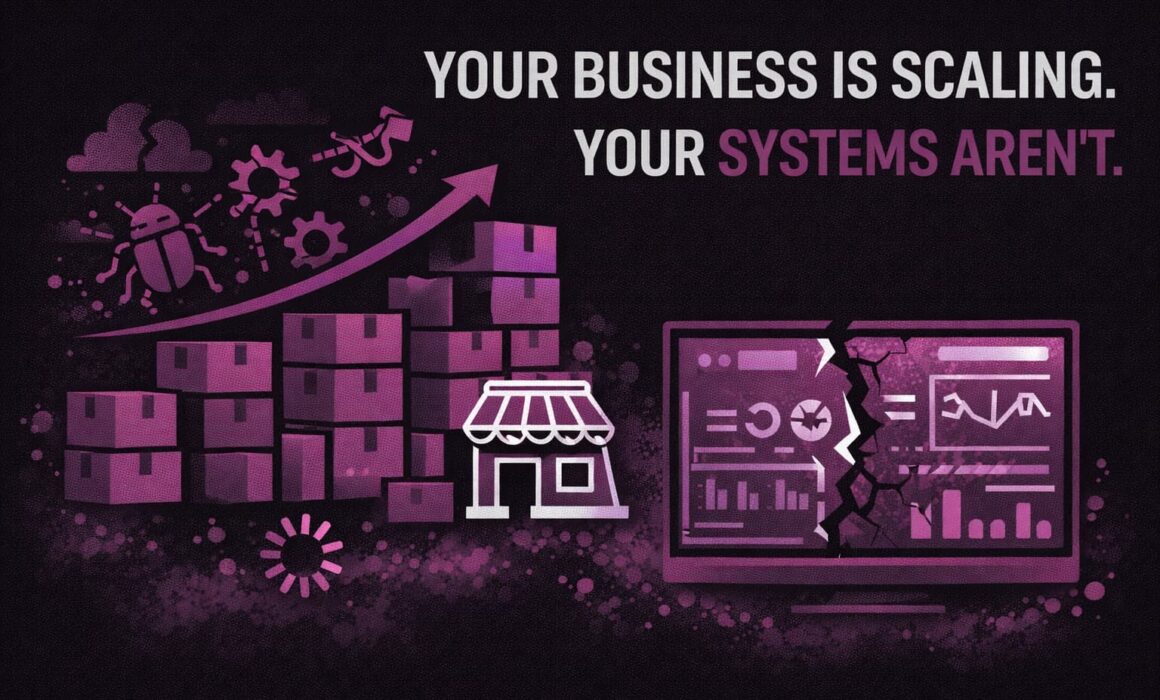
Your Business Is Scaling. Your Systems Aren’t.
Growth feels good until everything starts breaking
At first, growth is exciting.
More orders.
More traffic.
More customers.
You feel momentum. Progress. Validation that what you’re doing is working.
Then something shifts.
The site slows down.
Operations feel messy.
Support increases.
Marketing becomes harder to manage.
Growth is still happening, but it doesn’t feel smooth anymore.
That’s the moment most founders misread the situation.
The problem isn’t growth.
The problem is your systems haven’t kept up with it.
e a plugin.
Fix a layout issue.
Edit a product description.
Investigate a tracking issue.
Each job takes ten minutes. Maybe twenty.
But the list never ends.
And slowly, those “quick tasks” consume hours of every day.
Adanagers
Running a store and managing a platform are two completely different jobs.
One is about growth.
The other is about maintenance.
But many founders end up doing both.
That means your time is split between:
- Marketing decisions
- Operational tasks
- Technical troubleshooting
- Product development
- Platform management
The result is constant context switching.
And context switching is one of the biggest productivity killers in any business.
Scaling exposes what small businesses can get away with
When your store is small, inefficiencies hide easily.
Manual processes work.
Basic tracking is “good enough.”
Quick fixes don’t cause long-term damage.
Plugins can be stacked without much consequence.
There isn’t enough pressure on the system for cracks to show.
But scale changes everything.
What worked at 10 orders a day breaks at 100.
What worked at 100 breaks at 500.
And suddenly the business feels heavier, not faster.
More volume doesn’t fix weak systems. It amplifies them
Growth multiplies everything.
If your processes are clean, growth feels smooth.
If your setup is messy, growth feels chaotic.
You start to notice:
- Fulfilment mistakes increasing
- Delays in handling orders
- Customer support volume rising
- Tracking becoming unreliable
- Marketing decisions becoming harder
- Small bugs appearing more frequently
- Performance issues under load
The business hasn’t changed direction.
It’s just under more pressure.
Founders try to patch instead of rebuild
Most responses to this stage are reactive.
Add another app.
Tweak a setting.
Adjust a workflow.
Fix the immediate issue.
And move on.
The problem is, every patch adds complexity.
You end up with:
- More tools
- More dependencies
- More overlap
- More points of failure
The system becomes harder to manage at exactly the moment it needs to become simpler.
Systems should reduce effort as you grow, not increase it
A well-structured ecommerce operation behaves differently.
As it scales:
- Processes become more efficient
- Data becomes clearer
- Decisions become faster
- Workloads become more predictable
If the opposite is happening, your systems are not scaling with you.
You’re increasing output, but also increasing friction.
This is where growth starts to stall
When systems fall behind, founders slow things down without realising it.
You hold back ad spend because fulfilment feels stretched.
You delay launches because the site feels unstable.
You avoid testing because tracking isn’t reliable.
You postpone improvements because everything feels interconnected.
Growth doesn’t stop. It hesitates.
And hesitation is where momentum dies.
Scaling requires structure, not just effort
You cannot outwork broken systems.
At scale, ecommerce needs:
- Clean and reliable tracking
- Stable infrastructure
- Clear workflows
- Reduced plugin dependency
- Strong data visibility
- Predictable operations
- Ongoing maintenance
These aren’t “nice to have.”
They are the foundation that allows growth to continue.
The difference between scaling and struggling
Two businesses can have the same revenue.
One feels:
- Controlled
- Predictable
- Scalable
- Calm
The other feels:
- Reactive
- Fragile
- Overwhelming
- Constantly behind
The difference isn’t effort.
It’s systems.
Most founders don’t notice until it’s already a problem
Because revenue is increasing, everything feels fine on the surface.
But underneath:
- Technical debt is growing
- Processes are breaking down
- Complexity is increasing
- Stress is building
By the time it becomes obvious, fixing it is more expensive than it should have been.
You don’t need more tools. You need better structure
Adding more apps or processes won’t solve scaling problems.
What you need is:
- Less duplication
- Fewer dependencies
- Cleaner workflows
- Stronger foundations
Scaling is not about adding more.
It’s about removing friction.
Let Regal IT bring your systems up to your growth
Regal IT helps ecommerce brands realign their systems with their scale.
We stabilise infrastructure.
Simplify the stack.
Clean up tracking.
Improve workflows.
Remove bottlenecks.
So growth stops feeling like pressure and starts feeling like progress.
Because scaling shouldn’t make your business harder to run.
It should make it easier.
————————————— OR —————————————