
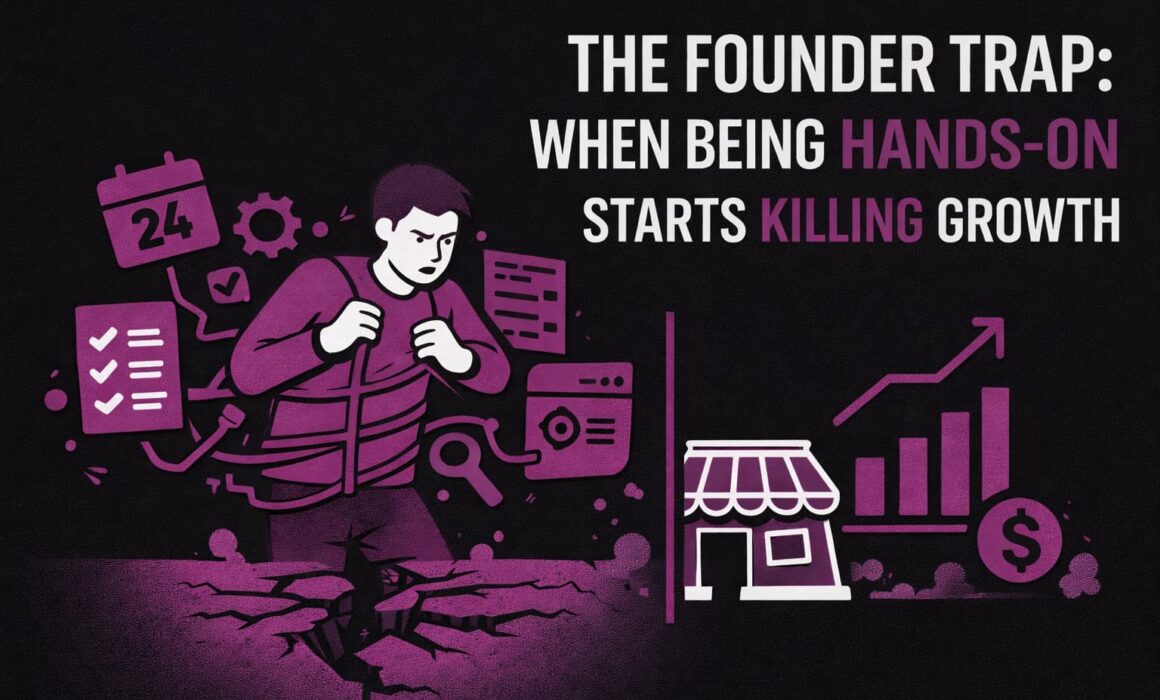
The Founder Trap: When Being Hands-On Starts Killing Growth
What got you here will not get you there
Being hands-on is usually the reason an ecommerce business exists in the first place. You built it, shaped it, fixed it, and pushed it forward when no one else could. That level of involvement is often the difference between an idea and a functioning store.
But there is a point where that same behaviour quietly turns from an advantage into a liability.
That point is the founder trap.
Being involved is not the same as being effective
Many founders confuse control with progress.
They stay deeply involved because it feels responsible. If something breaks, they can fix it. If a decision needs making, they are there. If a plugin update causes issues, they will handle it later in the evening.
On the surface, this looks like commitment. In reality, it creates dependency.
The business does not move unless you move it.
The trap forms slowly
No one decides to become the bottleneck. It happens over time.
You start by helping out.
Then you become the default problem solver.
Then the only one who understands the setup.
Then the only one confident making changes.
Eventually, everything flows through you by habit rather than design.
At that point, the business is not scaling. It is orbiting you.
Growth requires distance, not closeness
As the business grows, the work changes. The value is no longer in fixing things. It is in choosing what gets built, improved, tested, or removed.
Hands-on founders often struggle here because stepping back feels risky. But staying too close creates a different kind of risk.
When you are in the weeds:
- Strategy gets postponed
- Decisions are reactive
- Improvements happen only when something breaks
- Growth ideas never get the time they need
You are busy, but the business is not moving forward in a meaningful way.
The founder becomes the slowest part of the system
Founders rarely notice this until everything feels heavy.
Simple changes take days.
Projects stall because you are unavailable.
Marketing pauses when tech needs attention.
New ideas get delayed because there is no capacity to implement them.
At this point, the founder is no longer accelerating growth. They are limiting throughput.
Control feels safe, but it is expensive
Holding everything close gives the illusion of safety. You know what is happening. You can intervene quickly. You can keep standards high.
But the cost is enormous.
Your time is consumed by operational detail.
Your focus is fragmented.
Your energy is spent maintaining rather than expanding.
This is not leadership. It is survival mode with a nicer title.
Letting go is not losing grip
The most effective founders are not the most hands-on. They are the ones who design systems that work without them.
That does not mean disappearing. It means shifting your involvement to where it matters most.
High leverage founder work looks like:
- Setting direction
- Reviewing insights, not raw data
- Making strategic decisions
- Evaluating opportunities
- Removing obstacles for the business
Low leverage work is everything required to keep the store functioning day to day.
The difference between a business and a job
If your ecommerce operation requires your constant attention, you have built a job, not a scalable business.
Jobs stop when you stop.
Businesses continue.
The founder trap keeps you essential in the wrong places and absent in the ones that actually drive growth.
This is where professional ecommerce management changes everything
When the platform, performance, tracking, and optimisation are owned by someone else, the founder gets space.
Problems are prevented instead of escalated.
Updates happen without anxiety.
Data becomes reliable.
Decisions become clearer.
The business starts moving forward without needing you to push every step.
Step out of the trap before growth stalls
Most businesses do not fail because the founder stopped caring. They fail because the founder was doing too much of the wrong work for too long.
Hands-on effort builds businesses.
Hands-off systems scale them.
Let Regal IT remove you from the operational choke point
Regal IT takes ownership of the ecommerce foundations so growth does not depend on your availability.
You stay in control without being trapped in the detail.
The business gains momentum without burning you out.
Being hands-on got you here.
Letting go is what gets you further.
————————————— OR —————————————