
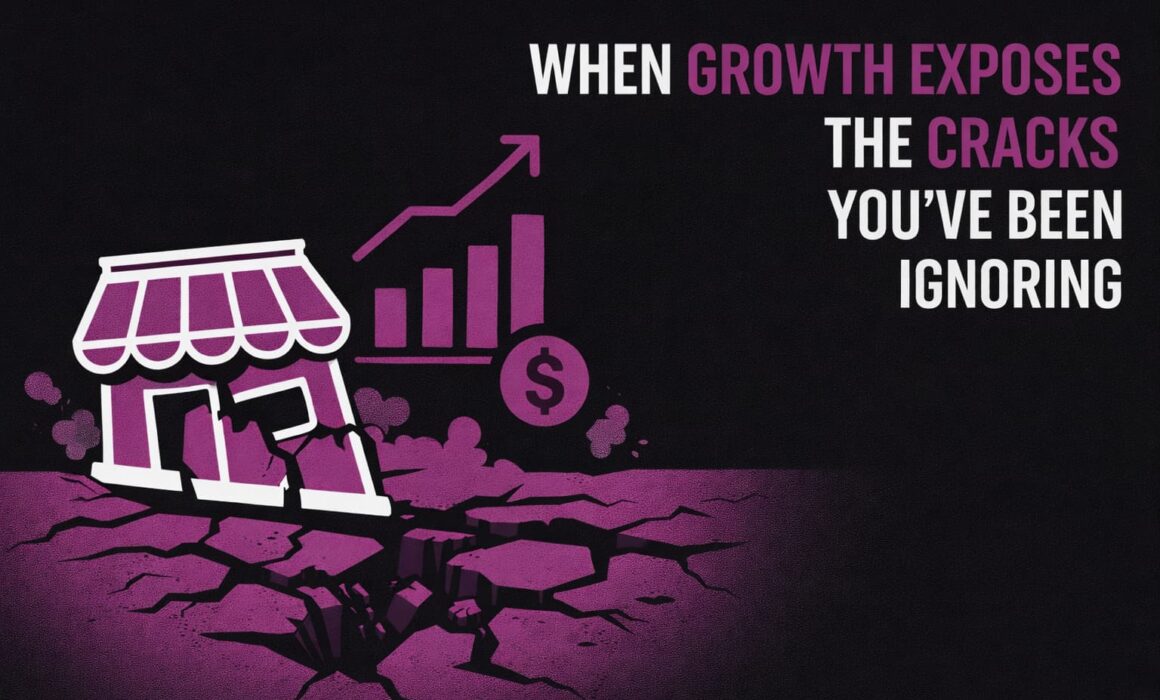
When Growth Exposes the Cracks You’ve Been Ignoring
Growth does not create problems. It reveals them
Most founders blame growth when things start breaking.
Traffic goes up and the site slows down.
Orders increase and fulfilment becomes messy.
Ad spend scales and tracking falls apart.
Revenue grows and suddenly nothing feels stable.
Growth did not cause these issues.
It simply applied pressure to weaknesses that were already there.
Early success hides a lot of bad habits
In the early stages, ecommerce platforms are forgiving.
Low traffic, simple setups, and manageable volume mean flaws stay hidden.
You can get away with:
- Basic tracking
- Manual processes
- Loose workflows
- Plugin heavy setups
- One person managing everything
The store works. Sales come in. Nothing feels urgent.
That does not mean it is solid. It just means it has not been tested yet.
Growth is a stress test you did not plan for
As soon as demand increases, the cracks start to show.
Common symptoms include:
- Checkout issues appearing only at peak traffic
- Stock errors caused by manual updates
- Fulfilment delays because processes do not scale
- Analytics becoming inconsistent
- Automations failing silently
- Site updates becoming risky
- Support volume overwhelming the team
The business feels busier, but not better.
The mistake is reacting instead of restructuring
Most founders respond to these problems the same way they always have. With fixes.
Another plugin.
Another workaround.
Another quick tweak to get through the week.
This works in the short term and quietly makes things worse long term.
Each reactive fix increases complexity.
Each shortcut reduces stability.
Each rushed decision adds technical debt.
Growth becomes harder, not easier.
Cracks widen faster than revenue grows
Revenue growth is visible. Structural damage is not.
The danger is that founders see sales going up and assume everything is fine. Meanwhile, the system underneath is becoming more fragile.
You end up with:
- Higher revenue but lower confidence
- More traffic but worse conversion
- Bigger marketing spend but weaker data
- More customers but more stress
Growth feels exciting and exhausting at the same time.
This is where most businesses stall
At this stage, many stores hit a plateau.
Not because demand disappears.
But because the business cannot comfortably support more volume.
Founders slow down marketing because the site feels unreliable.
They delay launches because systems are stretched.
They avoid change because everything feels interconnected.
The business survives, but it does not scale.
Growth demands systems, not heroics
What worked at ten orders a day does not work at one hundred.
Sustainable growth requires:
- Clean tracking and reporting
- Reliable infrastructure
- Documented workflows
- Reduced plugin dependency
- Proper automation
- Clear ownership of the platform
- Preventative maintenance
This is not about doing more.
It is about doing things properly.
Ignored cracks become expensive rebuilds
The longer structural issues are ignored, the more painful the fix becomes.
Small cracks turn into:
- Full rebuilds
- Emergency migrations
- Expensive consultancy
- Lost momentum
- Burnt out founders
Most of these costs are avoidable if the problems are addressed when growth first exposes them.
Growth is not the enemy. Neglect is
A well structured ecommerce business handles growth calmly.
Pages load.
Orders flow.
Data makes sense.
Decisions feel confident.
Growth should feel exciting, not stressful.
If growth feels like it is breaking everything, the issue is not ambition. It is foundation.
Let Regal IT fix the cracks before they split
Regal IT helps ecommerce brands stabilise their platforms before growth turns into friction.
We audit the foundations, clean up the technical debt, rebuild what matters, and put systems in place that support scale rather than fight it.
Growth will always expose weaknesses.
The smart move is fixing them before they become failures.
————————————— OR —————————————