
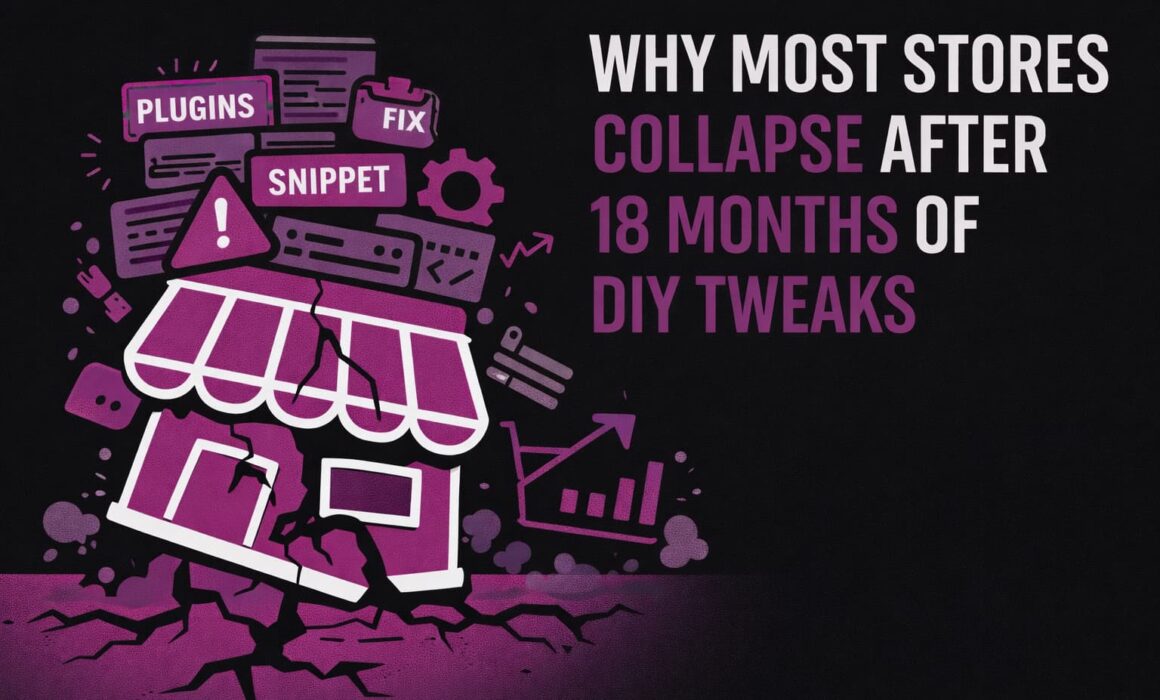
Why Most Stores Collapse After 18 Months of DIY Tweaks
It never breaks all at once
Most ecommerce stores do not fail dramatically. There is no single outage, no fatal mistake, no obvious turning point.
Instead, performance quietly degrades.
The site gets slower.
Conversions flatten.
Updates feel risky.
Marketing becomes unpredictable.
By the time founders realise something is wrong, the damage has already been done.
And almost always, the cause is the same.
Eighteen months of DIY tweaks.
The first year is deceptively forgiving
In the early stages, ecommerce platforms are generous. You can get away with a lot.
A few plugins.
A few snippets.
A couple of quick fixes copied from forums.
Default tracking.
Cheap hosting.
It works because the store is small, traffic is manageable, and nothing is under real pressure.
The problem is not what you do in month one.
It is what you never undo.
Every tweak feels harmless at the time
DIY changes are rarely bad decisions. They are just narrow ones.
You fix the immediate issue and move on.
You do not think about how it interacts with everything else.
Common examples include:
- Installing plugins instead of designing proper workflows
- Adding CSS fixes directly to the theme
- Leaving old apps active “just in case”
- Stacking tracking tools without a clear plan
- Layering page builders on top of each other
- Editing live sites instead of staging
- Avoiding updates because they might break something
Each tweak makes sense in isolation. Together, they create fragility.
Month twelve is where the cracks appear
Around a year in, the store starts behaving differently.
You might notice:
- Updates breaking things they never used to
- Slower admin and product editing
- Checkout behaving inconsistently
- Analytics numbers that no longer line up
- Marketing performance becoming erratic
- Bugs that only affect some users
Nothing is “broken enough” to rebuild.
But nothing feels solid anymore either.
By eighteen months, everything feels risky
This is the danger zone.
Founders stop making improvements because changes feel unsafe.
New features are avoided because the system feels unpredictable.
Technical debt has reached the point where every action has consequences.
The store still works.
But it does not scale.
Growth stalls not because demand is gone, but because the platform cannot support it cleanly.
DIY tweaks create technical debt faster than revenue
Technical debt compounds faster than sales.
Every workaround adds weight.
Every unused plugin adds noise.
Every quick fix reduces flexibility.
Eventually, the store becomes so interdependent that no one fully understands it anymore. Not even the founder.
This is when collapse happens. Not through failure, but through stagnation.
Most collapses look like plateaus
Stores rarely shut down at this stage. They plateau.
- Traffic stops converting
- Ads become less profitable
- Email performance drops
- CRO testing fails
- Margins shrink
- Motivation fades
The business does not die. It slowly suffocates.
The root problem is not skill, it is structure
DIY founders are not careless. They are resourceful.
But ecommerce systems need structure, maintenance, and intentional design. Without that, every tweak becomes another liability.
At scale, ecommerce is not about fixing problems.
It is about preventing them.
The fix is not another tweak
The solution is not a faster host, another plugin, or one more optimisation pass.
It is stepping back and asking:
- What should exist here
- What should not
- What has outlived its purpose
- What needs rebuilding, not patching
That requires experience, objectivity, and time. Three things founders rarely have spare.
This is where most stores either reset or decline
At the eighteen month mark, there are two paths.
One leads to a proper rebuild, clean systems, stable growth, and confidence.
The other leads to endless maintenance, frustration, and flat revenue.
Most stores collapse because they keep choosing the second path without realising there is a first.
Let Regal IT stop the slow collapse
Regal IT helps ecommerce brands step out of the DIY trap before the damage becomes permanent.
We audit, untangle, rebuild, and stabilise stores that have outgrown improvised setups. You get clarity, performance, and a platform designed for growth, not survival.
DIY tweaks get you started.
Professional structure keeps you alive.
————————————— OR —————————————