
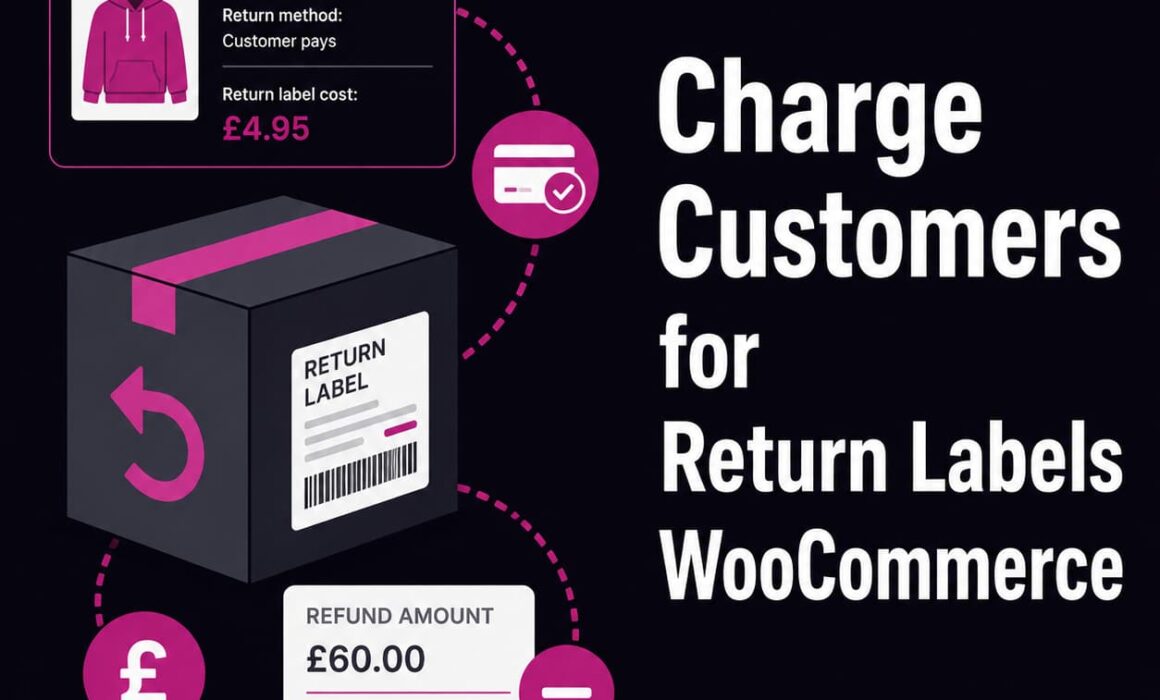
Charge Customers for Return Labels WooCommerce: A Practical Guide
Return shipping is one of the most easily overlooked costs in ecommerce. A customer buys a product, decides they no longer want it, and the store then pays for the return label as well as processing the refund. If that happens often enough, margins can disappear surprisingly quickly.
If you want to charge customers for return labels WooCommerce needs more than a basic return form. The customer needs a clear way to request the return, understand who pays for shipping, receive the correct label and have the label cost handled consistently within the return workflow.
That is where a proper RMA system becomes useful. Instead of treating return postage as a separate manual task, RMA Pro can connect return eligibility, customer-funded labels, tracking and the final refund or store-credit resolution.
Why charge customers for return labels WooCommerce stores process?
Not every return should necessarily be funded by the retailer.
If the store supplied the wrong product or the item arrived faulty, paying for the return is often the commercially sensible approach and may also be required depending on the circumstances and applicable consumer rights.
A change-of-mind return is different.
Suppose a customer orders three sizes of the same product, keeps one and sends two back. If the store pays for every return label, the cost of that buying behaviour is transferred directly to the retailer.
That can be expensive when combined with:
- Outbound delivery costs.
- Return postage.
- Payment processing fees.
- Warehouse handling.
- Inspection and repacking.
- Possible loss of product value.
- Administrative time.
For lower-margin products, one unnecessary return label can absorb a significant proportion of the profit from the original order.
The issue is therefore not simply whether customers should pay. The business needs a consistent method for deciding when the customer pays and a practical process for collecting that cost.
Commercial point: Return postage should be treated as part of the returns policy and margin model, not as an invisible support expense.
Why manual customer-paid return shipping causes problems
Charging a customer for return shipping sounds simple until the process is handled manually.
A common workflow looks like this:
- The customer emails asking to return an item.
- Support confirms that return postage is the customer’s responsibility.
- The customer asks how much the label will cost.
- An administrator checks a shipping service manually.
- The store sends a payment request or asks the customer to arrange their own shipping.
- The customer pays or posts the parcel independently.
- The administrator tries to match the parcel with the correct order.
- The refund is processed later.
Every step creates another opportunity for delay or confusion.
If the customer arranges their own return, the store may receive a parcel with no useful tracking information. If the store sells the label manually, staff need to collect payment separately and reconcile it with the return request.
A basic returns plugin does not necessarily solve this. It may collect the return reason but leave shipping completely outside the workflow.
A more complete WooCommerce returns plugin can make the label part of the RMA process itself.
Basic WooCommerce Returns Plugins vs RMA Pro
| Capability | Basic WooCommerce Returns Plugins | RMA Pro |
|---|---|---|
| Return requests | Simple return form | Structured RMA request linked to the order and products |
| Customer-paid return labels | Usually handled manually outside the plugin | Customer-funded label options can form part of the return workflow |
| Label generation | External shipping portal | Integrated return-label workflows with supported providers |
| Tracking | Checked separately | Tracking can remain connected to the RMA record |
| Refund deductions | Manual calculation | Return costs can be incorporated into the refund workflow where appropriate |
| Return eligibility | General return window | Detailed rules can determine when different return methods apply |
| Exchanges and store credit | Often refund-only | Refunds, exchanges and store credit can share the same workflow |
| Administration | Multiple systems and manual notes | Central RMA record with statuses, notes and activity history |
How customer-paid return labels can work in WooCommerce
There are several ways a store can make the customer responsible for return shipping.
The most suitable method depends on the store’s policy, shipping setup and the type of return.
1. The customer arranges their own shipping
This is the simplest approach technically. The store gives the customer the return address and asks them to choose their own postal service.
The disadvantage is lack of control.
The customer might use an unsuitable service, fail to obtain tracking or send the parcel to the wrong location. Staff may then spend time trying to identify an untracked return.
2. The store provides a label and charges separately
The retailer creates a prepaid label but asks the customer to pay for it before it is supplied.
This gives the store more control over the shipping service but introduces payment administration. Staff need to create a payment request, confirm that it has been paid and then issue the label.
3. Deduct the label cost from the refund
Where the store’s return policy permits it, another approach is to provide the label and deduct the return shipping cost from the customer’s final refund.
For example:
Returned item value: £60.00
Return label cost: £4.95
Final refund: £55.05
This can create a much smoother customer experience because there is no separate checkout or payment request before the parcel can be returned.
The important requirement is transparency. Customers should understand the return postage cost and how it affects the final resolution before proceeding.
Charge customers for return labels WooCommerce without creating extra admin
The aim should be to recover appropriate return costs without creating more work than the label is worth.
Manually charging £4.95 for a return label is not particularly useful if a staff member spends ten minutes creating a payment request, checking it and sending the label.
The return system should handle as much of that workflow as possible.
RMA Pro is designed to connect the return method with the RMA request so the administrator is not managing a separate shipping process beside the return.
Depending on the configured workflow, customer-funded return costs can be handled within the return process rather than requiring a completely separate support conversation.
This gives the business a cleaner sequence:
- The customer submits the return request.
- The relevant return rules are applied.
- The appropriate return method is presented.
- The customer can select or receive the appropriate label option.
- The shipping cost is handled according to the configured method.
- The parcel is tracked through the return process.
- The final refund, exchange or store credit is completed.
The commercial advantage comes from reducing both shipping cost leakage and administrative effort.
Use return rules to decide who pays for the label
A good return policy rarely treats every situation identically.
If the business caused the return, charging the customer for the label may produce a poor experience. If the customer simply changed their mind, the store may reasonably want to avoid absorbing the return postage.
Rules are therefore essential.
RMA Pro can use return rules to control eligibility and available workflows based on relevant conditions.
Example: faulty product
A customer receives a product with a manufacturing defect. The store wants to provide a prepaid return label at no cost to the customer.
The request reason can form part of the workflow and the store can process the return under the appropriate policy.
Example: change of mind
A customer orders the wrong colour and decides they no longer want the product.
The business may allow the return but require the customer to fund the label.
Example: incorrect item supplied
The warehouse sends the wrong variation.
The customer should not normally be financially disadvantaged because of a fulfilment error. The store can provide the return label and proceed with a replacement or exchange.
The advantage of using rules is consistency. Staff do not need to make a new decision on every request, and customers are less likely to receive different treatment depending on which administrator handles the case.
High-risk customers can be handled differently
Return postage can become particularly expensive when a small number of customers generate a disproportionate level of returns.
Consider a customer who repeatedly orders multiple sizes and returns most of the order each time.
The business may still want to accept legitimate returns, but continuing to provide free prepaid labels on every order can make the account unprofitable.
High-risk customer scenario
A customer places six orders over three months and returns more than 70% of the purchased items.
A rule-based workflow could provide tighter return conditions for that customer compared with a normal buyer.
Possible controls might include:
- Customer-funded return labels.
- Shorter eligibility windows where appropriate.
- Administrative review before approval.
- Restricted resolutions.
The objective is not to block valid returns. It is to prevent unusually expensive behaviour from being subsidised automatically.
VIP customers can receive better return terms
The same rules that control risk can also be used to improve retention.
A high-value or VIP customer may justify more generous return terms because their lifetime value is substantially higher.
VIP customer scenario
A long-standing customer spends several thousand pounds each year with the store.
Rather than requiring them to fund every change-of-mind return, the business may provide free return labels or an extended return window as part of a premium service level.
This creates a useful distinction between blanket free returns and commercially targeted free returns.
The store can protect margin across the wider customer base while still providing stronger service where it produces a retention benefit.
Return labels should connect to exchanges as well as refunds
Return shipping is not only relevant when the customer wants their money back.
Many returns are caused by variation issues, particularly with clothing, footwear, accessories and configurable products.
A customer may want another size rather than a refund.
If the store can handle the label and exchange in the same RMA request, the process becomes much easier to manage.
Exchange example
A customer buys a £75 jacket in medium and needs a large.
The store’s policy states that customers fund change-of-mind and sizing returns.
The customer submits an exchange request, selects the replacement size and receives the appropriate customer-funded return option.
The original jacket returns to the store and the exchange remains connected to the same RMA record.
Compared with refunding the jacket and asking the customer to reorder, the exchange protects the original sale and reduces the chance of losing the customer.
Mixed returns need flexible return-shipping logic
Real returns can involve several products and several outcomes.
A customer may return three products in one parcel for different reasons.
Mixed return scenario
- A jumper is the wrong size and needs exchanging.
- A damaged accessory needs replacing.
- A third product is unwanted and needs refunding.
The damaged product may justify merchant-funded return shipping while the change-of-mind items would normally be customer-funded. The workflow needs enough flexibility to represent the real return rather than forcing every item into one generic outcome.
This is where basic plugins often become restrictive.
A simple return form may record only one reason and one resolution for the whole request. Administrators then have to manually interpret the details.
RMA Pro is designed for more complex cases, allowing the return request to remain useful even when different items require different resolutions.
Deducting return postage from refunds can reduce friction
Making the customer pay does not necessarily mean forcing them through a separate payment screen.
Where the store’s policy supports it, deducting the return-label cost from the eventual refund can be a cleaner experience.
There are several advantages:
- The customer can generate or receive the return method without another payment step.
- The store does not need to reconcile a separate transaction.
- The label cost remains connected to the return request.
- The customer sees a predictable final refund amount.
There are also situations where the calculated deduction may need to be changed.
For example, the customer may initially select a retailer-provided return service but later decide to post the parcel independently. In that situation, the administrator needs enough flexibility to correct the final refund rather than being locked into an inappropriate deduction.
A practical returns system should support the real operational outcome, not simply the original selection.
Store credit can retain even more value
Customer-funded return labels can also work alongside store credit.
Suppose a customer returns a £100 product and the return shipping cost is £5.
Rather than issuing £95 back to the payment method, the customer may choose store credit where the store’s policy allows that option.
This keeps the remaining value within the business and gives the customer flexibility to buy something else.
Store-credit retention scenario
A customer returns footwear that does not fit. Their preferred replacement is out of stock.
The return label costs £4.50. Instead of refunding the remaining amount to the original payment method, the customer chooses store credit.
They later purchase a higher-value alternative and pay the difference.
The return still incurred a shipping cost, but the store retained the customer and preserved most of the original order value.
Return zones help manage different shipping realities
Return costs can vary significantly by location.
A domestic parcel may cost only a few pounds to return. An international return can cost several times that amount.
Applying the same rules everywhere can therefore produce poor commercial results.
Return zones allow the business to create more suitable policies for different locations.
For example:
- UK customers may receive a standard customer-paid tracked return option.
- Selected European customers may have a different return window.
- High-cost international regions may require the customer to arrange return shipping independently.
- VIP customers may receive an extended window regardless of zone.
The value comes from operational flexibility. The store can create a policy that reflects the actual cost and complexity of serving different markets.
Tracking makes customer-paid returns easier to manage
One advantage of providing the customer with a structured return-label option is visibility.
If the customer independently posts the parcel without tracking, the store may have no information until it arrives.
That often produces support messages such as:
- “Have you received my return?”
- “When will my refund be processed?”
- “The tracking says it arrived yesterday.”
Keeping tracking information connected to the RMA record gives administrators a clearer view of the parcel journey.
This helps them determine whether the request is:
- Waiting for the customer to post the item.
- In transit.
- Delivered.
- Ready for inspection.
- Ready for refund, exchange or store credit.
The operational benefit is faster decision-making and less time spent searching external shipping systems.
Activity logs provide a record of the return cost decision
Whenever money is deducted from a refund, good record keeping becomes important.
A customer may later ask why their refund was lower than the original item value.
The administrator should be able to determine:
- Which return method was selected.
- What label or shipping cost applied.
- Whether the cost was later changed.
- What final refund was issued.
- When the return was received and completed.
RMA Pro’s activity and request records make the process easier to audit than relying on scattered order notes and emails.
This is particularly useful when several staff members handle returns because the person answering the customer’s query may not be the person who originally processed the request.
Automation matters as return volume grows
Charging for return labels should reduce costs, not create another administrative bottleneck.
At low volume, staff may be able to make every decision manually. At scale, repeatedly checking the same conditions becomes inefficient.
| Manual task | Structured alternative | Operational benefit |
|---|---|---|
| Decide who pays for the return | Apply defined return rules | More consistent decisions |
| Calculate return postage manually | Use the configured return-label workflow | Less repetitive administration |
| Request separate customer payment | Handle cost within the return process where appropriate | Fewer payment and support steps |
| Search for parcel tracking | Keep tracking connected to the RMA | Faster case handling |
That difference becomes increasingly important as the number of returns rises.
What to look for in a WooCommerce customer paid return labels plugin
Do not choose a return-label solution based only on whether it can generate a shipping label.
The important question is how that label connects to the complete return process.
Can the system distinguish merchant-funded and customer-funded returns?
The store should be able to apply different policies depending on the reason and circumstances of the return.
Can the label cost be incorporated into the refund process?
If deduction from refund is part of the store’s policy, the workflow should make the amount clear and manageable.
Can administrators override an amount when reality changes?
The final refund should reflect what actually happened, not be permanently locked to an earlier choice.
Can it handle exchanges?
A return label is often needed for an exchange rather than a refund. The system should not treat those as unrelated processes.
Can it support store credit?
Store credit provides another way to retain order value after the return cost has been accounted for.
Can return rules determine eligibility?
Customer-funded labels are most effective when they form part of a wider policy rather than being applied indiscriminately.
Does tracking remain connected to the request?
This improves visibility and reduces support work.
Why RMA Pro suits stores that want to charge for return shipping
RMA Pro is built to manage returns as a complete operational workflow rather than a collection of disconnected tools.
For stores that want to charge customers for return postage, that means the label can sit alongside:
- Customer return requests.
- Eligibility rules.
- Refund calculations.
- Exchanges.
- Store credit.
- Return zones.
- Shipping labels.
- Tracking.
- Status management.
- Notes and activity history.
This makes it particularly useful for WooCommerce stores that want tighter control over return costs without making the customer experience unnecessarily difficult.
The store can decide when it should fund the return, when the customer should pay and how that cost should be reflected in the final resolution.
That is much more practical than simply telling customers to arrange their own postage or manually invoicing them for every label.
Recover return shipping costs without damaging the customer experience
Free returns can be commercially useful in the right circumstances, but they should be a deliberate business decision rather than the default outcome of an inflexible returns system.
For change-of-mind returns, customer-funded labels can help protect margin. For faulty or incorrectly supplied products, the store can still provide a merchant-funded service. VIP customers can receive better terms, while high-risk accounts can be controlled more carefully.
The important part is making those decisions consistent and easy to administer.
A structured return workflow can show the customer the relevant option, generate the appropriate label, track the parcel and incorporate the return cost into the final refund, exchange or store-credit resolution.
If you want to reduce the cost and administration of WooCommerce returns while keeping the process clear for customers, RMA Pro for WooCommerce provides a more complete way to manage customer-funded return shipping.