
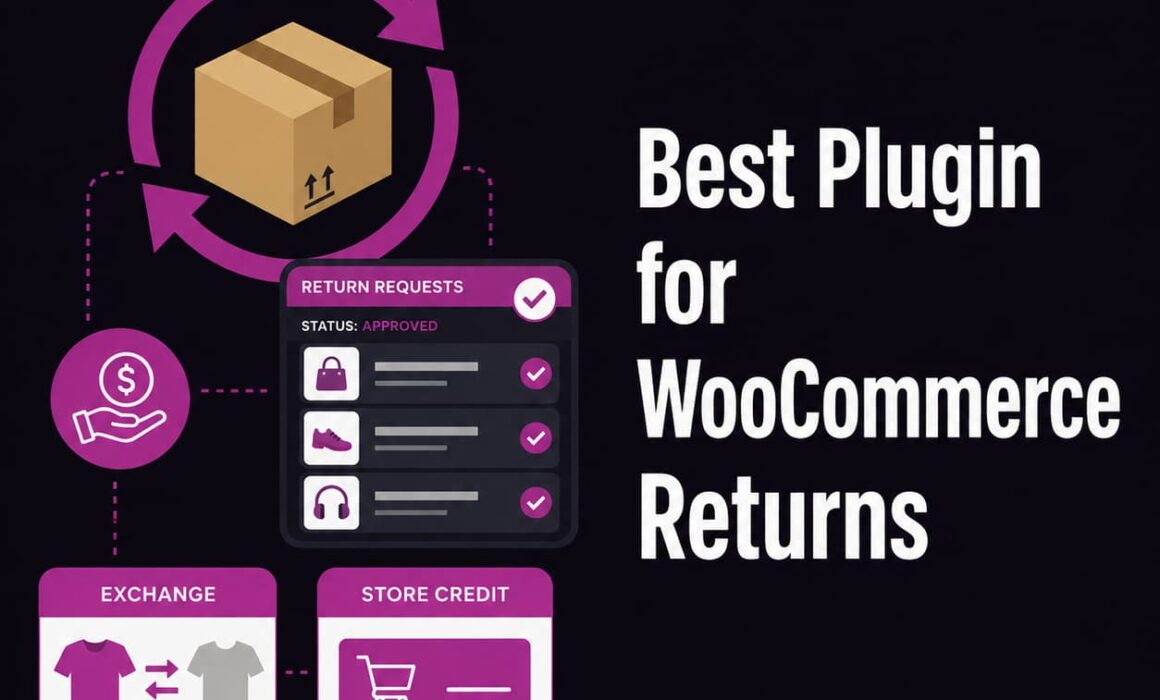
Best Plugin for WooCommerce Returns: What Serious Stores Actually Need
Choosing the best plugin for WooCommerce returns is not simply a matter of finding a form that lets customers request a refund. A basic form may work when a store handles one or two returns each week. Once order volume increases, returns quickly become an operational problem involving eligibility checks, exchanges, product variations, return labels, store credit, customer communication and internal accountability.
The real test is not whether a plugin can accept a return request. It is whether it can turn that request into a controlled workflow that protects revenue, reduces administration and gives customers a clear process from submission to resolution.
For serious WooCommerce stores, that usually requires a complete RMA system rather than another isolated refund tool.
What the best plugin for WooCommerce returns must actually solve
WooCommerce already gives administrators the ability to process refunds against orders. That does not mean WooCommerce provides a complete returns operation.
Before money can be refunded or an exchange completed, the business may need to answer several questions:
- Is the order still within the permitted return period?
- Is the product eligible for return?
- Is the customer requesting a refund, exchange, replacement or store credit?
- Does the request involve one item or several?
- Is evidence required?
- Who should pay for return shipping?
- Has the customer sent the item back?
- Has the parcel arrived?
- Has the returned item been inspected?
- Has the correct resolution been completed?
If the plugin only collects a message from the customer, most of that work still falls to support staff. Administrators then move between emails, WooCommerce orders, spreadsheets, shipping portals and internal notes to reconstruct what is happening.
The best return plugin should reduce that workload. It should connect the customer request, eligibility decision, return shipment and final outcome within one managed record.
Operational reality: Returns are not just a refund problem. They are a workflow problem involving products, customers, stock, shipping, payments and communication.
Why basic WooCommerce returns plugins are often too limited
Many WooCommerce returns plugins are designed around a simple process: the customer submits a request, the store approves it and a refund is issued.
That approach may be enough for a small store with straightforward products and a low return rate. It becomes restrictive when the business needs to support more realistic ecommerce situations.
A customer might want to exchange one product, refund another and replace a damaged item from the same order. A standard return form may force the customer to submit several requests or contact support manually.
A store may also need different return conditions for:
- Sale products.
- Personalised products.
- International orders.
- High-value items.
- VIP customers.
- Customers with a high return rate.
- Faulty products.
- Change-of-mind returns.
When a plugin provides only a single return window and one generic return outcome, the business must handle every exception manually.
This is why stores looking for a WooCommerce returns plugin should assess the entire operational process rather than focusing only on the customer-facing form.
Basic WooCommerce Returns Plugins vs RMA Pro
| Capability | Basic WooCommerce Returns Plugins | RMA Pro |
|---|---|---|
| Customer requests | Basic return or refund form | Structured returns portal connected to the order and products |
| Resolutions | Usually refund-led | Refunds, exchanges, replacements and store credit |
| Mixed returns | Often requires separate requests | Different resolutions can be managed within one return request |
| Eligibility | One general return period | Detailed rules based on products, customers, order conditions and more |
| Return windows | Same period for most customers | Flexible windows through rules and return zones |
| Return labels | Manual label creation | Integrated label workflows with supported shipping services |
| Tracking | Stored separately or checked manually | Tracking details connected to the RMA record |
| Administration | Email, order notes and manual follow-up | Central record with statuses, notes, actions and activity history |
| Revenue retention | Primarily focused on refunds | Exchanges and store credit help retain order value |
| Scaling | Administration rises directly with return volume | Rules and structured workflows reduce repetitive handling |
The best plugin for WooCommerce returns should reduce admin workload
A return can involve far more administrative work than the original order.
The initial sale may be automated from checkout through to fulfilment. The return often arrives as an unstructured email that requires someone to find the order, check the date, identify the product, confirm the policy, request evidence, create a label and track the final outcome.
A proper WooCommerce RMA plugin changes the starting point.
Instead of asking the customer to explain everything manually, the system connects the request to the original order and purchased products. The customer chooses the relevant items, quantities, reasons and requested resolutions.
Administrators receive a complete record rather than a vague message saying, “I want to return my order.”
Before using a structured RMA system
- The customer emails support.
- Support asks for the order number.
- The customer confirms which item is being returned.
- Support checks the return period manually.
- Another email asks whether the customer wants a refund or replacement.
- A shipping label is created separately.
- The order receives an internal note.
- The customer asks for an update several days later.
After implementing RMA Pro
- The customer submits the request against the correct order.
- The selected products and quantities are recorded.
- The customer chooses from the available resolutions.
- Return rules help determine eligibility.
- The administrator reviews one complete RMA record.
- Statuses and activity logs show what has happened.
- The final refund, exchange or credit remains connected to the request.
Reducing a few minutes of work from each return may not sound significant. Across dozens or hundreds of requests, the saving becomes substantial.
A customer returns portal should prevent unnecessary support contact
Customers generally do not want to contact support to return a product. They want a clear process that confirms whether the product is eligible and explains what happens next.
A returns portal improves the experience by giving the customer a structured path through the request.
Instead of writing an email, the customer can:
- Locate the relevant order.
- Select the item being returned.
- Choose the quantity.
- Provide the reason.
- Upload evidence where required.
- Select an available resolution.
- Submit the request for review.
The operational benefit is immediate. Support staff spend less time collecting basic information, while customers receive a more professional and predictable service.
This matters commercially because poor return experiences affect future purchasing decisions. A customer who receives a quick, controlled exchange may remain loyal. A customer who spends a week chasing support may not order again.
Return rules help control eligibility and prevent abuse
The best returns experience is not the same as approving every request.
Stores need a fair process that protects legitimate customers while preventing costly or abusive behaviour.
A basic return plugin may apply one return window to every customer and every product. That makes the process easy to configure but difficult to control.
RMA Pro allows stores to apply more detailed return rules using relevant order, product and customer conditions.
High-risk customer scenario
A customer has placed eight orders and returned most of the products from each one. The business may not want to block the customer completely, but continuing to offer unrestricted returns could be commercially damaging.
A rule can place tighter restrictions on requests from customers who meet defined high-risk conditions. The request can be limited or sent for greater administrative review.
The purpose is not to make accusations. It is to make sure that unusual behaviour is not treated identically to a normal customer return.
Product eligibility scenario
A store may allow standard products to be returned but exclude personalised items unless they are faulty. Sale items might be eligible for exchange or store credit but not a cash refund.
When these rules are built into the returns workflow, customers see the correct options and administrators avoid repeating the same policy decisions manually.
Commercial impact: Return rules reduce inconsistent decisions, protect margin and help prevent customers from using the return process in ways the store never intended.
Exchanges protect more revenue than refund-only workflows
A refund removes the value of the original sale. An exchange can solve the customer’s problem while retaining that revenue.
This is particularly important for stores selling products with variations such as clothing, footwear, accessories, furniture finishes, electronics or configurable products.
The customer may be completely satisfied with the product but need a different size, colour or version.
Without an exchange system, the store may ask the customer to return the product for a refund and place a new order. That introduces several risks:
- The customer may never place the replacement order.
- The required variation may sell out.
- The customer may purchase from a competitor.
- Payment and shipping costs may be duplicated.
- Support staff need to coordinate two separate transactions.
A direct exchange keeps the replacement connected to the return request. The administrator can see what was originally purchased and what the customer wants instead.
Mixed return scenario
A customer orders three products. One item is the wrong size, one arrives damaged and one is no longer required.
- The first item is exchanged for another variation.
- The damaged item is replaced with the same product.
- The final item is refunded.
A basic plugin may require three separate requests. RMA Pro can manage the different outcomes as part of one structured return case.
This gives the customer a simpler experience and gives the administrator a complete view of the returned parcel.
Store credit creates another route to customer retention
An exchange is not always possible. The correct variation may be unavailable, the product may have been discontinued or the customer may prefer something completely different.
Store credit provides an alternative to an immediate cash refund.
Store-credit retention scenario
A customer returns a £60 product but has not chosen a replacement. The store issues £60 of store credit.
The customer can take time to browse and select another product later. The business retains the value within the store rather than losing it through a refund.
The eventual order may also be worth more. A customer with £60 credit might select an £85 product and pay the remaining £25.
Store credit should not be used to avoid obligations under the store’s policy or applicable consumer law. It should be presented as a legitimate resolution where appropriate.
When handled correctly, it gives the customer flexibility while improving the store’s chance of retaining revenue.
Return windows by zone provide operational flexibility
A single return period does not always work well for every order.
A domestic customer may receive a parcel in one or two days. An international customer may wait considerably longer. Applying the same return window without accounting for delivery location can produce an unfair result.
Return zones allow different return periods to be applied according to relevant fulfilment areas.
This gives the store flexibility without relying on manual exceptions.
VIP customer scenario
A regular customer receives the standard return period. A VIP customer receives an extended window as part of a loyalty benefit.
Without a rules-based system, support staff must remember to make the exception each time. With RMA Pro, the extended window can form part of the normal eligibility process.
The commercial benefit is controlled flexibility. The store can provide stronger service to selected customers without extending the same terms to every order.
WooCommerce also provides guidance on clearly documenting return conditions and customer responsibilities within its refund and return policy guidance.
Activity logs improve visibility and accountability
Returns often pass between several members of staff. One person approves the request, another monitors the returned parcel and another completes the refund or exchange.
Without a central history, each person must search through order notes or ask colleagues what has already happened.
An activity log provides a chronological record of the request.
This is useful when:
- A customer asks for an update.
- A manager reviews an unusual refund.
- A different administrator takes over the case.
- The business needs to confirm when a status changed.
- Several actions were taken against the same return.
Clear statuses also help teams separate requests that are waiting for customer action from those requiring administrator attention.
The result is better visibility and fewer duplicated actions.
Return labels should be part of the workflow
Approving a return does not bring the product back to the warehouse. The customer still needs a clear method for sending it.
When labels are handled manually, an administrator may need to open a separate shipping platform, enter the customer address, choose a service, generate the label and email it as an attachment.
The RMA record may contain no clear indication that the label was created or whether the parcel is in transit.
RMA Pro supports connected return-label workflows with services such as Shippo and ShipStation where configured.
Merchant-funded returns
The store may provide the label where it is responsible for the cost, such as when the wrong product was supplied or an item arrived faulty.
Customer-funded returns
Where the store’s policy permits it, the customer can cover the return cost or the cost can be handled within the resolution process.
Tracking visibility
Tracking information connected to the request helps administrators see whether the parcel has been sent and when it is likely to arrive.
This reduces manual checking and can shorten the delay between receiving the returned product and completing the customer’s refund or exchange.
Automation becomes essential as return volume increases
Manual return handling may appear manageable while a store processes only a few requests. As order volume grows, every repeated check becomes a bottleneck.
Staff may spend time:
- Checking order dates.
- Confirming product eligibility.
- Reviewing customer history.
- Writing return instructions.
- Creating labels.
- Updating customers.
- Finding the current status.
- Recording the final outcome.
Automation should not mean approving every return without oversight. It should mean automating the predictable parts of a defined return policy.
| Manual task | Automated alternative | Commercial benefit |
|---|---|---|
| Check whether the order is within the return period | Apply the configured return window | Less repetitive administration |
| Check whether the product is eligible | Evaluate product and category rules | More consistent policy decisions |
| Ask the customer what outcome they want | Present valid refund, exchange or credit options | Fewer support messages |
| Search for the current return status | Use a central RMA record and activity log | Faster case handling |
The best return plugin should make each additional request easier to handle, not simply add another record to an expanding list.
How to choose the best plugin for WooCommerce returns
Do not choose a plugin based only on whether it adds a return button to the customer account.
Consider what happens after the button is clicked.
Can it handle refunds, exchanges and store credit?
A refund-only workflow gives the business fewer ways to retain revenue. The plugin should support different outcomes where the store’s policy allows them.
Can it handle mixed returns?
Customers may want different resolutions for different items. The system should not force the entire order into one outcome.
Can it control eligibility?
Look for detailed return rules rather than relying only on a general return period.
Can it display product variations clearly?
Exchanges often involve sizes, colours and configurations. The original and replacement variations need to be clear to administrators.
Can it support return labels and tracking?
Shipping is a central part of the return process. A system that ignores labels leaves significant manual work in place.
Does it provide a complete activity history?
Administrators should be able to see what happened without searching through several systems.
Will it scale with the store?
The plugin should reduce work per request through rules, structured information and repeatable workflows.
Why RMA Pro is built for serious WooCommerce stores
RMA Pro is designed for stores that need more than a simple refund-request form.
It combines the main parts of return management within one system:
- Customer return requests.
- Refunds.
- Exchanges.
- Replacements.
- Store credit.
- Eligibility rules.
- Return zones.
- Return labels.
- Tracking.
- Status management.
- Notes and activity logs.
This makes it particularly useful for stores that sell variation-heavy products, process regular returns, operate with several administrators or want to reduce support workload.
The benefit does not come from one individual feature. It comes from connecting the full return process.
The customer submits a structured request. Rules help control eligibility. The administrator manages the request from a central record. Shipping and tracking remain connected to the case. The final refund, exchange or credit is documented clearly.
That is the difference between a basic form and a complete WooCommerce returns and exchanges plugin.
Build a returns process that protects revenue as your store grows
The best return system should make life easier for both the customer and the store.
Customers need a clear method for submitting requests, selecting products and choosing appropriate resolutions. Administrators need rules, records, statuses, labels and activity history that prevent every return from becoming a manual support case.
Refunds remain an important part of ecommerce, but they should not be the only available outcome. Exchanges can preserve the sale. Store credit can retain customer value. Eligibility rules can reduce abuse. Return zones can provide controlled flexibility. Integrated labels and tracking can reduce operational delay.
For stores processing more than occasional basic refunds, RMA Pro for WooCommerce provides the structure needed to turn returns into a controlled, scalable and commercially useful workflow.