
WooCommerce Self Service Returns: Reduce Support Tickets
WooCommerce self service returns are not just about letting customers submit a return request without emailing you. They are about reducing support noise, collecting better return information, applying rules earlier and giving your team a clearer workflow for refunds, exchanges, store credit, labels and RMA decisions.
The real ecommerce problem is simple: returns create too many manual touchpoints. A customer emails support, forgets the order number, asks whether an exchange is possible, wants a label, then chases two days later because nobody has confirmed the next step. That is not just poor customer experience. It is operational drag.
Why WooCommerce self service returns matter
Returns are part of ecommerce, but the way most WooCommerce stores handle them is often too manual. The customer sends an email or fills in a contact form. Support has to identify the order, check the item, confirm the return window, apply the policy, ask what outcome the customer wants and then decide whether the request should be approved.
That workflow might be acceptable when return volume is low. It becomes a problem when the store grows, product ranges expand and support staff are already busy dealing with fulfilment issues, delivery questions, damaged items and customer queries.
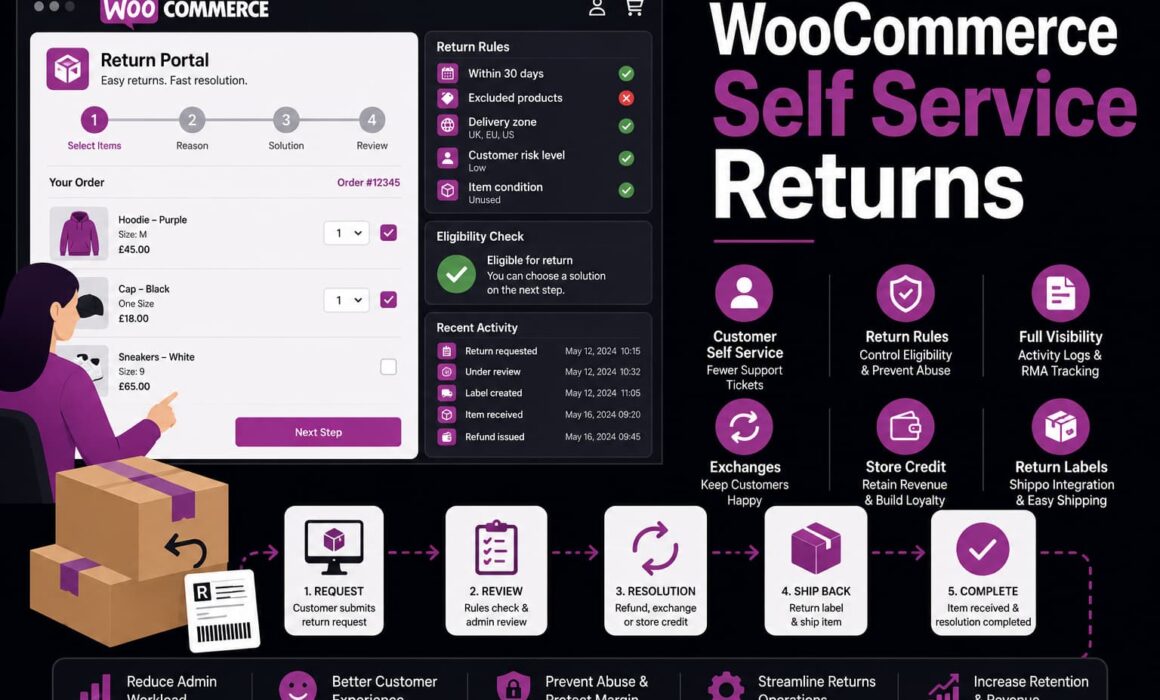
WooCommerce self service returns create a cleaner first step. Instead of asking the customer to explain everything in a free-text email, a return portal guides them through the request. The store receives structured information connected to the order, which means staff can review the case faster and with better context.
Commercial point: self service returns are not about removing staff judgement. They are about stopping your support team from wasting time collecting basic information that the customer could provide through a proper return portal.
This is where RMA Pro for WooCommerce fits. It gives WooCommerce stores a more complete return management system covering customer requests, refunds, exchanges, store credit, return rules, return labels and RMA activity visibility.
WooCommerce self service returns reduce support tickets
A weak returns process creates avoidable support tickets. The initial request becomes one message. Missing order details become another. The customer asking whether the item is eligible becomes another. Return label questions become another. Chasing for status becomes another.
One return can easily turn into a chain of five or six messages before the store has even received the item back.
A self service return portal reduces this by giving customers a clear route. They do not need to guess what information the store needs. They can start the request through a structured process and provide the details required for review.
Without self service
The customer emails support, staff ask for missing information, the customer replies later, and the request sits in an inbox while everyone waits.
With self service
The customer submits a structured request through the return portal, giving staff the details they need to review the case more quickly.
The customer gets a clearer route. The support team gets fewer repetitive questions. The store gets better return data from the start.
Basic WooCommerce Returns Plugins vs RMA Pro
Not every self service return tool solves the real operational problem. Some basic WooCommerce returns plugins provide a customer-facing form, but still leave your team doing most of the work manually.
A serious return process needs more than a form. It needs rules, visibility, return labels, exchange handling, store credit and a proper RMA workflow.
| Area | Basic WooCommerce Returns Plugins | RMA Pro |
|---|---|---|
| Self service portal | May provide a simple return request form. | Provides a structured return portal connected to the wider RMA workflow. |
| Admin workload | Often still depends on manual checking, email replies and order notes. | Helps reduce repetitive admin by centralising return management. |
| Refunds and exchanges | Usually refund-first, with exchanges handled manually. | Supports refunds, exchanges and store credit as part of return handling. |
| Return rules | May only support basic return windows or manual approval. | Uses return rules to control eligibility and reduce abuse. |
| Return windows by zone | Often applies the same return window to every customer and region. | Supports more flexible return windows by zone where operational differences matter. |
| Return labels | Labels may need to be created separately and emailed manually. | Supports return labels and Shippo workflow support where relevant. |
| Activity logs | Limited audit trail and weak visibility across the team. | Activity logs help staff see what happened during the RMA process. |
The difference is control. A basic returns plugin may help the customer ask for a return. RMA Pro helps the store manage the full return lifecycle.
WooCommerce self service returns improve the customer experience
Customers do not want to email support to ask how to return something. They expect a clear route, especially if they are used to larger ecommerce stores with dedicated return portals.
That does not mean a smaller WooCommerce store has to copy enterprise retailers. It means the customer should not feel like the return process is improvised.
A self service return portal gives the customer a clear starting point. They can request a return, explain the issue, identify the item and choose the relevant outcome where allowed. That feels more professional than a generic contact form.
It also reduces anxiety. When customers know there is a proper process, they are less likely to send multiple follow-up messages asking whether their request has been received.
- Customers can submit return requests without searching for an email address.
- The store receives clearer return information.
- Support staff spend less time asking basic follow-up questions.
- Return status and activity visibility help reduce uncertainty.
- The process feels more organised and more trustworthy.
This matters because returns are often a moment of risk. The customer already has a problem. A messy return process can turn a normal issue into a lost customer.
WooCommerce self service returns still need rules and control
Self service does not mean customers should be allowed to do whatever they want. That is where many stores get nervous. They assume a return portal means handing control to the customer.
A proper WooCommerce return portal should do the opposite. It should make the customer experience smoother while helping the store apply policy more consistently.
Return rules are the control layer. They help define what can be returned, when it can be returned, which products are excluded, which customers need manual review and which outcomes should be available.
Example: high-risk customer controlled through rules
A customer repeatedly orders multiple sizes, wears items briefly and returns most of the order. A weak self service process may allow every request to enter the same queue. With return rules and activity history, the store can apply tighter controls, require manual review or restrict certain return outcomes.
This matters because return abuse is rarely obvious from one request. It appears as a pattern. Rules and activity logs help the store see and manage that pattern more effectively.
With RMA Pro for WooCommerce, self service returns sit inside a controlled RMA workflow rather than becoming an open door for unchecked requests.
How self service returns reduce admin workload
Admin workload is where the return process quietly becomes expensive. Staff may spend only a few minutes per message, but returns often require several messages and checks before anything is resolved.
Typical manual return admin includes:
- Finding the order from incomplete customer information.
- Checking whether the order is inside the return window.
- Confirming which item the customer wants to return.
- Asking whether they want a refund, exchange or store credit.
- Checking product exclusions or special conditions.
- Creating or sending return label instructions.
- Updating order notes so the rest of the team knows what happened.
A self service return portal does not remove all of that work, but it reduces the worst part: repeated information gathering. It gives the customer a structured way to submit the request and gives staff a better starting point.
For ecommerce managers, the benefit is not just fewer emails. It is a more predictable workflow. Staff can review return requests in a more consistent way instead of rebuilding the context from scratch each time.
WooCommerce self service returns for refunds, exchanges and store credit
A strong self service returns process should not treat every request as a refund. That is too narrow and often commercially damaging.
Customers may want different outcomes:
- A refund because they no longer want the product.
- An exchange because they ordered the wrong size or colour.
- Store credit because they want to choose something else later.
- A mixed outcome where one item is refunded and another is exchanged.
If the self service process only supports basic refund requests, the store can lose revenue unnecessarily. Exchanges and store credit are important because they keep value inside the business.
Mixed return scenario: exchange and refund in one request
A customer buys three items. They want to exchange a jacket for a larger size, refund a pair of trousers and keep the third item. In a manual process, this becomes a long email thread. Support has to interpret the request, check the order, update notes and make sure each item gets the correct outcome.
A more complete RMA workflow makes this cleaner. The store can manage different outcomes as part of the same return process instead of treating the whole order as a single refund problem.
How exchanges protect revenue
Exchanges are one of the best reasons to improve your return workflow. If a customer likes the product but needs a different size, colour or variation, refunding them sends the revenue back out of the store.
A self service exchange path helps the customer stay with the store. It turns a potential refund into a retained sale.
How store credit improves retention
Store credit is useful when a direct exchange is not possible. The replacement may be out of stock, the customer may want time to choose, or the store may want to offer a flexible alternative without refunding immediately.
Store credit scenario
A customer returns a £60 product because the colour is not suitable. The replacement is unavailable. A refund ends the sale. Store credit keeps the customer active and may lead to a later £85 order.
RMA Pro supports refunds, exchanges and store credit as part of a wider WooCommerce returns and exchanges plugin workflow, helping stores choose the right outcome instead of defaulting to refunds.
Return windows by zone make self service returns more realistic
Return windows are not always simple. A customer in one region may receive their order quickly and return it easily. Another customer may face longer shipping times, slower carrier movement or different return costs.
If every customer gets the same return window, the policy may be too rigid in some cases and too generous in others.
Return windows by zone allow the store to apply more realistic timing based on operational conditions. This is useful for WooCommerce stores selling across multiple regions, using different carriers or dealing with different customer groups.
| Return window condition | Why it matters | Operational impact |
|---|---|---|
| Domestic orders | Delivery and return shipping are usually faster. | A standard return window may be practical. |
| Remote or slower regions | Customers may need longer because shipping takes more time. | A longer window can reduce support disputes. |
| VIP customers | High-value customers may justify better service treatment. | Extended windows can support retention. |
| High-risk customers | Repeated return behaviour can damage margin. | Tighter control or manual review may be needed. |
VIP customer scenario: extended return window
A loyal customer has placed several high-value orders and rarely returns anything. They request an exchange just outside the standard return window. A rigid process rejects them. A more flexible return management system allows the store to review the request and offer a sensible exception without changing the public policy for everyone.
That is the advantage of combining self service returns with proper rule control. Customers get convenience, but the store still manages exceptions intelligently.
Return labels and Shippo support make self service practical
A self service return request is only the first step. The item still has to come back. That means instructions, labels, tracking, warehouse visibility and final resolution.
If labels are handled separately from the return workflow, the process can become disconnected. Support approves the request. Someone else creates the label. The customer receives instructions from a separate email. The warehouse receives the parcel but does not know whether it is linked to a refund, exchange or store credit request.
Return label support helps connect the request to the physical return. Shippo support can also help stores that want a more joined-up label workflow.
Operational example
A customer submits a self service return request for a damaged item. Support reviews the request, approves it, handles the label workflow, and the warehouse can later connect the returned parcel to the RMA record before admin issues the correct resolution.
This is where self service becomes operationally useful. It is not just a customer form. It connects the customer request to what your team needs to do next.
Activity logs give self service returns proper visibility
Visibility matters because return requests change. A customer may start by asking for a refund, then accept an exchange. Support may approve a request, then the warehouse may find the item has been used. A return label may be issued, but the parcel may not arrive.
If your return process does not have a clear activity history, staff end up searching through inboxes, order notes and shipping tools to understand what happened.
Activity logs help answer practical questions:
- When did the customer submit the request?
- Who reviewed it?
- Was the request approved or rejected?
- Was a return label issued?
- Did the customer ask for refund, exchange or store credit?
- Was an exception made?
- Has the item been received back?
This improves handovers between support, warehouse and admin. It also helps store owners spot recurring issues, policy drift and repeat return behaviour.
RMA Pro includes activity logs so WooCommerce stores can manage self service returns with better visibility instead of relying on scattered notes.
WooCommerce self service returns and UK customer expectations
WooCommerce stores should use return rules carefully. A return portal and policy rules do not replace legal obligations. In the UK, online customers usually have cancellation rights for many distance sales. GOV.UK guidance explains that customers can generally tell the seller within 14 days of receiving an item that they want to cancel, then have another 14 days to return it.
There are exceptions and product-specific details, so stores should take proper advice for their own products and trading situation. The operational point is that a self service return system should help apply policy consistently, not create confusing barriers for legitimate returns.
You can review the official GOV.UK guidance here: accepting returns and giving refunds.
A good return portal should make the process clearer for customers while giving the store enough structure to handle eligibility, exclusions, return windows and exceptions properly.
Why automation matters as self service return volume grows
Self service returns reduce friction, but they can also increase visibility of return demand. Once customers have a clear route, more requests may arrive through the correct channel instead of being hidden in emails and support messages.
That is good, but only if the workflow behind the portal can handle the volume.
Automation matters because the store should not manually inspect every basic condition on every request. Staff should focus on decisions that need judgement, not repetitive checks that can be guided by rules.
| Manual task | Why it becomes a problem | Self service workflow benefit |
|---|---|---|
| Collecting order details | Support wastes time asking for information that should be captured upfront. | The portal structures the request around the customer order. |
| Checking return windows | Staff repeatedly apply the same date logic. | Rules can help control eligibility and review needs. |
| Choosing refund or exchange | Stores may default to refunds because exchanges take more effort. | Exchange and store credit workflows help protect revenue. |
| Creating labels | Separate label workflows create delays and missing context. | Return label handling can sit closer to the RMA process. |
| Tracking decisions | Scattered notes make handovers and disputes harder. | Activity logs give staff clearer return history. |
As stores scale, the goal is not to remove human review completely. The goal is to make sure human review is used where it actually adds value.
Where RMA Pro fits in a self service returns workflow
RMA Pro is built for WooCommerce stores that need more than a customer-facing form. It gives stores a structured RMA process that supports customer requests, admin review, return rules, refunds, exchanges, store credit, labels and activity visibility.
A practical self service workflow should look like this:
- The customer starts a return request through the WooCommerce return portal.
- The request captures structured information linked to the order.
- Return rules help control eligibility and identify cases requiring review.
- Support reviews the request and selects the right outcome.
- The store handles refund, exchange or store credit as appropriate.
- Return label handling supports the physical return process.
- Activity logs keep the team aligned on what happened.
That is much stronger than asking customers to email support and hoping staff remember every policy detail.
If your store wants an advanced returns system that supports self service without losing operational control, RMA Pro gives you a practical WooCommerce-focused route.
Signs your store needs WooCommerce self service returns
You may not need a self service return portal on day one. But there are clear signs your current process is becoming too manual.
- Customers regularly email asking how to return items.
- Support staff keep asking for missing order numbers or item details.
- Return requests are scattered across email, contact forms and order notes.
- Customers chase because they do not know what stage their request is at.
- Exchanges are missed because refunds are easier.
- Store credit is rarely used because the workflow is awkward.
- Return labels are handled manually outside the RMA process.
- High-risk customers are difficult to control.
- VIP customer exceptions depend on staff memory.
- Support, admin and warehouse teams do not share a clear return history.
These are operational symptoms. They show the store needs a more structured return process, not just another support inbox.
Build a self service returns process customers can trust
WooCommerce self service returns give customers a clearer way to request help and give your team a better way to manage the work behind the scenes. That combination matters. A return process that is only convenient for customers can expose the store to abuse. A return process that is only convenient for staff can frustrate customers and damage repeat purchase behaviour.
The better approach is a controlled self service workflow. Customers can submit structured requests. Staff can apply rules, review exceptions, manage refunds, offer exchanges, issue store credit, handle labels and rely on activity logs when questions come up.
That turns returns from a messy support task into a managed ecommerce process. It reduces admin, improves consistency and gives customers more confidence when something needs to be returned.
If your current return process still relies on emails, manual checks and scattered notes, RMA Pro for WooCommerce gives you a stronger way to manage WooCommerce self service returns while keeping control over refunds, exchanges, store credit, return rules and labels.