
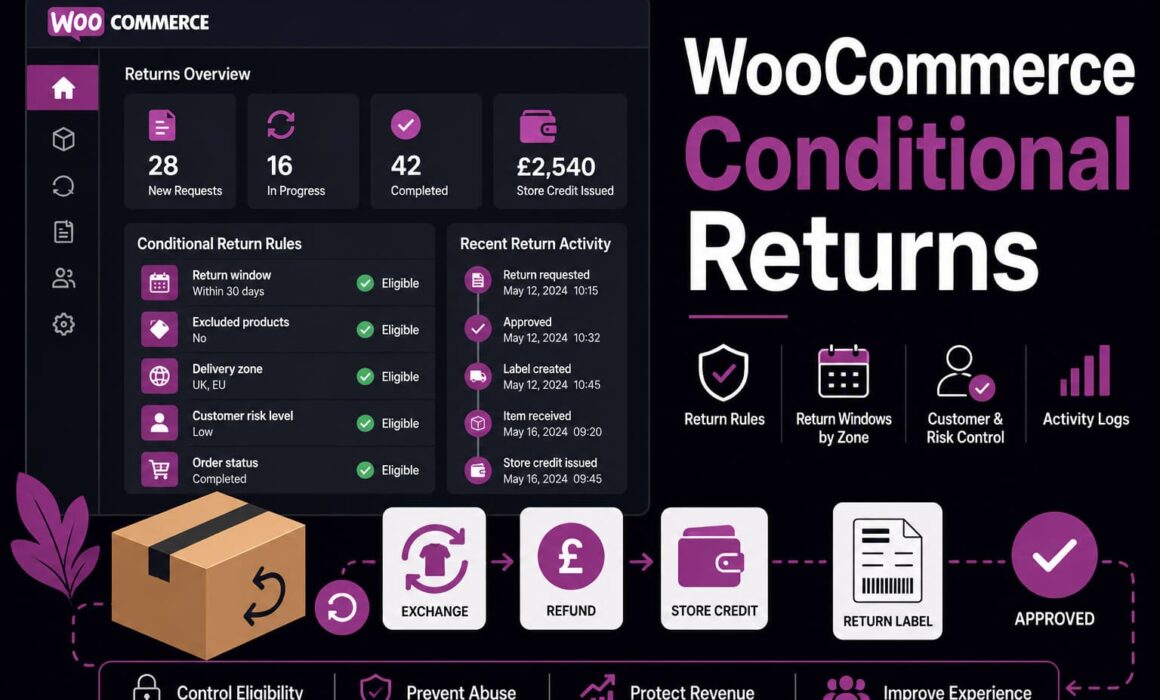
WooCommerce conditional returns: smarter rules for serious stores
WooCommerce conditional returns are what separate a basic returns form from a return process that actually protects your store. Without conditions, every return request starts to look the same, even when the customer, product, order age, delivery zone, refund type or risk level is completely different.
That creates a real ecommerce problem. Your team ends up manually deciding whether a return is allowed, whether an exchange should be offered, whether store credit is better, whether the customer is outside the return window and whether the request looks abusive. If those decisions live in staff memory, inbox threads and scattered order notes, your return process will become inconsistent as soon as order volume increases.
Why WooCommerce conditional returns matter
Returns are not only a refund problem. They are an operational control problem. A customer asking to return a product triggers several decisions before any money moves. Is the order eligible? Is the item excluded? Is the request inside the return window? Is the customer asking for a refund, exchange or store credit? Has the product been used? Does the delivery zone affect the allowed return period? Is the customer a repeat returner?
A basic returns plugin may allow a customer to submit a request, but that does not mean the store has control. If every request lands in the same queue and staff have to inspect each one manually, the plugin has not solved the main issue. It has only moved the contact form into a different place.
Commercial point: conditional returns help your store apply return policy logic before staff waste time reviewing requests that should never have reached the same workflow.
This is where RMA Pro for WooCommerce becomes useful. It gives WooCommerce stores a more structured return management system with rules, returns, refunds, exchanges, store credit, labels and activity visibility built around real ecommerce operations.
WooCommerce conditional returns turn policy into workflow
Most stores already have a return policy. The problem is that the policy is often written for customers, not enforced inside the return workflow. A policy page may say items can be returned within 30 days, personalised items are excluded, sale items are exchange-only and international orders have different return handling. But if your returns plugin does not understand those rules, staff still have to apply them manually.
WooCommerce conditional returns turn policy wording into operational logic. Instead of asking support staff to remember every exception, the store can define conditions that shape what customers can request and what staff need to review.
That matters because returns policy mistakes are expensive. If staff approve excluded products, accept late returns or refund customers who should have been offered exchange or store credit, the store loses margin quietly. The issue is not one single mistake. It is the repeated drift from the intended policy.
Examples of useful conditional return logic
- Only allow return requests within a defined return window.
- Exclude specific products or product categories from standard returns.
- Allow exchanges but restrict refunds for selected items.
- Offer store credit for certain return scenarios.
- Apply different return windows by zone.
- Require manual review for high-risk customers.
- Give VIP customers more flexible handling.
- Control whether return labels are issued automatically or manually.
The benefit is not just automation. It is consistency. A store that applies its policy consistently is easier to manage, easier to train and harder to abuse.
Basic WooCommerce Returns Plugins vs RMA Pro
Conditional returns are where many basic WooCommerce returns plugins start to show their limits. A simple request form may be acceptable when return volume is low, but it will struggle when the store needs rules, exceptions, exchanges, store credit and proper activity tracking.
| Area | Basic WooCommerce Returns Plugins | RMA Pro |
|---|---|---|
| Conditional return rules | Often limited to basic return windows or manual approval. | Supports return rules to control eligibility and reduce manual decision-making. |
| Customer return portal | May collect a return request but leave the real decision to staff. | Provides a structured return portal connected to the wider RMA workflow. |
| Refunds and exchanges | Usually refund-first, making exchanges awkward or manual. | Handles refunds, exchanges and store credit as part of return management. |
| Abuse prevention | Weak visibility can make repeat return behaviour harder to spot. | Rules and activity logs help stores apply tighter controls where needed. |
| Return windows by zone | Often applies one return window across all customers and regions. | Supports more flexible return windows by zone where operational differences matter. |
| Return labels | Labels may need to be created outside the return workflow. | Supports return labels and Shippo workflow support where relevant. |
| Visibility | Limited audit trail across approval, labels, refunds and exchanges. | Activity logs help teams see what happened during the RMA process. |
The main difference is depth. A basic plugin may help the customer ask for a return. RMA Pro helps the store control what should happen next.
WooCommerce conditional returns reduce admin workload
Manual return admin is repetitive because staff have to answer the same eligibility questions again and again. Is the order too old? Is the product returnable? Did the customer buy from a region with a different policy? Is the return reason valid? Should this be refund, exchange or store credit?
Those checks may only take a few minutes each, but they add up quickly. More importantly, they interrupt higher-value work. A support team that spends the morning interpreting return requests is not spending that time improving customer experience, resolving urgent issues or supporting sales.
Conditional returns reduce admin by moving predictable decisions into the workflow. Staff still review cases where judgement is needed, but they are not forced to manually inspect every obvious policy condition.
Without conditions
Every request enters the same process. Staff manually check the order, item, date, policy, return reason and customer notes before deciding what to do.
With conditions
The return workflow can apply rules first, helping staff focus on valid requests, exceptions and cases that genuinely need review.
With RMA Pro for WooCommerce, the aim is not to remove human oversight. The aim is to remove repetitive checking and give staff a clearer route from request to resolution.
How conditional return rules prevent abuse
Most customers are reasonable. Return abuse usually comes from a smaller group of behaviours: repeated size bracketing, returning used items, exploiting vague policies, asking for exceptions after the return window or repeatedly pushing support staff for goodwill refunds.
If your return system treats every customer the same, abuse becomes harder to control. Staff may approve requests because they do not see the pattern, or because the current case looks acceptable in isolation.
Example: high-risk customer controlled through rules
A customer repeatedly orders several sizes, keeps one, returns the rest and asks for exceptions on late returns. A basic returns process sees each request as a normal return. A conditional returns workflow can require manual review, apply tighter eligibility or prevent certain outcomes for high-risk cases.
This does not mean refusing legitimate returns. It means giving the store enough control to distinguish between normal customer behaviour and patterns that damage margin.
Activity logs also matter here. If staff can see what happened previously, they can make better decisions. A return process without history makes abuse easier because each request starts with a blank page.
How the return portal improves customer experience
Conditional returns are not only useful for the store. They also improve the customer experience when applied properly.
A clear return portal helps customers understand what they can request, which items are eligible and what the next step is. That is better than forcing them to email support and wait for someone to explain the policy manually.
The best return experience is structured but not cold. Customers need a process that feels simple. The store needs a process that remains controlled.
- Customers submit return requests through a clear portal.
- The store receives structured information connected to the order.
- Rules help guide eligibility before staff review the request.
- Customers can be offered refund, exchange or store credit where appropriate.
- Status visibility can reduce avoidable chasing.
This becomes especially important during peak periods. Black Friday, Christmas, January sales and seasonal campaigns can all generate higher return volume. A manual process may cope in quiet months, then collapse when support tickets spike.
WooCommerce conditional returns for refunds, exchanges and store credit
One of the biggest weaknesses in simple return workflows is that they treat every return as a refund problem. That is too narrow. Sometimes the customer wants their money back. Sometimes they want a different size. Sometimes they are happy with store credit. Sometimes one order needs multiple outcomes.
Conditional logic helps the store guide those outcomes more intelligently.
Mixed return scenario: exchange and refund in one request
A customer buys four items. They want to exchange a jacket for a larger size, refund a pair of trousers, keep a T-shirt and receive store credit for an accessory because the preferred replacement is out of stock.
A basic return form turns that into a long support message. Staff have to split the request manually, check the order, update notes, issue the right refund and make sure the exchange is not forgotten.
A stronger return management process allows the store to handle different outcomes within the wider RMA workflow. This is how real ecommerce returns behave. They are not always one order, one item and one refund.
How exchanges protect revenue
Exchanges are commercially important because they keep the customer inside the buying journey. If a customer likes a product but needs another size or colour, a refund is often the worst outcome. The sale disappears, and the customer may buy from a competitor.
Conditional returns can support an exchange-first approach where it makes sense. For example, selected products or categories could encourage exchanges rather than immediate refunds, while still allowing staff to review exceptions.
How store credit improves retention
Store credit is useful when a customer is not ready for a direct exchange. The replacement may be out of stock, the customer may want time to choose, or the store may want to retain value after a discretionary return.
Store credit scenario
A customer returns a £70 product because the colour is not suitable. The replacement is unavailable. A refund sends the money out of the business. Store credit keeps the customer active and gives them a reason to return, possibly spending more on the next order.
RMA Pro supports refunds, exchanges and store credit in a more complete WooCommerce RMA workflow, making it easier to choose the right resolution for each case.
Return windows by zone make conditional returns more realistic
A single return window for every customer can be too blunt. Delivery speed, carrier performance, customer location and return shipping options can all affect what is realistic.
For example, a domestic customer may receive an order quickly and have easy access to return shipping. A customer in a remote area or international zone may need longer. A VIP customer may justify more flexibility. A high-risk return pattern may justify tighter controls.
Return windows by zone help stores match policy to operational reality.
| Condition | Why it matters | Practical return workflow impact |
|---|---|---|
| Domestic delivery zone | Shorter delivery and return times are usually easier to manage. | Standard return window can apply with normal label handling. |
| Remote or slower delivery zone | Customers may receive items later and need more practical flexibility. | A longer return window may reduce support disputes. |
| VIP customer group | High lifetime value can justify better service treatment. | Extended return windows or manual review can protect retention. |
| High-risk customer behaviour | Repeated returns can damage margin and stock availability. | Rules can trigger tighter eligibility or manual review. |
VIP customer scenario: extended return window
A customer has placed several high-value orders, rarely returns items and has a strong purchase history. They request an exchange just outside the normal return window. A rigid process rejects the request automatically. A commercially aware process allows a more flexible decision because the customer relationship is worth protecting.
Conditional returns let stores handle that type of situation without turning every return into a manual exception.
Return labels and Shippo support keep the physical workflow connected
Returns are not purely digital. The customer submits the request online, but the product still has to travel back through a carrier, warehouse and inspection process.
If return labels are handled outside the main return workflow, the process can become disconnected. Support approves the request, someone else creates the label, the customer receives separate instructions, the warehouse receives a parcel and admin has to work out what should happen next.
Return label support helps connect approval, shipping and resolution. Shippo support can also help stores that want a more joined-up label workflow.
Operational example
A customer requests a return for a damaged item. The return rule allows manual review because the reason is damage-related. Support approves the request, label handling is managed through the workflow, the item arrives back, and the activity log helps admin decide whether to refund, exchange or issue store credit.
This matters because warehouse and support teams need the same view of the return. If the physical parcel is disconnected from the RMA record, mistakes become more likely.
Activity logs make conditional returns easier to trust
Conditional returns are only useful if the store can see what happened. Rules may guide eligibility, but staff still need visibility when requests change, exceptions are made or disputes arise.
Activity logs help create a record of the return process. They can show who reviewed the request, when the status changed, whether an exception was made and which resolution was chosen.
That helps with practical questions:
- Who approved the return?
- Was the customer inside the return window?
- Was this handled as refund, exchange or store credit?
- Was a return label issued?
- Did the customer change the request?
- Was the item received before the refund was processed?
For store owners, this visibility reduces the need to personally inspect every return. For support teams, it makes handovers cleaner. For warehouse staff, it gives better context. For customer disputes, it creates a clearer history.
WooCommerce conditional returns and UK customer expectations
WooCommerce return rules should be used carefully. A store policy cannot remove statutory rights. In the UK, online customers often have cancellation rights for many distance sales, and GOV.UK guidance explains that customers can usually notify the seller within 14 days of receiving an item, then have another 14 days to return it.
There are exceptions and product-specific rules, so stores should take proper legal advice where needed. The practical point is that return rules should help apply your policy consistently, not create misleading barriers for customers.
You can review the official GOV.UK guidance here: accepting returns and giving refunds.
For WooCommerce stores, this means conditional returns should be configured with both commercial control and customer rights in mind. The aim is not to block legitimate returns. The aim is to manage eligibility, exceptions, abuse risk and workflow in a more reliable way.
Why automation matters as WooCommerce stores scale
Manual returns can feel manageable when order volume is low. They become fragile when the business grows. The issue is not only the number of returns. It is the number of small decisions inside each return.
Automation matters because it removes repetitive checks. Staff should not have to manually inspect the same conditions on every request if those conditions can be applied by the workflow.
| Manual task | Why it becomes a problem | Conditional workflow benefit |
|---|---|---|
| Checking return windows | Staff waste time confirming the same date logic repeatedly. | Rules can help determine whether a request is inside the allowed period. |
| Reviewing excluded products | Ineligible products may be accepted by mistake. | Product and category conditions can support more consistent handling. |
| Choosing refund or exchange | Stores may default to refunds because they are easier. | Exchange and store credit workflows help protect revenue. |
| Spotting repeat abuse | Patterns are hard to see when requests are isolated. | Rules and activity logs help support better review decisions. |
As the store scales, conditional returns become less of a feature and more of a control layer. They help the business keep returns manageable without treating every request as a one-off support case.
Where RMA Pro fits in a serious WooCommerce returns setup
RMA Pro is built for WooCommerce stores that need a more operationally useful returns process. It is not just about giving customers a form. It is about giving store owners control over how returns are submitted, reviewed, approved, rejected and resolved.
That makes it useful for stores that need to:
- Apply return rules more consistently.
- Reduce admin time spent checking eligibility.
- Offer exchanges instead of defaulting to refunds.
- Use store credit to retain revenue.
- Control high-risk customers and edge cases.
- Support flexible return windows by zone.
- Manage return labels and Shippo-related workflows where relevant.
- Use activity logs to improve visibility across the team.
If your store is still managing returns through email, order notes and manual judgement, RMA Pro gives you a more structured route. It works as a return management system for WooCommerce rather than a basic refund request form.
Signs your store needs WooCommerce conditional returns
Conditional returns become important when the current process starts creating friction or margin leakage. You may need a stronger system if these issues are becoming familiar:
- Staff manually check every return against the policy.
- Late return requests are handled inconsistently.
- Excluded products are sometimes accepted by mistake.
- Refunds are issued when exchanges would have protected revenue.
- Store credit is rarely offered because the workflow is awkward.
- High-risk customers keep getting manual exceptions.
- VIP customers cannot be handled flexibly without staff notes.
- Return labels are created outside the main return process.
- Warehouse, support and admin teams do not share the same return history.
These are operational symptoms. They show that the store has outgrown a simple return process and needs better rules, visibility and workflow control.
Build a returns process that applies the right rules at the right time
WooCommerce conditional returns help your store move away from manual policy interpretation and towards a cleaner return management workflow. That matters because serious ecommerce stores cannot afford to treat every return as a blank decision.
The right return system should protect the customer experience while giving the store control. It should support legitimate returns, make exchanges easier, use store credit where it makes commercial sense, apply eligibility rules consistently and give staff enough visibility to manage exceptions properly.
That is the value of a more complete WooCommerce RMA process. It reduces repetitive admin, prevents avoidable policy drift and helps the store handle returns as part of operations, not just customer support.
If your current process relies too heavily on staff memory, manual checks and inconsistent exceptions, RMA Pro for WooCommerce gives you a stronger way to manage WooCommerce conditional returns with rules, exchanges, store credit, return labels and activity visibility built into the workflow.