
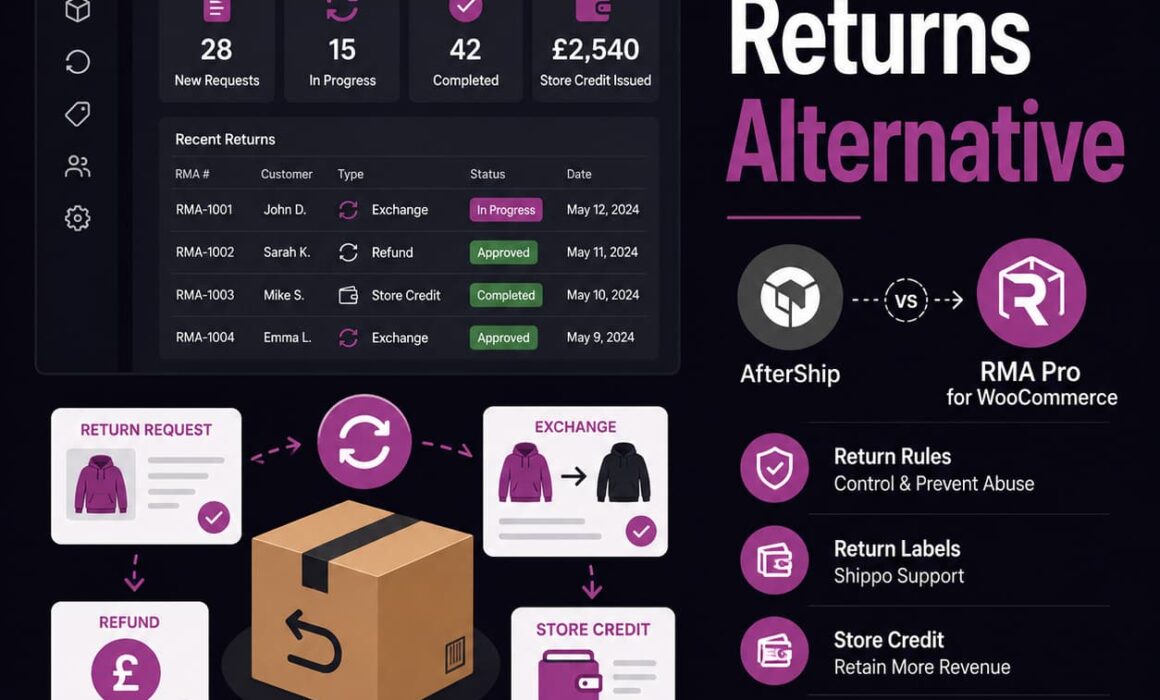
AfterShip Returns Alternative for WooCommerce Stores
An AfterShip returns alternative is worth considering when your WooCommerce store needs more than a polished returns page. Returns are not just a customer-facing form. They affect refunds, exchanges, stock movement, support workload, return labels, customer retention, abuse prevention and admin visibility.
AfterShip Returns is a recognised returns and exchanges platform, and for some stores it will make sense. But if you run a WooCommerce store and want a return management system that feels closer to your own ecommerce operation, you may want a more focused WooCommerce returns plugin rather than a broader post-purchase platform.
Why WooCommerce stores look for an AfterShip returns alternative
AfterShip has built a strong name around the post-purchase experience. Its Returns product is positioned around returns and exchanges management, branded return experiences, automation and revenue retention. That makes it relevant for ecommerce businesses that want a dedicated returns platform.
The question for WooCommerce store owners is not whether AfterShip Returns is useful. The better question is whether it is the right operational fit for how your WooCommerce store handles returns day to day.
WooCommerce stores often need a returns system that sits naturally around their existing order process, support workflow and store admin habits. If your team already lives inside WordPress and WooCommerce, adding a separate platform may feel heavier than necessary, especially if your main requirement is to manage returns, refunds, exchanges, store credit, eligibility rules, labels and activity logs in a clear RMA workflow.
Commercial point: the best returns system is not always the biggest platform. It is the one that reduces admin, protects revenue and gives your team enough control without creating another layer of complexity.
This is where RMA Pro for WooCommerce fits. It is designed for WooCommerce stores that want a practical return management system covering returns, refunds, exchanges, store credit, return rules, return labels and RMA visibility.
AfterShip returns alternative: what should you actually compare?
When comparing an AfterShip returns alternative, it is easy to focus only on surface-level features. A branded returns page looks good. Automated labels sound useful. Exchanges and store credit sound commercially sensible. But a store owner should go deeper than the feature list.
The real comparison should be based on workflow fit.
Ask what happens when a customer wants to return one item, exchange another, receive store credit for a third and keep the rest of the order. Ask how your team checks eligibility. Ask whether a high-risk customer can be handled differently from a trusted customer. Ask whether your support team can see the full activity history without digging through emails and order notes.
That is where returns become operational. A returns system needs to help the store make better decisions, not just capture customer requests.
| Comparison area | Typical platform-style returns solution | WooCommerce-focused RMA workflow |
|---|---|---|
| Operational fit | Often built as a broader post-purchase platform across ecommerce systems. | Built around WooCommerce return management and store admin needs. |
| Returns portal | Usually strong on branded customer-facing return experiences. | Provides a WooCommerce return portal tied to RMA handling and store workflow. |
| Refunds and exchanges | Often supports refunds and exchanges as part of a wider platform. | Supports refunds, exchanges and store credit as part of a WooCommerce RMA process. |
| Eligibility control | May offer eligibility rules depending on plan and setup. | Uses return rules to control eligibility and reduce manual decision-making. |
| Labels and shipping | Often strong where carrier and label automation are central requirements. | Supports return labels and Shippo workflow support where relevant. |
| Visibility | Can provide platform-level return visibility. | Activity logs help WooCommerce teams see what happened inside the RMA process. |
| Best fit | Stores wanting a broader post-purchase platform with external workflow layers. | WooCommerce stores wanting practical return control without unnecessary platform overhead. |
Basic WooCommerce Returns Plugins vs RMA Pro
Not every AfterShip returns alternative is automatically better for WooCommerce. Some basic returns plugins are too limited in the opposite direction. They may provide a simple request form, but still leave your team doing the real work manually.
A serious WooCommerce store should avoid both extremes: a platform that feels heavier than required, and a basic plugin that does not actually solve the operational problem.
| Area | Basic WooCommerce Returns Plugins | RMA Pro |
|---|---|---|
| Customer requests | Often provide a simple return request form with limited structure. | Provides a return portal for structured return, refund, exchange and store credit requests. |
| Admin workload | Still relies heavily on manual checking, emails and order notes. | Centralises RMA handling to reduce repetitive admin and improve visibility. |
| Exchanges | Often refund-first, making exchanges awkward or manual. | Supports exchanges so stores can protect revenue rather than defaulting to refunds. |
| Store credit | Usually missing or handled using separate tools. | Supports store credit as a retention-focused alternative to refunds. |
| Return rules | May only offer basic return windows or manual review. | Uses return rules to control eligibility, reduce abuse and apply policy consistently. |
| Return windows by zone | Often too rigid for stores with different delivery regions or customer groups. | Supports more flexible return windows by zone where operational differences matter. |
| Activity logs | Limited audit trail, making disputes and internal handovers harder. | Activity logs improve visibility across support, admin and warehouse handling. |
The right choice is the one that gives your team enough structure to handle real returns without turning the process into another admin burden.
Why returns are an operational problem, not just a refund problem
Many ecommerce stores underestimate returns because they only look at the financial transaction. A customer returns a product, the store refunds them, and the matter appears closed. Behind the scenes, that single return may have touched customer service, warehouse, finance, stock management and shipping.
That is why returns are operational. Every return creates questions:
- Is the product eligible?
- Is the customer inside the return window?
- Does the customer want a refund, exchange or store credit?
- Does the returned item need inspection?
- Should the store issue a label?
- Should the replacement be sent before or after receipt?
- Has the customer returned too many items before?
- Who approved the request and why?
If your system does not handle those questions clearly, your staff have to. That is where returns become expensive.
Operational reality: the refund is often the final action. The work starts much earlier, when the customer submits the request and your team has to decide what should happen next.
RMA Pro is designed to help WooCommerce stores manage that full return lifecycle, rather than only dealing with the final refund stage.
How RMA Pro helps reduce admin workload
Admin workload is one of the clearest reasons to look for an AfterShip returns alternative. Not because AfterShip cannot automate work, but because WooCommerce stores may want a simpler, store-focused way to reduce return admin without moving the whole process into a wider platform.
Manual return handling usually creates repeated small tasks. Each one feels manageable, but together they eat into the working day.
- Finding the original order.
- Checking the product purchased.
- Confirming the return reason.
- Checking whether the return is inside policy.
- Asking the customer what resolution they want.
- Creating labels or sending instructions.
- Updating notes so the rest of the team knows what happened.
A return portal reduces this by making the customer submit clearer information from the start. Instead of a vague email saying “I want to return this”, the store receives a structured request linked to the order.
With RMA Pro for WooCommerce, your team can manage returns from a central RMA workflow, review the request, apply rules, track activity and handle outcomes such as refunds, exchanges or store credit with better visibility.
The commercial impact is not just time saved. It is fewer errors, fewer duplicated conversations and fewer avoidable customer follow-ups.
How the returns portal improves customer experience
A good returns experience does not mean approving everything. It means giving customers a clear route, setting expectations and avoiding unnecessary friction.
Customers do not want to hunt for a policy page, write a long email, wait for a reply, send another email with missing information and then chase again three days later. That makes the store look disorganised, even if the team is doing its best behind the scenes.
A WooCommerce return portal gives customers a more direct path. They can submit a request in a structured way, and the store receives the information needed to make a decision. This benefits both sides.
Without a portal
The customer emails support, waits for questions, sends order details manually and may chase because they cannot see progress.
With a portal
The customer submits a structured request, selects the relevant item and gives the store clearer information from the start.
This is especially important during peak trading periods. Black Friday, Christmas, January sales and seasonal campaigns all create return pressure. The customer experience can quickly deteriorate if every return becomes a manual support ticket.
How rules help control eligibility and prevent abuse
Any returns system that only focuses on customer convenience is incomplete. Store owners also need control. Rules matter because not every return request should be treated the same.
Some products may be excluded. Some requests may be outside the return window. Some customers may have a history of excessive returns. Some order statuses may not be eligible. Some regions may have different operational constraints.
Without rules, staff have to make these decisions manually. That causes three problems:
- Different staff members may apply the policy differently.
- Customers may receive inconsistent answers.
- High-risk customers may exploit gaps in the process.
Example: high-risk customer controlled through rules
A customer repeatedly orders multiple sizes, returns most of the order and asks for exceptions after the return window. Without rules and visibility, each case may look normal. With structured return rules and activity history, the store can require manual review, restrict eligibility or apply tighter controls.
RMA Pro helps WooCommerce stores use return rules to reduce policy drift. That gives the team a clearer framework and helps protect margin from avoidable abuse.
How exchanges protect revenue better than default refunds
One of the main reasons to move beyond a basic return setup is exchange handling. A refund closes the sale. An exchange keeps the customer and the revenue in play.
This matters because many returns are not caused by total dissatisfaction. The customer may like the product but need a different size, colour, variation or quantity. If the store makes exchange handling awkward, the customer may accept a refund and buy elsewhere.
Mixed return scenario: exchange and refund in one request
Imagine a customer buys four items from a WooCommerce store. They want to exchange a jacket for a larger size, refund a pair of trousers, keep one T-shirt and receive store credit for another item because the preferred replacement is out of stock.
A simple returns form struggles with that. The request becomes a long message that support has to interpret. The refund may be processed correctly, but the exchange gets delayed. The warehouse may receive the parcel without knowing which item needs which resolution.
A stronger return management workflow allows the store to handle different outcomes inside the same RMA case. That is how returns work in real ecommerce. They are not always one item, one refund, one decision.
RMA Pro works as a WooCommerce returns and exchanges plugin, giving stores a better way to manage the commercial difference between refunding a customer and keeping the order value alive.
How store credit improves retention
Store credit is not a trick. It is a useful middle ground between an exchange and a refund. It gives the customer a fair outcome while keeping value inside the store.
It is especially useful when a direct exchange is not possible. The replacement item may be out of stock. The customer may not know what they want yet. The product may be seasonal. In those cases, store credit can stop the return becoming a lost customer.
Store credit scenario
A customer returns a £65 item because the colour is not right. The size they want is unavailable, so an exchange cannot happen immediately. If the store issues a refund, the sale is gone. If the store offers store credit, the customer keeps value with the store and later spends £90 on a different product.
That is the commercial value of store credit. It protects future purchase intent. RMA Pro supports store credit as part of the wider return management workflow, so it can sit alongside refunds and exchanges rather than being handled as a disconnected manual workaround.
Why return windows by zone help operational flexibility
Return windows are not always one-size-fits-all. Domestic deliveries, international orders, remote regions and VIP customer groups can all create different return timing realities.
A UK customer may receive an order quickly and have easy return options. A customer in a slower delivery region may need more time. A high-value customer may justify more flexibility. A region with expensive return logistics may need tighter control.
Return windows by zone help WooCommerce stores build policies that reflect operational reality rather than forcing every customer into the same rule.
VIP customer scenario: extended return window
A VIP customer has ordered several times, rarely returns and has a strong lifetime value. They contact the store slightly outside the normal return window. A rigid system treats them the same as a high-risk customer. A more flexible return management system allows the store to support an extended window or manual review without changing the entire public policy.
This matters because good customers and risky customers should not always be managed in exactly the same way. RMA Pro gives stores more control over the rules and exceptions that shape return eligibility.
Activity logs improve visibility across the return process
Return disputes often come down to visibility. A customer says they were promised an exchange. A staff member says the item was outside policy. The warehouse says the return arrived damaged. Admin says the refund was processed because no exchange note was visible.
Without activity logs, those situations become time-consuming to untangle. Staff search emails, order notes, helpdesk comments and shipping records. The longer the trail, the easier it is to miss something.
Activity logs give the return process a clearer record. They help answer practical questions:
- Who approved the request?
- When was the request submitted?
- Was the customer offered refund, exchange or store credit?
- Was a return label created?
- Was an exception made?
- What changed during the RMA process?
This is useful for support teams, warehouse staff, ecommerce managers and store owners. It creates a shared view of what happened, which makes handovers cleaner and disputes easier to resolve.
Return labels and Shippo support help the physical workflow
Returns are both digital and physical. The customer submits a request online, but the product still has to move back through the carrier, warehouse and inspection process.
If return labels are created separately from the RMA process, the workflow can become disjointed. Support approves the request. Another person creates the label. The customer receives instructions from a different system. The warehouse receives the parcel but does not have enough context.
Return label support helps connect the request to the physical return. Shippo support can also help where stores want a more joined-up label workflow.
Operational example
A customer requests a return for a damaged item. The request is approved, a label is handled through the workflow, the parcel arrives at the warehouse and the admin team can review the activity before issuing the final refund, exchange or store credit.
This reduces unnecessary chasing and gives the team more confidence that each return is being handled in the right order.
Why automation matters as WooCommerce stores scale
Manual returns feel manageable until order volume increases. The same process that worked at 20 returns a month can become painful at 100 returns a month. The issue is not only the number of returns. It is the number of decisions hidden inside each return.
Automation matters because it removes repetitive checking and helps staff focus on cases that need judgement. That does not mean every return should be auto-approved. It means the system should help filter, structure and track the work.
| Manual task | Why it causes problems at scale | Better workflow with RMA Pro |
|---|---|---|
| Checking eligibility | Staff spend time applying the same policy repeatedly. | Return rules help control eligibility more consistently. |
| Reading customer emails | Unstructured requests lead to missing information and follow-up messages. | The portal captures clearer request information from the customer. |
| Choosing refund or exchange | Stores may default to refunds because they are easier to process. | Exchange and store credit workflows help protect revenue. |
| Sending return instructions | Customers chase if labels or instructions are delayed. | Return label workflows help make the process cleaner. |
| Tracking decisions | Handovers become risky when notes are scattered. | Activity logs improve visibility and accountability. |
As stores scale, the goal is not to remove human judgement. The goal is to stop wasting human judgement on repetitive checks that the system should help manage.
AfterShip returns alternative for stores that want WooCommerce control
AfterShip Returns may suit stores that want a broader external returns platform, especially when returns are part of a larger post-purchase software stack. But many WooCommerce stores want something more direct: a return management system that focuses on the store’s RMA workflow without unnecessary operational distance.
That is the core reason to consider RMA Pro as an AfterShip returns alternative. It is not trying to be a broad post-purchase suite. It is built around the practical return management needs of WooCommerce stores.
RMA Pro is useful when you want to:
- Give customers a clearer WooCommerce return portal.
- Reduce repetitive return admin.
- Handle refunds, exchanges and store credit more commercially.
- Use return rules to control eligibility and reduce abuse.
- Support different return windows by zone.
- Improve visibility with activity logs.
- Connect return label handling into the return workflow.
- Manage returns like an operational process, not just a support inbox.
If your store already feels stretched by manual returns, the value is not just in adding another feature. It is in making the whole workflow cleaner.
Choosing the right returns system for your WooCommerce store
The right returns system depends on what problem you are actually trying to solve.
If your main goal is a broad post-purchase platform across multiple channels and systems, AfterShip Returns may be worth reviewing. If your main goal is to improve WooCommerce return handling with a focused RMA workflow, RMA Pro may be the more practical option.
Before choosing, look at the real work your team does each week. Count the time spent checking return windows, replying to unclear emails, creating labels, handling exchanges manually, issuing refunds that could have been store credit and trying to work out who approved what.
That is where the better decision usually appears. Returns software should reduce that work, not just give it a new dashboard.
Decision checkpoint
If your WooCommerce store needs a practical return portal, exchange support, store credit, return rules, labels and activity visibility, choose a system built around those daily operational needs.
Build a cleaner WooCommerce returns workflow with RMA Pro
An AfterShip returns alternative should not simply copy AfterShip. It should solve the specific problem your WooCommerce store has.
For many stores, the problem is not a lack of software. It is a lack of operational control. Returns are scattered across emails, order notes, warehouse messages and manual decisions. Exchanges are missed. Store credit is underused. High-risk customers are handled inconsistently. Staff cannot easily see what happened.
RMA Pro gives WooCommerce stores a more focused way to manage that process. It brings returns, refunds, exchanges, store credit, rules, return labels and activity logs into a practical RMA workflow designed for serious ecommerce stores.
If your current returns setup is too basic, too manual or too disconnected from how your WooCommerce store actually runs, RMA Pro for WooCommerce is a strong AfterShip returns alternative built around control, visibility and better return outcomes.