
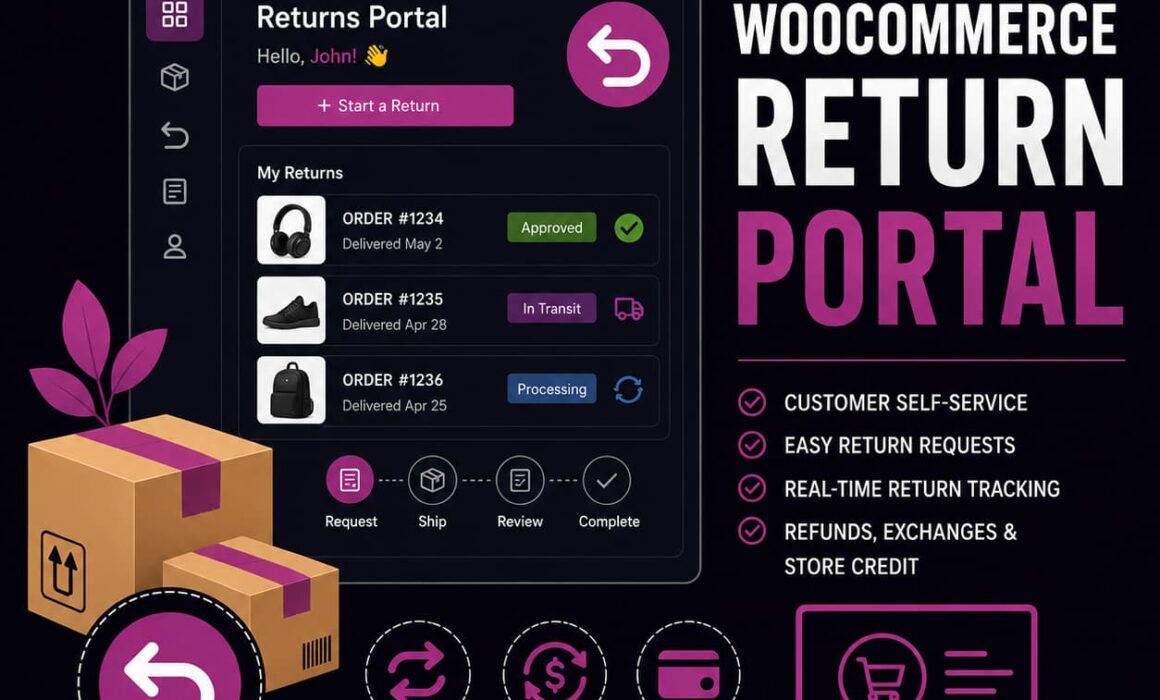
WooCommerce Return Portal: A Smarter Way to Manage Returns
A WooCommerce return portal is not just a nicer way for customers to ask for a refund. For a serious ecommerce store, it becomes the operational layer between the customer, the warehouse, the support team, the refund process, exchanges, store credit, return labels and abuse control.
That matters because returns are rarely as simple as “customer sends item back, store gives money back”. In real stores, returns create admin noise, stock uncertainty, margin leakage, customer frustration and support tickets. If your WooCommerce return process still depends on contact forms, inbox threads and manual notes, the problem is not just the time it takes. The problem is that nobody has a clean system of record.
Why a WooCommerce return portal matters more than most stores realise
Most WooCommerce stores start with a fairly basic return process. A customer emails support. Someone checks the order. Someone asks what they want to return. Another person checks whether the item is eligible. Then the customer asks whether they can exchange it instead. Then someone creates a note somewhere, possibly in WooCommerce, possibly in the helpdesk, possibly in a spreadsheet that nobody admits exists.
That works when a store has low order volume and one person knows every order by memory. It starts to fail when volume increases, product ranges get bigger, customer expectations rise, and the team has to handle returns while also dealing with fulfilment, stock issues, supplier delays, customer service and marketing.
Commercial point: a poor return process does not only cost admin time. It can reduce repeat purchase rates, increase unnecessary refunds, hide repeat abuse patterns and make your customer service team slower on every other task.
A proper WooCommerce return portal gives customers a clear route to submit a return request and gives the store a structured workflow to review, approve, reject, exchange, refund or issue store credit. That is the difference between handling returns reactively and managing returns as part of the wider ecommerce operation.
This is where RMA Pro for WooCommerce is designed to fit. It gives WooCommerce stores a return management system built around real operational decisions, not just a basic refund button.
WooCommerce return portal problems basic plugins do not solve
A lot of basic WooCommerce returns plugins focus on one narrow task: allowing a customer to request a return. That sounds useful, and it is, but it is only the first part of the job. The harder part is what happens after the request lands.
Store owners need to know what has been requested, whether the request is valid, whether the item has been returned, whether the customer wants a refund or exchange, whether a return label is required, whether store credit would be better, and whether this customer has a history of questionable returns.
Basic plugins often become another contact form with a different name. They collect a request, but they do not give the store enough control over the workflow.
| Area | Basic WooCommerce Returns Plugins | RMA Pro |
|---|---|---|
| Customer requests | Often allow simple return requests, usually with limited structure. | Provides a proper return portal for structured return, refund, exchange and store credit requests. |
| Eligibility control | May offer basic return windows or manual review only. | Supports return rules so stores can control eligibility by product, customer, order, zone and other conditions. |
| Exchanges | Often refund-focused, making exchanges awkward or manual. | Supports exchanges so stores can protect revenue rather than defaulting to refunds. |
| Store credit | Usually not included or handled separately. | Allows store credit workflows to retain value inside the store. |
| Return labels | Often requires separate tools and manual customer emails. | Includes return label support and Shippo workflow support where relevant. |
| Visibility | Limited history, weak audit trail and poor team visibility. | Activity logs help teams see what happened, when it happened and who handled it. |
| Operational fit | Useful for very small stores with simple refund needs. | Built for WooCommerce stores that need control, automation and proper return management. |
The real test is not whether a plugin can receive a return request. The real test is whether it helps your team make the right decision quickly, consistently and profitably.
How a WooCommerce return portal reduces admin workload
Returns become expensive when every request has to be interpreted manually. The support team has to check the customer’s message, find the order, confirm the product, look at the order date, work out whether it falls inside the return window, ask for missing information and then decide what should happen next.
Multiply that by 20, 50 or 100 return requests a month and the hidden cost becomes obvious. Returns are not just refunds. They are small admin projects that interrupt the rest of the business.
A WooCommerce return portal reduces that workload by making the customer submit the right information at the start. Instead of a vague email saying “I want to send this back”, the store receives a structured request connected to the order and item.
Before
Support checks the order manually, asks follow-up questions, copies details into notes and tries to remember the current return policy.
After
The customer submits a structured request through the return portal, and the admin team reviews it inside a managed workflow.
With RMA Pro for WooCommerce, the return process becomes less dependent on inbox triage. Staff can handle requests from a central system, review return details, track status changes and keep the process moving without having to reconstruct the whole story from email threads.
The commercial value is simple: less admin per request means support staff can handle more volume without the store having to hire earlier than necessary. It also reduces mistakes. A missed return window, a wrong refund amount or a forgotten exchange can cost more than the time saved by doing things manually.
WooCommerce return portal workflows for refunds, exchanges and store credit
One of the biggest weaknesses in basic return systems is that they treat every return like a refund. That is commercially lazy. Sometimes a refund is the right answer, but often it is not the best outcome for the customer or the store.
A good WooCommerce return portal should support different resolutions because customer intent is not always the same. One customer may want their money back. Another may have ordered the wrong size. Another may prefer store credit if it gets processed faster or gives them flexibility for a future order.
Mixed return scenario: exchange and refund in one request
Imagine a fashion store receives a return request for three items from one order. The customer wants to exchange a jacket for a different size, refund a pair of trousers and keep the third item. A simple return form does not handle this cleanly. The customer writes a long message, support interprets it, and someone has to manually update the order notes.
With a more advanced returns system, the request can be split by item and resolution. The store can approve the exchange for one item, process the refund for another and leave the kept item untouched. That reduces confusion and protects margin because the store does not default the whole request to a refund.
Exchanges protect revenue
Exchanges are one of the most important return outcomes for ecommerce stores. If a customer likes the product but chose the wrong size, colour or variation, a refund loses the sale unnecessarily. An exchange keeps the customer relationship alive and preserves the order value.
That is especially important in categories like fashion, footwear, pet accessories, sports equipment and homeware, where fit, colour, size and preference drive a lot of return behaviour.
Store credit keeps value inside the business
Store credit can be useful when a customer is happy to buy again but does not want an immediate replacement. Instead of sending money back to the payment method, the store can retain the value and give the customer a reason to return.
For example, a customer returns a £60 item because the style was not right. If they receive a straight refund, the sale is gone. If they receive store credit and later spend £85, the store has retained the customer and increased future order value.
RMA Pro supports these commercially useful outcomes by acting as a WooCommerce returns and exchanges plugin, not just a refund request form.
Using return rules to control eligibility and prevent abuse
Returns are part of ecommerce, but not every return request should be treated the same. Some customers are reasonable. Some are confused. Some are pushing the policy. A store without rules ends up relying on staff judgement every time, which creates inconsistency and opens the door to abuse.
Return rules help define what should be allowed before the request becomes a support argument. That can include return windows, product restrictions, customer conditions, order status, zones and other operational criteria.
Example: high-risk customer control
A customer repeatedly buys multiple sizes, wears items briefly and returns most of the order. Without rules, each request looks like a normal return. With rules and activity history, the store can apply tighter controls, limit eligibility or require manual review before approval.
This matters because abuse rarely appears as one dramatic event. It usually appears as a pattern. A customer returns too frequently. A certain product has suspicious behaviour. A return reason keeps appearing for a specific customer group. If the system only records isolated refund requests, those patterns are harder to see.
RMA Pro helps WooCommerce stores apply return rules so eligibility is not handled entirely by memory, inbox searches or inconsistent staff decisions.
Why return windows by zone give WooCommerce stores more flexibility
Return windows are not always simple. A UK customer might receive an order in two days. An international customer might receive it after a longer delivery period. A local delivery zone might be easier to manage than a remote or overseas return. Applying one blanket return window across every customer and region can create unnecessary pressure or unfair outcomes.
Return windows by zone are useful because they let stores reflect real fulfilment and logistics conditions. A domestic customer might have a standard return window. A VIP customer or specific region might receive longer. Another zone may require tighter controls because return shipping is expensive or slower.
VIP customer scenario: extended return window
Consider a customer who spends regularly, rarely returns and has a high lifetime value. A rigid return process treats them exactly like everyone else. That may be technically fair, but commercially blunt. A more flexible approach allows the store to offer an extended return window for selected customers or zones, improving retention without changing the whole public returns policy.
The operational benefit is control. The store can make policy decisions without asking staff to remember exceptions manually. The commercial benefit is that good customers can be treated in a way that reflects their value to the business.
How the returns portal improves customer experience without losing control
Customers do not want to chase returns. They want to know what they can return, how to return it, what happens next and when they should expect an outcome. If the only route is a support email, the customer has no visibility and the support team receives follow-up messages before they have even had time to review the original request.
A WooCommerce return portal gives the customer a clear self-service path. It reduces uncertainty and makes the process feel more professional. That does not mean giving customers unlimited power. The portal can still sit behind store rules, approval workflows and eligibility checks.
This balance is important. Good customer experience does not mean approving every request instantly. It means giving customers a clear process and giving the store enough structure to make consistent decisions.
- Customers can submit requests without writing vague support emails.
- Staff receive structured information linked to the order.
- Status updates reduce avoidable “what is happening?” tickets.
- Rules prevent the portal from becoming a free-for-all.
- Exchanges and store credit give customers more useful options than a flat refund.
For ecommerce managers, this is where the return portal becomes a customer service asset. It does not just reduce workload. It makes the store look more organised, which matters when customers are deciding whether to buy again.
Return labels, Shippo support and why fulfilment workflow matters
Returns do not end when a request is approved. The physical item still has to come back. That means return instructions, labels, tracking, warehouse visibility and status updates. If this part of the process is disconnected, staff spend time manually sending labels, checking tracking numbers and matching parcels back to requests.
Return label support helps close that gap. When return labels are part of the workflow, the store can move from approval to physical return handling more cleanly. Shippo support is useful where stores want a more connected shipping workflow rather than manually creating labels outside the return system.
This becomes particularly important when there are multiple people involved. Customer service might approve the request. The warehouse might receive the parcel. Admin might process the refund. Without a shared record, each person sees only part of the process.
Operational example
A customer requests a return for a damaged item. The request is approved, a label is generated, the parcel arrives at the warehouse, and the admin team can see the activity history before issuing the final refund or replacement. That is much cleaner than a return label in one system, tracking in another and decision notes buried in emails.
The commercial impact is reduced delay. Faster return handling means fewer customer complaints, fewer duplicate support tickets and cleaner stock decisions.
Activity logs make WooCommerce returns easier to trust
When a return process is manual, the biggest problem is often visibility. Someone approved the return, but nobody knows why. Someone promised an exchange, but it was not logged. A customer says they were told something different last week. A staff member processed a refund, but the warehouse had not received the item yet.
Activity logs solve this by creating a record of what happened in the RMA process. That helps with staff accountability, customer disputes, training and operational review.
For store owners, this is more important than it sounds. A returns process with weak visibility can quietly leak money. Refunds get issued too early. Exceptions become normal. Repeat issues are missed. Staff waste time checking with each other because the system does not show the full story.
With RMA Pro, activity logs help turn returns from a messy support trail into a clearer operational record. That gives store owners and ecommerce managers better control over the process without having to personally inspect every request.
WooCommerce return portal automation becomes essential as stores scale
Manual workflows can feel flexible, but they become fragile at scale. The same person who “just knows what to do” eventually gets busy, takes holiday, leaves the business or becomes a bottleneck. A good system captures the logic that would otherwise live in someone’s head.
Automation does not mean removing human judgement. In returns, the best automation usually means removing repetitive checks and surfacing the cases that genuinely need attention.
| Manual task | Why it becomes a problem | Portal-led workflow benefit |
|---|---|---|
| Checking order dates | Staff waste time confirming basic eligibility. | Rules help filter requests based on policy logic. |
| Reading long customer emails | Important details get missed or interpreted differently. | Structured requests make decisions faster and clearer. |
| Creating exchanges manually | Stores may default to refunds and lose revenue. | Exchange workflows help retain order value. |
| Sending return instructions manually | Customers chase updates and labels. | Return label workflows reduce back-and-forth. |
| Tracking decisions in notes | Teams lose context when requests change hands. | Activity logs improve visibility across the team. |
For a store processing a handful of returns, this may feel optional. For a store processing returns every day, it becomes basic operational hygiene.
WooCommerce return portal compliance and customer expectations
Returns also sit close to consumer rights, so stores need to be careful. In the UK, online customers generally have cancellation rights for many distance sales, with GOV.UK guidance explaining that customers can usually tell the seller within 14 days of receiving an item that they want to cancel, then have another 14 days to return it. Stores should always take their own legal advice for their specific products, exemptions and trading situation, but the operational point is clear: returns need proper handling, not guesswork.
You can review the official GOV.UK guidance on accepting returns and giving refunds for the current public guidance.
A WooCommerce return portal does not replace legal compliance. It supports the practical side of compliance by helping the store apply its policy consistently, record actions and reduce ad hoc decision-making.
This matters even more when stores sell products with special rules or operational exceptions, such as personalised items, hygiene-sensitive goods, perishable items, made-to-order products or products with different regional shipping costs.
Where RMA Pro fits in a serious WooCommerce store
RMA Pro is useful for stores that have outgrown basic returns handling. That does not necessarily mean enterprise scale. It means the return process has become important enough that manual handling is creating friction, mistakes or avoidable cost.
A serious WooCommerce store needs more than a refund form. It needs a return management system that connects customer requests to store operations.
For store owners
RMA Pro helps reduce manual oversight and gives better control over refund, exchange and store credit decisions.
For ecommerce managers
It creates a more structured return workflow, making it easier to manage support, operations and customer expectations.
For support teams
It reduces repetitive admin and helps staff see return history, statuses and next actions more clearly.
For customers
It gives a clearer way to request returns, exchanges or store credit without relying on unstructured email chains.
If your current process is still based on contact forms and manual emails, RMA Pro for WooCommerce gives you a more operationally useful way to handle returns inside WooCommerce.
Signs your store needs a better WooCommerce return portal
Not every WooCommerce store needs an advanced returns system on day one. But there are clear signs that the existing process is starting to hold the store back.
- Your support team spends too much time asking customers for order numbers, item details or return reasons.
- Customers chase return updates because they do not know what stage their request is at.
- Refunds are being issued when exchanges would have protected revenue.
- Store credit is difficult to offer consistently.
- Return windows or eligibility rules are being checked manually.
- Staff cannot easily see who approved a return or why.
- Return labels are created outside the main return workflow.
- Repeat return behaviour is hard to spot.
- Warehouse, support and admin teams are working from different information.
These are not just software annoyances. They are operational symptoms. When returns start creating uncertainty, the store needs more structure.
How to think about return portal ROI
The return on investment from a WooCommerce return portal is not only measured by how many refunds it processes. The better question is how much time, revenue and customer trust it protects.
For example, if a store reduces each return request by only five minutes of admin time, that may not sound exciting. But across hundreds of requests, it becomes meaningful. If exchanges save even a small percentage of orders that would have been refunded, the revenue impact becomes more visible. If store credit keeps customers buying, the return process becomes part of retention rather than just loss management.
There is also a risk reduction element. Better logs, clearer rules and structured workflows make it harder for edge cases to become costly mistakes.
Simple ROI example
A store receives 80 return requests per month. If a structured return portal saves six minutes per request, that is eight hours of admin time saved each month. If just 10 of those requests become exchanges instead of refunds, the retained revenue could be far more valuable than the time saving alone.
That is why return management should not be treated as a back-office afterthought. It directly affects margin, customer service load and repeat purchase behaviour.
Building a better WooCommerce return portal process with RMA Pro
A good return process should feel simple to the customer but controlled behind the scenes. The customer should know where to go and what to submit. The store should know what is eligible, what resolution is being requested, who handled each stage and what needs to happen next.
That is the gap RMA Pro is built to fill. It gives WooCommerce stores a more complete way to manage refunds, exchanges, store credit, rules, return labels and RMA activity in one operational workflow.
For small stores, that creates breathing room. For growing stores, it creates consistency. For serious WooCommerce operations, it gives returns the structure they should have had from the start.
If returns are already taking too much time, creating too many support tickets or costing more revenue than they should, it is worth moving beyond a basic form. A proper WooCommerce return portal gives your store a cleaner, more commercially sensible way to manage the full return lifecycle.