
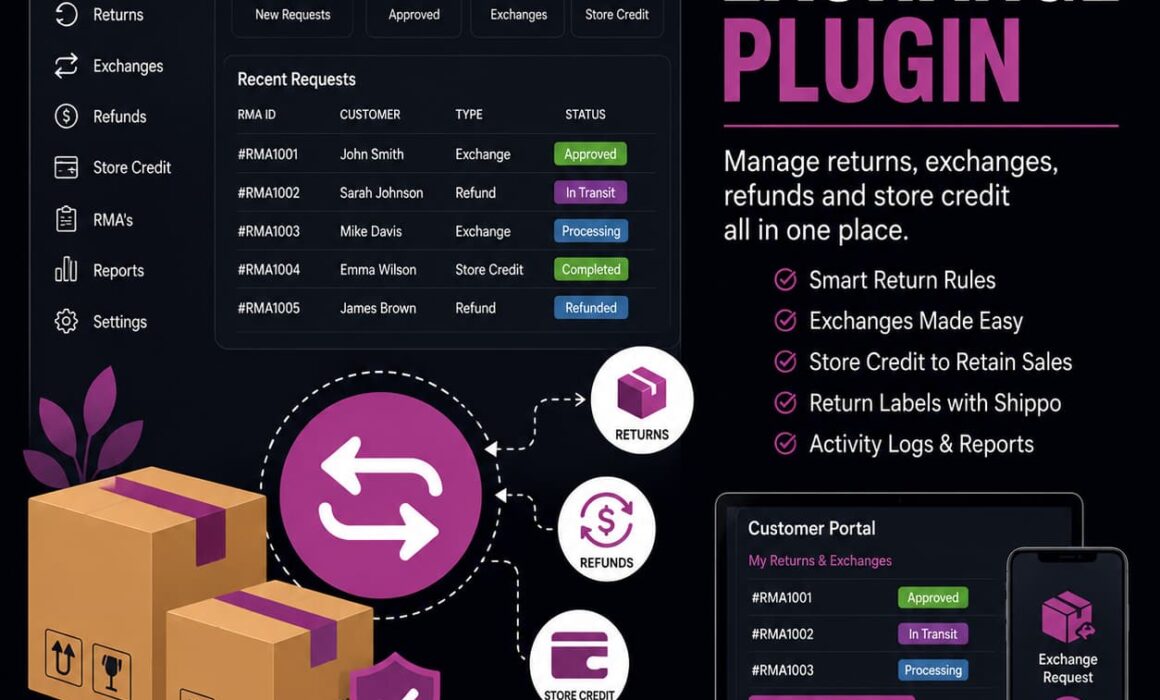
WooCommerce Exchange Plugin: A Better Way to Manage Returns, Refunds and Store Credit
Choosing the right WooCommerce exchange plugin is not just about giving customers a way to swap one product for another. It is about protecting revenue, reducing admin, keeping customers happy and making sure every return request is handled consistently. In real ecommerce, exchanges are rarely neat. Customers ask for different sizes, alternative colours, partial refunds, store credit, return labels and updates on where their request has got to.
If your current exchange process lives in email threads, order notes and staff memory, the problem is not WooCommerce. The problem is that exchanges are being treated as a customer service task instead of an operational workflow. RMA Pro for WooCommerce is built to help store owners manage returns, refunds, exchanges, store credit, return rules, labels and RMA records in one more structured system.
Why a WooCommerce exchange plugin matters for serious ecommerce stores
A refund ends the sale. An exchange gives the customer a reason to stay. That is the commercial difference, and it is why WooCommerce stores should not treat exchanges as a minor add-on to refunds.
Many returns happen because the customer chose the wrong size, colour, variant or product type. That does not mean they dislike the brand. It often means they still want to buy from the store, but need the order corrected. If your returns workflow pushes them straight towards a refund, the business may lose revenue that could have been retained through a better exchange process.
A strong WooCommerce exchange plugin helps the store manage that moment properly. It gives the customer a clear route to request an exchange and gives the admin team a structured way to process it without relying on back-and-forth emails.
For stores with products that come in sizes, colours, lengths, bundles, variations or compatibility options, this matters even more. Exchanges are part of the normal customer journey. They need to be managed with the same discipline as orders, fulfilment and support.
Returns are an operational problem, not just a refund problem
It is easy to think of returns as a finance issue. A customer sends something back, the store refunds the order, and the case is closed. That view is too narrow.
Every return can affect:
- Customer service: staff need to answer questions, confirm eligibility and manage expectations.
- Fulfilment: returned parcels need labels, tracking, inspection and possible replacement shipments.
- Stock control: the store needs to know whether returned items can be resold.
- Finance: refunds, partial refunds, store credit and exchange balances need to be handled correctly.
- Retention: the customer experience affects whether the customer buys again.
- Abuse prevention: repeated or high-risk return behaviour needs proper controls.
When these parts are handled manually, mistakes are easy. One team member agrees an exchange, another processes a refund, and a third receives the returned parcel without knowing the context. The customer then chases support, and everyone has to reconstruct the timeline from emails and notes.
RMA Pro helps turn returns into structured RMA records, so the process is easier to manage from request through to resolution.
Why basic WooCommerce returns plugins are often too limited for exchanges
Basic returns plugins usually solve the most visible problem: they add a return request form. That is useful, but it does not always solve the operational work that follows.
The real work starts after the customer submits the request:
- Is the item eligible for return?
- Is the customer asking for a refund, exchange or store credit?
- Is the replacement product available?
- Is there a price difference?
- Does the order contain multiple items with different outcomes?
- Does the customer need a return label?
- Has this customer returned too many previous orders?
- Who approved the request and when?
A simple form does not answer those questions. It collects the message and leaves staff to work everything out manually. That may be acceptable for a small store with occasional returns, but it becomes weak as order volume grows.
A proper WooCommerce exchange plugin needs to support the full return decision, not just the initial request. That is where RMA Pro is built differently. It combines returns, exchanges, refunds, store credit, rules, labels and activity history into a more practical WooCommerce workflow.
Basic WooCommerce Returns Plugins vs RMA Pro
Not all return tools are built for real exchange workflows. Some are enough for collecting a request. Others help manage the full commercial and operational journey. This is where the difference becomes important.
| Feature or workflow | Basic WooCommerce Returns Plugins | RMA Pro |
|---|---|---|
| Exchange requests | Often treated as a message attached to a return request. | Designed to support returns, refunds, exchanges and store credit workflows. |
| Mixed outcomes | Can struggle when one order needs both refund and exchange handling. | Better suited to real-world RMA scenarios with different item outcomes. |
| Return eligibility | Usually controlled with simple global settings. | Return rules help control eligibility, windows and resolution options. |
| Customer portal | Often limited to a basic request form. | Gives customers a clearer returns and exchange request experience. |
| Store credit | Often missing or handled separately. | Store credit can be used to retain revenue and support future purchases. |
| Return labels | Often requires manual label creation or another tool. | Return label and Shippo support help streamline return fulfilment. |
| Activity history | Often limited to basic notes or status changes. | Activity logs improve visibility, accountability and support consistency. |
| Scalability | Suitable for low-volume stores with simple returns. | Built for serious WooCommerce stores that need operational control. |
How RMA Pro works as a WooCommerce exchange plugin
RMA Pro gives WooCommerce stores a more complete way to manage the return journey. Instead of forcing staff to handle exchanges through emails and order notes, it helps turn each request into a structured RMA workflow.
That means the customer can submit a clearer request, and the store can process the outcome with better visibility. The process can support returns, refunds, exchanges, store credit, labels and activity history, rather than treating every request as a one-off admin job.
Commercial point: exchanges protect revenue because they keep the customer in the buying journey. A better exchange workflow reduces the chance of refunding customers who would have happily accepted the right replacement.
This is particularly useful for ecommerce stores selling products where fit, size, colour or compatibility matters. Clothing, footwear, dog accessories, homeware, electronics accessories and personalised product ranges can all create return requests that are better solved with exchanges than refunds.
Exchange workflows protect revenue better than refund-first processes
A refund-first process is simple for the store, but it is not always the best commercial outcome. If a customer still wants the product in a different size or variant, a refund loses the sale unnecessarily.
Exchanges are more useful because they solve the customer’s actual problem. The customer did not necessarily reject the store. They may have selected the wrong size, misunderstood a product option or changed their mind about a colour.
For example:
- A customer orders a medium harness but needs a large.
- A customer buys black but decides they want beige.
- A customer orders the wrong accessory for their product.
- A customer wants to swap one item from a larger basket.
In these cases, a clear exchange workflow keeps the relationship alive. The store retains more value, and the customer gets a better experience.
RMA Pro helps make exchanges part of the returns process rather than a manual workaround. That matters because staff need a consistent way to handle exchange decisions, especially when several people work on customer service and fulfilment.
Mixed return requests need more than a basic exchange form
Real ecommerce returns are often untidy. A customer may not return a whole order. They may return one item, exchange another and keep the rest. If your system assumes every request has one simple outcome, staff end up forcing the process to fit the plugin rather than the customer’s actual request.
Scenario: one order with both exchange and refund
A customer buys three products. The first item is the wrong size and needs exchanging. The second item is unwanted and needs refunding. The third item is being kept. A basic form may capture the customer’s message, but the admin team still has to manually work out which item needs which outcome.
A more structured WooCommerce returns and exchanges plugin helps the store handle this type of scenario with better context. The goal is not just to receive a return request. The goal is to process the right outcome for each case without confusion.
Return rules help control eligibility and prevent abuse
Returns need to be fair, but they also need to be controlled. If every customer, product and order receives the same return options, the store has very little protection from abuse.
A customer who returns nearly every order should not necessarily be treated the same as a loyal customer who rarely sends anything back. A clearance item should not always have the same options as a full-price product. A domestic return may need a different window from an international return.
RMA Pro includes return rules to help stores control eligibility more intelligently. This can support more practical decisions around return windows, product exclusions and customer-specific handling.
Scenario: a high-risk customer controlled through rules
A customer repeatedly places large orders, keeps one item and returns the rest. Each return creates admin work, label costs and stock handling. A basic returns plugin may continue offering the same options automatically. A rules-based system helps the store apply tighter controls where appropriate.
Scenario: a VIP customer receiving an extended return window
A loyal customer spends regularly and rarely returns items. Giving that customer a longer return window can make commercial sense. It protects the relationship without forcing the store to loosen its policy for everyone.
That is the benefit of flexible return rules. The store can be more generous where it is commercially sensible and more controlled where the risk is higher.
Store credit gives exchanges more flexibility
Not every customer is ready to choose a replacement immediately. Sometimes the preferred variant is out of stock. Sometimes the customer wants to choose something else later. In those cases, store credit can be more useful than a refund.
Store credit gives the customer flexibility while keeping value inside the business. It is particularly useful when the customer still likes the brand but does not want an immediate exchange.
Scenario: store credit used to retain revenue
A customer returns a £70 product. They do not want a direct replacement today, but they are happy to buy again later. If the store issues a refund, the £70 leaves the business. If the store offers store credit, the customer has a reason to come back and place another order.
Store credit should not replace refunds in every case. It should be an option when it makes sense. RMA Pro helps make store credit part of the return workflow rather than a disconnected discount-code workaround.
The customer portal improves the exchange experience
Customers want clarity. They do not want to search for a contact email, explain the whole order manually, wait for a reply, then answer three follow-up questions before the return can even be reviewed.
A customer returns portal gives them a clearer route. They can raise a request in a structured way, which helps the store collect better information from the start.
This reduces the common support loop:
- “What is your order number?”
- “Which item do you want to exchange?”
- “What size or colour do you need instead?”
- “Do you want a refund or store credit?”
- “Can you confirm the reason for return?”
For the customer, the experience feels more professional. For the store, the request arrives in a more useful format. That means fewer back-and-forth messages and faster processing.
Returns are part of the buying experience. A customer who has a smooth exchange process is more likely to trust the store again. A customer who has to chase support for basic updates may not come back.
Return labels and Shippo support reduce fulfilment friction
Return labels are often where admin starts to pile up. Staff create labels manually, email them to customers, update the order, wait for the parcel, then try to match the parcel to the correct request.
At low volume, that may be manageable. At higher volume, it becomes messy. Parcels arrive without clear context. Customers chase updates before the returned item has been matched. Staff waste time searching through emails and order notes.
RMA Pro’s return label and Shippo support can help streamline that workflow by keeping label handling closer to the RMA process. This helps reduce disconnected admin steps and makes the process easier to follow internally.
The commercial benefit is simple: fewer manual steps, fewer mistakes and a clearer return journey for both the customer and the store team.
Activity logs improve visibility across the whole exchange process
When exchanges are handled manually, the timeline can become unclear. Someone approves an exchange. Someone else asks for the returned item. Another person processes store credit. The customer then contacts support, and nobody has the full picture.
Activity logs help solve this by keeping a clearer record of what happened. They are useful when multiple people work on the same return, when a customer disputes an outcome, or when a manager needs to review the handling of a request.
Better visibility helps with:
- Support consistency
- Internal accountability
- Disputed returns
- Training new staff
- Reviewing return patterns
- Understanding where admin bottlenecks happen
A good WooCommerce exchange plugin should not only help customers submit requests. It should also help the business understand what happened after the request was submitted.
Return windows by zone make policies more practical
A single return window is simple, but it is not always operationally realistic. Domestic and international orders can have different delivery times. Some regions may have slower return transit. Certain fulfilment zones may need slightly different policy handling.
Return windows by zone give stores more flexibility. Instead of making staff manually decide exceptions, the return process can better reflect the store’s real delivery and fulfilment setup.
For example, a UK order may have one standard return window, while another zone may need more time because shipping takes longer. That can make the policy fairer for customers and clearer for staff.
This type of control is useful because it reduces policy ambiguity. Staff do not have to guess. Customers do not have to argue. The system supports a more practical process.
Automation matters when exchange volume increases
Manual exchange handling often works until it does not. A handful of monthly requests can be managed through email. Regular return volume is different. The more exchanges you receive, the more important consistency becomes.
Automation does not mean removing human judgement. It means removing repetitive admin from the process so staff can focus on the decisions that matter.
A better exchange workflow can help:
- Reduce repeated support questions
- Apply return rules more consistently
- Keep exchange requests easier to track
- Make store credit easier to offer
- Improve visibility across the team
- Reduce refund leakage by making exchanges easier
This is where RMA Pro is useful for serious WooCommerce stores. It provides a stronger operational base for returns, refunds and exchanges than a basic request form.
How to decide if you need a better WooCommerce exchange plugin
Your store probably needs a more advanced WooCommerce exchange plugin if exchanges already create manual admin or inconsistent decisions.
Common signs include:
- Customers regularly ask to swap sizes, colours or variants.
- Staff handle exchange requests through email.
- Refunds are being issued when an exchange would have kept the sale.
- Return rules differ by product, customer or region.
- Returned parcels are difficult to match to requests.
- Multiple staff members need visibility over the same return.
- Store credit is handled manually with discount codes.
- High-risk return behaviour is difficult to control.
If those problems sound familiar, the cost is already inside the business. It is showing up as support time, refund loss, staff confusion, customer frustration and weaker retention.
Build a WooCommerce exchange process that keeps more sales alive
Exchanges should not feel like awkward manual exceptions. For many ecommerce stores, they are a normal part of trading. The difference is whether the process protects revenue or quietly drains it.
RMA Pro helps WooCommerce stores manage exchanges as part of a wider returns workflow, with support for refunds, store credit, rules, labels, customer requests and activity history. It gives store owners more control while giving customers a clearer route to resolve order issues.
If your store has outgrown basic return forms and needs a more practical return management system for WooCommerce, RMA Pro gives you a stronger way to handle exchanges, reduce admin and keep more value inside the business.