
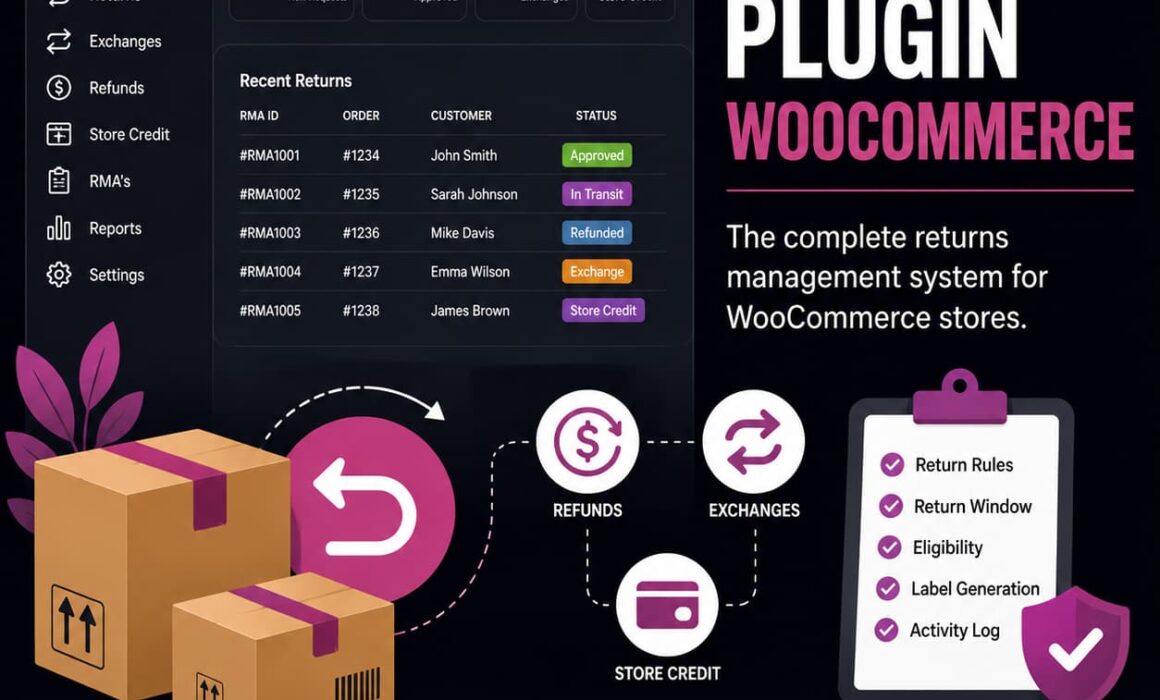
Returns Plugin WooCommerce: A Better Way to Manage Returns, Refunds and Exchanges
Choosing the right returns plugin WooCommerce stores can depend on is not just about giving customers a return form. Returns affect cash flow, admin workload, stock accuracy, customer retention, support time and profit. If your current process relies on inbox replies, manual order notes and staff memory, the return itself is not the problem. The process is.
For serious WooCommerce stores, returns need to be handled as an operational workflow. Customers need a clear way to request a return, refund or exchange. Store teams need rules, visibility, labels, activity history and flexible resolution options. RMA Pro for WooCommerce is built for that reality: it helps store owners manage returns, refunds, exchanges, store credit, return rules, labels and RMA records from a more structured system.
Why a returns plugin WooCommerce store owners choose should solve the full workflow
A return is rarely just a refund. In a real ecommerce store, a customer might want to exchange a size, swap a colour, return one product from a larger order, ask for store credit, report a fault or request a label. The store then needs to check eligibility, confirm the return window, decide the resolution, update the customer, receive the item, process the outcome and keep a record of what happened.
That is why basic return request forms often fall short. They collect information, but they do not properly manage the work that follows. The admin burden simply moves from the customer to your team.
A proper WooCommerce returns plugin should help with the full journey:
- Customer return requests
- Refunds and exchanges
- Store credit options
- Return eligibility rules
- Return labels
- Admin statuses
- Activity logs
- Operational visibility
For small stores, manual returns might feel manageable. For growing WooCommerce stores, they quickly become inconsistent, expensive and difficult to track.
Returns are an operational problem, not just a refund problem
Many WooCommerce store owners underestimate returns because they view them as a financial transaction. A customer sends something back, the store issues a refund, and the case is closed. That is only one part of the picture.
Every return touches several parts of the business:
- Customer service: answering questions, confirming eligibility and handling updates.
- Fulfilment: managing parcels, labels, returned stock and replacement shipments.
- Finance: issuing refunds, partial refunds, store credit or exchange adjustments.
- Stock control: deciding whether returned items can be resold.
- Retention: keeping the customer happy enough to buy again.
- Abuse prevention: spotting customers or products that create avoidable return costs.
If your returns process does not bring those parts together, staff end up rebuilding the process manually every time. One return is handled by email. Another sits in order notes. Another gets refunded without checking the item. Another customer receives a replacement before the returned item arrives. That inconsistency is where costs creep in.
RMA Pro gives WooCommerce stores a more controlled return management system, so the return is treated as a structured case rather than a loose message.
Basic WooCommerce Returns Plugins vs RMA Pro
Many plugins add returns to WooCommerce at a surface level. They may let a customer submit a request, but they do not always give the store enough control over rules, exchanges, store credit, labels and internal visibility. That difference matters once return volume increases.
| Feature or workflow | Basic WooCommerce Returns Plugins | RMA Pro |
|---|---|---|
| Return request form | Usually available, but often limited to collecting a basic reason. | Provides a more structured RMA workflow for return handling. |
| Refunds and exchanges | Often refund-focused, with exchanges handled manually. | Supports returns, refunds, exchanges and store credit workflows. |
| Mixed return outcomes | Can become awkward when one order needs multiple resolutions. | Better suited to real ecommerce cases where different items need different outcomes. |
| Return rules | Often uses simple global settings. | Rules help control eligibility, return windows and abuse-prevention scenarios. |
| Store credit | Often missing or disconnected from the returns process. | Store credit can help retain revenue and encourage repeat purchases. |
| Customer portal | May be basic and form-led. | Gives customers a clearer way to request and follow return outcomes. |
| Return labels | Often requires manual label handling or another tool. | Return label and Shippo support can help streamline return fulfilment. |
| Activity logs | Usually limited or dependent on order notes. | Activity history improves visibility, accountability and support consistency. |
How RMA Pro works as a returns plugin WooCommerce stores can scale with
RMA Pro is designed for WooCommerce stores that need more than a basic returns form. It gives store owners and ecommerce managers a clearer way to handle return requests, refunds, exchanges, store credit and return rules from one operational flow.
The commercial value is not just in having more features. It is in reducing the number of disconnected steps staff have to manage manually. A return request should not require someone to search through emails, check policy pages, calculate values manually, create labels in another system, update order notes and then hope the next person understands what happened.
With RMA Pro for WooCommerce, the aim is to make the return process more consistent. Customers submit clearer requests. Admins get better visibility. Rules help control eligibility. Store credit and exchanges create alternatives to refunds. Activity logs keep the process easier to follow.
Commercial point: the right returns system does not just reduce support work. It helps keep more value inside the business by making exchanges and store credit easier to offer where appropriate.
Why basic WooCommerce returns plugins are often too limited
Basic returns plugins usually solve the first visible problem: customers need a way to request a return. That is useful, but it is only the beginning.
The real problems appear after the request is submitted:
- Staff need to check whether the item is eligible.
- The customer may want an exchange rather than a refund.
- The order may include several products with different outcomes.
- The return may involve a high-risk customer.
- The customer may need a label.
- The store may want to offer credit instead of refunding.
- The team needs a record of decisions and status changes.
A basic form does not solve those problems. It collects the message and leaves the store to do the thinking manually. That is fine for occasional returns, but weak for stores with regular order volume.
RMA Pro is built around the operational layer. It helps WooCommerce stores create a more controlled process around returns rather than relying on staff to remember the policy, interpret the request and manually rebuild the workflow each time.
Return rules help protect profit and reduce abuse
Not every return should be treated the same. A loyal customer who accidentally ordered the wrong size is not the same as a repeat returner who regularly sends back most of what they buy. A full-price product is not the same as a clearance item. A UK return may not need the same window or handling process as an international return.
Return rules matter because they let store owners apply more realistic policy controls. Instead of using one blunt return policy across every scenario, rules can help shape eligibility based on how the store actually operates.
For example, a WooCommerce store may want to:
- Restrict returns on final-sale products.
- Offer different return windows by zone.
- Give VIP customers a longer return window.
- Limit certain resolution methods for high-risk customers.
- Apply different rules to different product categories.
Scenario: a high-risk customer controlled through rules
A customer repeatedly places large orders, returns nearly everything and creates support work each time. A basic plugin may continue offering the same return options automatically. With a rules-based system, the store can control eligibility more carefully and reduce avoidable margin loss.
Scenario: a VIP customer receiving an extended return window
A loyal customer rarely returns items and spends regularly. Extending their return window can be commercially sensible because it protects the customer relationship. With better return rule control, the store can be flexible without weakening the policy for everyone.
Exchanges help protect revenue when customers still want to buy
One of the biggest mistakes in return management is treating every return as a lost sale. Many returns happen because the customer chose the wrong size, colour, variant or product type. They may still want to buy from the store. They just need the right replacement.
If your return workflow pushes them straight towards a refund, the business loses revenue unnecessarily. An exchange gives the customer a practical fix while keeping the sale alive.
This is particularly important for stores selling products with variants, such as:
- Clothing and footwear
- Dog collars, harnesses and accessories
- Homeware
- Beauty and wellness products
- Electronics accessories
- Products with size, colour or compatibility options
A WooCommerce returns and exchanges plugin should make exchanges part of the return process, not a manual workaround handled through email.
Scenario: a mixed return with exchange and refund
A customer buys three items. One is the wrong size and needs exchanging. One is unwanted and needs refunding. One is being kept. A basic return form may turn this into a messy email thread. A structured RMA system gives staff a clearer way to handle different outcomes within the same order context.
This is the kind of scenario that separates a basic plugin from a proper return management system for WooCommerce.
Store credit gives customers a reason to come back
Store credit is useful because it creates a middle ground between a refund and an immediate exchange. Sometimes the customer does not want a direct replacement, but they are still open to buying something else later.
Without store credit, staff often rely on manual discount codes or refunds. Discount codes can be clumsy and hard to control. Refunds remove value from the business entirely.
Store credit can help retain revenue while giving the customer flexibility. It works well when:
- The customer likes the brand but not the specific product.
- The replacement item is not currently available.
- The customer wants time to choose something else.
- The store wants to offer a goodwill resolution without losing the customer.
Scenario: store credit used to retain revenue
A customer returns a £75 item but still wants to shop with the brand. A refund sends the £75 out of the business. Store credit keeps that value available for a future order and increases the chance the customer comes back. The customer still gets a fair outcome, but the store protects more of the original sale value.
RMA Pro helps make store credit part of the return workflow rather than a disconnected manual fix.
The customer returns portal reduces support friction
Customers do not enjoy asking for returns. They want the process to be simple, clear and predictable. If they have to email support, wait for a reply, provide order details manually, ask for instructions and chase for updates, the experience feels weaker than it needs to be.
A customer returns portal improves that experience by giving customers a defined place to start. It also helps the store because the request is submitted in a more structured format.
That reduces the common support loop:
- “What is your order number?”
- “Which item are you returning?”
- “Do you want a refund or exchange?”
- “Can you confirm the reason?”
- “Can you send photos?”
When information is captured more clearly at the start, staff can process requests faster. Customers get fewer back-and-forth messages. The business looks more organised.
That matters because returns are part of the buying experience. A customer who has an easy return may still buy again. A customer who feels ignored or confused is less likely to come back, even if the product was good.
Return labels and Shippo support improve the fulfilment workflow
Return labels can become a surprisingly time-consuming part of ecommerce admin. Staff may need to create labels manually, email them to customers, update the order, track the returned parcel and match it against the request when it arrives.
That is manageable at low volume, but it becomes messy as order numbers grow. Labels end up separated from the return request. Parcels arrive without clear context. Customers chase support before the team has matched the returned goods.
RMA Pro’s return label and Shippo support can help reduce that friction by bringing the label process closer to the return workflow. This helps teams handle returns with fewer disconnected steps.
The operational benefit is simple: less manual handling, fewer mistakes and a clearer process for staff and customers.
Activity logs make return decisions easier to track
Manual return handling often fails because nobody has a complete view of what happened. One staff member agrees an exchange. Another issues a refund. A third checks the parcel. The customer then asks for an update and everyone has to piece the story together from emails and notes.
Activity logs help solve this by keeping better visibility over the RMA record. They make it easier to understand the timeline of the return and reduce confusion when multiple people are involved.
This is especially useful for:
- Busy ecommerce teams
- Stores with multiple support staff
- Disputed returns
- High-value products
- Returns involving exchanges or store credit
- Managers reviewing customer service consistency
A return management system should not only help customers submit requests. It should also help the business understand and control what happened after the request was made.
Return windows by zone give stores more operational flexibility
A single return window is easy to explain, but it does not always reflect real fulfilment conditions. Domestic orders, international orders, remote zones and delayed delivery areas may need different handling.
Return windows by zone can give stores more flexibility. For example, a UK customer may have a standard return window, while customers in another region may need a slightly different policy because shipping times are longer. This can make the policy fairer without creating unnecessary admin exceptions.
The key is control. Instead of staff making case-by-case decisions manually, the return system can support rules that better match the store’s fulfilment reality.
For ecommerce managers, this is useful because it reduces policy ambiguity. Staff have clearer guidance, customers get a more appropriate experience, and the store avoids applying a one-size-fits-all policy where it does not make sense.
Automation matters when WooCommerce returns start to scale
Manual returns do not scale well. At first, a shared inbox and a few order notes may be enough. Then return volume increases, staff get busier, customers chase updates and mistakes become harder to avoid.
Automation matters because it reduces repeated admin. It does not remove human judgement. It simply gives the team a better framework for handling common return workflows.
A more automated returns process can help with:
- Reducing repetitive customer service messages
- Applying return rules more consistently
- Improving visibility across the admin team
- Making exchanges and store credit easier to process
- Reducing mistakes during busy periods
- Improving customer confidence after purchase
This is where RMA Pro becomes useful for serious WooCommerce stores. It is not just adding a return button. It is helping create a more reliable return management workflow around the business.
How to decide if your store needs a better returns plugin WooCommerce setup
If returns are rare and simple, your current process may be enough. But if staff are spending time chasing information, checking eligibility manually, calculating exchange outcomes or searching through email threads, the cost is already there. It is just hidden inside admin time.
Your store probably needs a stronger returns plugin WooCommerce setup if:
- Customers regularly ask for exchanges.
- Support staff handle returns manually by email.
- Refunds are being issued when store credit or exchange would be better.
- Return policies differ by product, customer or region.
- Returned parcels are hard to match to requests.
- Multiple staff members need visibility over the same return.
- You want better control over abuse or high-risk customers.
- Your return volume is increasing as the store grows.
The right plugin should reduce operational drag, improve the customer journey and protect more revenue from unnecessary refunds.
Build a WooCommerce returns process that protects admin time and revenue
Returns are unavoidable, but a weak returns process is optional. If your store treats every return as a manual support issue, you lose time, visibility and often revenue. A better system gives customers a clearer route and gives your team a more controlled way to manage each outcome.
RMA Pro brings returns, refunds, exchanges, store credit, rules, labels and activity history into a more practical WooCommerce workflow. That makes it a stronger fit for stores that have outgrown basic return forms and want more operational control.
If your store needs a more serious return management system for WooCommerce, RMA Pro is built to help you manage returns properly while keeping more value inside the business.