
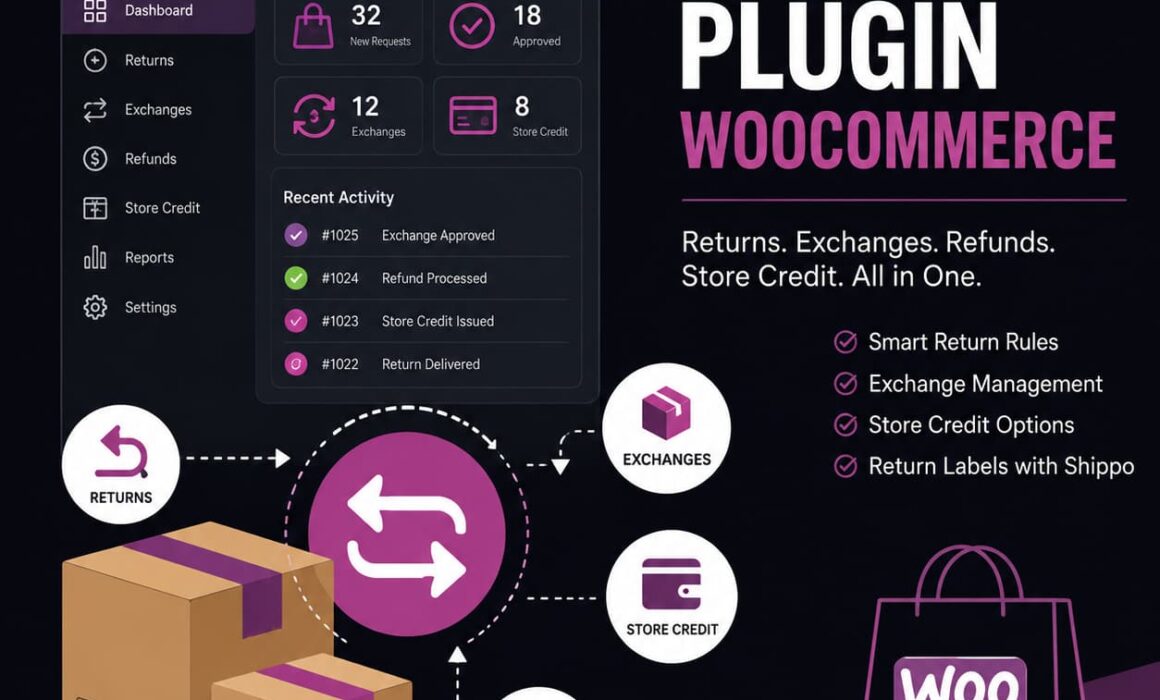
Exchange Plugin WooCommerce: A Better Way to Manage Returns, Refunds and Exchanges
Finding the right exchange plugin WooCommerce stores can actually rely on is harder than it should be. Most return tools focus on refunds, but real ecommerce returns are messier than that. Customers want different sizes, alternative colours, partial refunds, store credit, return labels, status updates and clear communication. Store owners need control, visibility and protection from abuse. When exchanges are handled badly, revenue leaks out of the business and admin time disappears into email threads.
For serious WooCommerce stores, exchanges are not just a customer service feature. They are a revenue protection workflow. A good exchange system helps keep the order value inside the business while giving customers a practical way to fix the purchase instead of walking away entirely.
Why an exchange plugin WooCommerce stores use needs to do more than process refunds
A refund is simple on paper. A customer returns an item, the store sends money back, and the transaction ends. An exchange is more commercially useful, but operationally more complex. The store has to check eligibility, understand what is being returned, calculate the value available, manage replacement products, handle any difference in value, record the decision, and keep the customer informed.
That is why a basic returns form is rarely enough. A form can collect a message, but it does not manage the process. It does not understand return windows, product rules, exchange values, partial outcomes, customer risk, store credit or fulfilment steps. It simply moves the problem from the customer to the admin inbox.
RMA Pro for WooCommerce is built around the reality that returns are operational. It gives WooCommerce store owners a structured way to manage returns, refunds, exchanges, store credit, labels, rules and activity history from one workflow.
If your store only receives the odd return, a basic form may be enough. If you are dealing with regular ecommerce returns, size exchanges, product swaps, customer queries and refund decisions, you need a proper WooCommerce returns and exchanges plugin that is designed for the full process.
What makes exchanges different from standard WooCommerce refunds?
WooCommerce has native refund tools, but they are mostly admin-side accounting actions. They are not designed to give customers a guided exchange journey. That gap matters because customers rarely think in admin terms. They do not say, “I need a manually adjusted refund against line item three.” They say, “I need the same product in a bigger size.”
That customer request creates several decisions for the store:
- Is the product still inside the return window?
- Is the item eligible for exchange?
- Is the replacement product available?
- Is there a price difference?
- Should the customer receive store credit for any balance?
- Does the customer need a return label?
- Should this customer be allowed to return again?
Without a structured exchange workflow, staff often handle this through email, order notes, spreadsheets and manual refunds. That works until volume increases, multiple staff get involved, or a customer disputes what was agreed.
An effective exchange plugin WooCommerce store owners can depend on should turn that messy decision-making into a managed process. It should help the customer request the right outcome and help the store process it without losing track of values, items, statuses or history.
Basic WooCommerce Returns Plugins vs RMA Pro
Many WooCommerce return plugins look useful at first glance because they add a returns request form. The problem appears later, when the store needs proper exchange handling, eligibility rules, store credit, return labels and operational visibility.
| Feature or workflow | Basic WooCommerce Returns Plugins | RMA Pro |
|---|---|---|
| Exchange requests | Often basic or handled as notes on a refund request. | Built for returns, refunds, exchanges and store credit workflows. |
| Mixed return outcomes | Usually awkward if one item needs a refund and another needs an exchange. | Supports more practical RMA handling for real-world return scenarios. |
| Rules and eligibility | Limited rules or blanket settings. | Return rules help control eligibility, windows and customer-specific scenarios. |
| Store credit | Often unavailable or disconnected from the return process. | Store credit helps retain revenue instead of losing the customer to a refund. |
| Activity logs | Often limited to order notes or basic status changes. | Activity history gives staff better visibility over what happened and when. |
| Return labels | May require a separate manual process. | Return label and Shippo support can help streamline fulfilment workflows. |
| Operational scalability | Suitable for low-volume stores with simple requirements. | Better suited to serious WooCommerce stores that need control and consistency. |
How RMA Pro turns exchanges into a managed WooCommerce workflow
RMA Pro gives customers a clearer way to raise return and exchange requests, while giving the store a more controlled admin process behind the scenes. That matters because the customer-facing experience and the internal workflow need to match. A polished form is not useful if staff still have to manually calculate every decision afterwards.
With RMA Pro for WooCommerce, the return request becomes part of a wider RMA workflow. Instead of treating every issue as a loose message, the store can manage requests with statuses, rules, item-level detail, activity logs and outcome options.
Practical example: A customer buys three items. One is too small, one is unwanted, and one is faulty. A basic form turns that into a long email chain. A proper return management system lets the store handle the exchange, refund and review process with more structure.
This is where an exchange plugin WooCommerce stores use needs to support real behaviour, not idealised behaviour. Customers do not always make simple requests. They mix outcomes, change their minds, ask for store credit, return part of an order and expect the store to understand the full context.
Exchange plugin WooCommerce rules help prevent return abuse
Returns are part of ecommerce, but not every return should be treated the same. A first-time customer with a genuine size issue is different from a repeat returner who regularly buys multiple sizes, wears items once and sends most of them back. If your return system treats both customers identically, your margins take the hit.
RMA Pro includes return rules so stores can control eligibility more intelligently. Rules can help define what is returnable, when it is returnable, and under what conditions certain return methods should be available.
For example, a store may want to:
- Offer a standard return window for most customers.
- Give VIP customers a longer return window.
- Restrict returns on clearance or final-sale products.
- Limit exchange options for certain categories.
- Control high-risk customers more tightly.
This is not about being difficult with customers. It is about protecting the business from avoidable loss. Good customers still get a smooth process. Riskier scenarios can be handled with tighter rules instead of blunt, store-wide restrictions.
Scenario: controlling a high-risk customer
Imagine a customer who has placed six orders and returned most of them. A basic WooCommerce returns plugin may continue offering the same options every time. With a more advanced returns system, the store can apply tighter controls where appropriate, reducing the chance of repeat abuse without damaging the experience for normal customers.
Scenario: giving a VIP customer more flexibility
Now compare that with a loyal customer who spends regularly and rarely returns anything. Giving that customer an extended return window can be commercially sensible. They feel looked after, and the store protects a valuable relationship. Return windows by zone or customer logic can give stores more operational flexibility than a single blanket policy.
Exchanges protect revenue better than automatic refunds
Refunds send money out of the business. Exchanges keep the customer in the buying journey. That is why exchanges should not be treated as an afterthought.
For fashion, accessories, footwear, pet products, homeware and many other ecommerce categories, a large number of returns are not caused by the customer disliking the brand. They are caused by size, colour, fit, compatibility or expectation mismatch. In those cases, a refund may be the worst commercial outcome because the customer still wanted something from the store.
A good WooCommerce exchange plugin helps capture that intent. Instead of pushing the customer towards a refund, the process can make exchanging the item a clear and practical option.
For example:
- A customer orders a medium harness but needs a large.
- A customer orders a black item but wants the green version.
- A customer wants to swap one product for another in the same range.
- A customer returns one item but wants store credit for another purchase.
Each of those scenarios can save revenue if handled properly. The customer gets a solution, the store avoids a full refund, and the relationship continues.
If your current process turns all return requests into refunds by default, your store may be leaking revenue unnecessarily. An advanced returns system gives you more ways to resolve the issue without immediately giving up the sale.
Store credit can turn a return into a second purchase
Store credit is one of the most useful tools in return management because it gives the customer flexibility while keeping value inside the store. It is especially useful when the customer does not know what they want immediately, but is still happy to buy from you again.
Without store credit, the usual options are refund or manual discount code. Refunds reduce revenue. Manual discount codes can be clumsy, difficult to track and easy to misuse. A structured store credit workflow is cleaner.
Scenario: retaining revenue with store credit
A customer returns a £60 product. They are not ready to choose an exchange today, but they still like the brand. If the store issues a refund, the money leaves the business and the customer may buy elsewhere. If the store offers store credit, the customer has a reason to come back and place another order.
That does not mean store credit should replace refunds in every case. It means stores should have the option available when it makes commercial sense. RMA Pro helps make store credit part of the return workflow rather than a separate manual workaround.
The customer portal matters because returns are part of the buying experience
Customers judge a store by what happens after the sale, not just by the product page. If a customer has to email support, wait for a reply, explain the order, send photos, ask what happens next, and chase for updates, the experience feels unprofessional even if the final outcome is fair.
A returns portal improves that experience because it gives customers a clear place to start. They can submit the request in a more structured way, and the store receives information in a format that is easier to process.
That has a direct admin benefit. Staff spend less time asking for missing information and more time resolving requests. It also reduces customer anxiety because the process feels controlled rather than improvised.
For WooCommerce stores trying to grow, this matters. A poor returns experience can stop customers ordering again. A clear exchange process can do the opposite. It reassures customers that if they choose the wrong size or variant, the store has a proper process in place.
Return labels and Shippo support reduce fulfilment friction
Return labels are often where the operational drag begins. A customer asks how to send something back. Staff manually create a label, email it over, update the order, and then try to connect the returned parcel to the right request when it arrives.
That workflow is manageable at low volume. At scale, it becomes messy. Parcels arrive without context, staff search emails, and customers chase updates because nobody is sure where the return sits.
RMA Pro’s return label and Shippo support can help make that process more consistent. The value is not just label generation. The value is reducing disconnected admin steps so the return sits closer to the RMA workflow.
For ecommerce teams, fewer disconnected steps means fewer mistakes. It also makes training easier because staff are not relying on someone remembering the “usual way” of handling labels.
Activity logs give staff the visibility manual returns lack
One of the biggest problems with manual return handling is that important decisions get buried. A customer emails support. Someone replies. Another staff member checks the order. A refund is discussed. An exchange is agreed. Then a week later, nobody can remember exactly what happened.
Activity logs solve a practical problem: accountability. They help staff see what changed, when it changed and what stage the request is at. This matters when:
- A customer contacts support for an update.
- Multiple staff members process returns.
- A customer disputes what was agreed.
- A manager wants to understand return volume and patterns.
- The store needs consistency across busy periods.
Basic plugins often focus on the request submission. RMA Pro focuses more on the operational journey after submission. That is the part that tends to cost the store time and money.
Mixed return scenarios need a better WooCommerce exchange plugin
Real orders do not always fit neat categories. A customer may want to exchange one item, refund another and keep the rest. If the system cannot handle that clearly, staff have to create a workaround.
Scenario: mixed exchange and refund in one request
A customer orders three dog accessories. The collar is the wrong size, so they want to exchange it. The lead is no longer needed, so they want a refund. The patch is correct, so they are keeping it. A weak process turns this into a long support thread with manual notes. A stronger RMA workflow gives the store item-level context and a clearer path to process each part of the request.
This is why an exchange plugin WooCommerce stores choose should not assume every return has one outcome. Serious stores need flexibility because customers buy in bundles, variants and mixed baskets.
Automation matters more as your store scales
Manual return handling often feels fine until growth exposes the cracks. Ten returns per month can be handled in an inbox. Fifty returns per month starts to create mistakes. Hundreds of returns per month can overwhelm a team if there is no system.
Automation does not mean removing human judgement. It means removing repetitive admin from the process so staff can focus on the decisions that actually need attention.
RMA Pro helps by making the returns process more structured. Rules, statuses, portal submissions, labels, store credit and logs all reduce the need for staff to rebuild the process from scratch each time.
That has a commercial impact. Faster handling reduces customer frustration. Better rules reduce abuse. Exchanges reduce refunds. Store credit improves retention. Clearer visibility reduces internal mistakes.
Choosing an exchange plugin WooCommerce stores can grow with
When choosing an exchange plugin WooCommerce stores should look beyond the first request form. The real question is what happens after the customer submits the request.
Ask whether the plugin can support:
- Refunds and exchanges, not just simple returns.
- Store credit where commercially useful.
- Rules for product, customer or policy control.
- Return windows that reflect real operational needs.
- Activity logs for visibility and accountability.
- Return labels and fulfilment workflow support.
- A customer portal that reduces support friction.
- Admin workflows that still make sense as volume grows.
If a plugin cannot support those areas, it may still work for a very small store. But it may also become the reason returns remain slow, inconsistent and expensive as the business grows.
Build a returns process that keeps more revenue in the business
Returns are never going to disappear, but the way your store handles them can change the outcome. A refund-first process sends customers and revenue away too quickly. A better exchange workflow gives customers a practical solution while helping the store protect margin, reduce admin and keep clearer control over return decisions.
RMA Pro is built for WooCommerce stores that need more than a basic returns form. It gives store owners a more complete way to handle returns, refunds, exchanges, store credit, return rules, labels and activity history in one structured workflow.
If your store is starting to outgrow manual returns or basic refund request tools, take a closer look at RMA Pro for WooCommerce and build an exchange process that works properly for both customers and the business.