
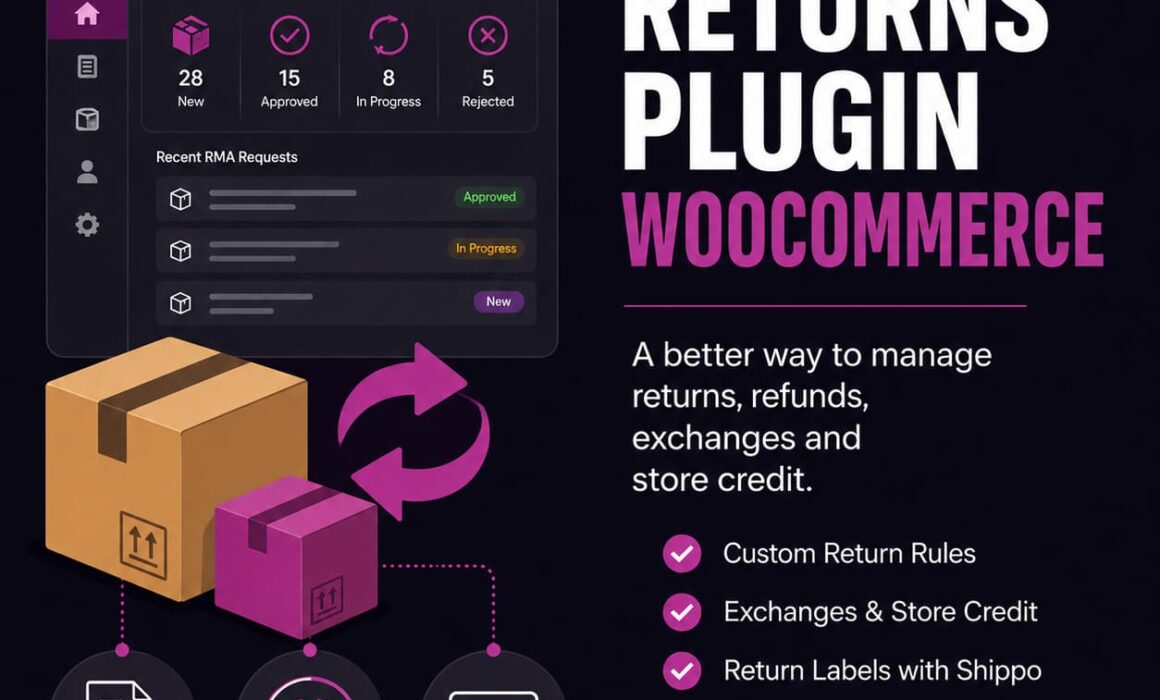
Returns Plugin WooCommerce: A Better Way to Manage Returns, Refunds and Exchanges
Choosing a returns plugin WooCommerce stores can actually rely on is not just about giving customers a button to request a refund. Returns affect stock, cash flow, customer service workload, abuse prevention, exchange revenue and customer retention. If the process is too basic, the admin burden simply moves from the customer to your team.
That is where many WooCommerce stores start to feel the pain. A return request comes in, then a second email follows, then a customer wants an exchange instead of a refund, then the original order has multiple items, different return reasons and maybe a paid return label. At that point, a simple form is not a returns system. It is just another inbox queue.
Why a returns plugin WooCommerce stores use needs to handle operations, not just refunds
Returns are often treated as a customer service issue, but for ecommerce stores they are an operational issue first. A refund request touches the order, payment, stock, shipping, fulfilment, customer communication and sometimes accounting. If the system does not control those steps properly, the process becomes inconsistent very quickly.
A basic WooCommerce refund plugin may let a customer submit a request, but that does not mean it can support how real stores work. Most store owners need to answer practical questions every day:
- Is this product still inside the return window?
- Should this customer be allowed to return this item?
- Is the customer asking for a refund, exchange or store credit?
- Does this return need a label?
- Has the team already approved, rejected or partly processed the request?
- Should the return be treated differently because of the order value, product type or customer history?
Without a proper return management system, those decisions are made manually. That creates delays, mistakes and inconsistent customer experiences. For small stores, that is annoying. For growing WooCommerce stores, it becomes expensive.
RMA Pro for WooCommerce is designed around the idea that returns should be managed as a controlled workflow, not a loose conversation between the customer and the store.
returns plugin WooCommerce features that matter once your store starts scaling
The right returns plugin WooCommerce store owners choose should do more than collect return requests. It should reduce avoidable admin, guide the customer, protect the business and give the team enough visibility to act quickly.
There is a big difference between a return form and an RMA workflow. A return form records a problem. An RMA workflow helps resolve it.
Practical ecommerce point: the commercial cost of returns is rarely just the refund itself. It is the time spent checking eligibility, chasing information, creating labels, updating customers, correcting errors and losing revenue that could have been retained through an exchange or store credit.
For example, a clothing store may receive a return request for three items from one order. The customer wants to refund one item, exchange another for a different size and keep the third. A basic system may force the store to handle that manually. A stronger returns system gives the customer a structured way to request what they need and gives the admin team a cleaner route to process the outcome.
This matters because customers do not judge a return by how your backend works. They judge it by whether the process is clear, fair and fast. Your team, however, needs enough control behind the scenes to avoid expensive mistakes.
Basic WooCommerce returns plugins vs RMA Pro
Many WooCommerce returns plugins are fine for very simple refund workflows. They may be enough if you sell a small number of products, process low return volumes and do not need exchanges, store credit, return rules or labels. The problem is that ecommerce usually becomes more complicated as soon as sales increase.
| Area | Basic WooCommerce Returns Plugins | RMA Pro |
|---|---|---|
| Return requests | Often limited to simple refund forms. | Structured RMA requests for returns, refunds, exchanges and store credit. |
| Rules and eligibility | Usually basic return windows or manual approval. | Advanced rules help control eligibility by product, customer, order, return zone and other conditions. |
| Exchanges | Often unsupported or handled manually. | Exchange workflows help retain revenue instead of defaulting every request to a refund. |
| Store credit | May not be included. | Store credit can keep value inside the business and encourage the customer to buy again. |
| Admin visibility | Limited notes or status tracking. | Activity logs and RMA records help the team see what happened and when. |
| Labels and shipping | Often manual or disconnected from the request. | Return label support and Shippo integration help streamline fulfilment workflows. |
| Best fit | Small stores with very simple return needs. | Serious WooCommerce stores that need control, automation and better customer handling. |
How RMA Pro reduces admin workload
Admin workload grows when decisions are unclear. If staff have to check order dates, customer history, item eligibility, return reasons, previous messages and internal notes manually, every return becomes slower than it needs to be.
A good WooCommerce returns plugin should remove repetitive decision-making wherever possible. RMA Pro does this by giving the store a controlled process for return requests rather than relying on scattered emails and manual order notes.
Instead of asking the customer to email support with a vague message such as “I want to return this”, the customer can use a guided returns portal. That gives the store more structured information from the start. The admin team can then review the request, see the relevant items, understand the requested resolution and process the next step without rebuilding the whole situation from scratch.
For example, if a customer submits a return because a product is the wrong size, the team can see whether an exchange makes sense. If the customer wants a refund, the store can process that route. If store credit is better commercially, the store has a way to offer that too.
This is the difference between reacting to messy support messages and managing returns through a repeatable workflow.
The returns portal improves customer experience without giving away control
Customers want a return process that is clear. They do not want to search through policy pages, send multiple emails or wait days just to find out whether they are allowed to return an item.
However, store owners also need control. A generous returns experience should not mean every order is automatically eligible, every customer gets the same terms or every return becomes a refund by default.
The customer-facing returns portal in RMA Pro for WooCommerce helps bridge that gap. Customers get a cleaner route to submit requests, while the store keeps control through settings, statuses and rules.
That matters because a confused customer usually creates more work. They email support, message on social media, reply to dispatch emails or open payment disputes. A structured portal reduces that friction by giving them a clear place to start.
From an ecommerce perspective, that is not just “better customer experience”. It is fewer support tickets, fewer repeated questions and fewer cases where a customer feels ignored because nobody has yet pieced together the full request.
Using rules to control eligibility and reduce return abuse
Return abuse does not always look dramatic. It can be a customer repeatedly buying multiple sizes and returning most of them, someone trying to return outside the policy window, or a buyer expecting exceptions every time they order.
Manual checks can catch some of this, but manual checks are inconsistent. One admin may approve a return that another would reject. A busy support team may miss a pattern. A VIP customer may deserve more flexibility, while a high-risk customer should be handled more carefully.
Rules are where a serious return management system for WooCommerce becomes valuable. RMA Pro can help store owners define return behaviour based on business logic rather than relying on memory.
Scenario: a high-risk customer
A customer has a history of repeated returns and borderline policy requests. With a basic plugin, the team may only realise that after manually reviewing past orders. With rules and better visibility, the store can apply tighter controls and avoid approving every request by default.
Scenario: a VIP customer
A loyal customer with high lifetime value may deserve a longer return window or more flexible handling. That is commercially sensible. Losing a strong customer over a rigid return process can cost more than the return itself.
This is where return windows by zone and conditional handling can support a more realistic policy. Not every product, customer or location needs the same return rules. A store shipping nationally and internationally may need different windows, label handling or eligibility logic depending on fulfilment realities.
Exchanges protect revenue better than automatic refunds
Refunds remove revenue. Exchanges can preserve it.
That sounds obvious, but many WooCommerce stores still run return processes that push customers towards refunds because exchanges are too awkward to manage manually. If a customer bought the wrong size, colour or variation, refunding them may be the easiest admin route, but it is not always the best commercial route.
A WooCommerce returns and exchanges plugin should make it practical to offer exchanges without creating chaos. RMA Pro helps stores manage exchange requests as part of the return workflow, which means the team can handle customer intent more accurately.
Scenario: mixed return with exchange and refund
A customer buys three items:
- A jacket they want to exchange for a different size.
- A pair of trousers they want refunded.
- A T-shirt they are keeping.
In a basic setup, this often becomes a messy support thread. The team may need to manually calculate values, confirm what is coming back, create a replacement order, issue a partial refund and keep notes somewhere on the order.
With a more advanced returns system, the workflow can separate what is being refunded from what is being exchanged. That gives the store a clearer view of the value involved and reduces the chance of over-refunding or missing part of the request.
The commercial benefit is straightforward: exchanges keep the customer active and help protect order value. A refund ends the transaction. An exchange keeps the relationship moving.
Store credit keeps value inside the business
Store credit is not suitable for every return, but it can be a useful retention tool when used properly. If a customer likes the brand but picked the wrong item, store credit gives them a reason to buy again instead of taking the money elsewhere.
For ecommerce stores, this matters because the original acquisition cost has already been paid. If you spent money through SEO, paid ads, email marketing or social content to win the customer, losing the full order value through a refund is painful. Store credit gives the store a chance to recover that value.
Scenario: retaining revenue with store credit
A customer returns a product because the fit is not right, but they still like the brand. Instead of refunding the order completely, the store offers store credit. The customer uses that credit towards another product, spends slightly more than the credit value and remains engaged with the store.
That is a better outcome than a straight refund. The customer gets a fair resolution, and the store has a path to preserve revenue.
RMA Pro includes store credit workflows so this can be handled as part of the return process rather than as a manual workaround.
Return labels and Shippo support make the workflow easier to manage
Return labels are one of the areas where manual handling becomes frustrating quickly. If the customer needs a label, the team has to create it, send it, track it and make sure the right request is updated. If the store handles labels separately from the RMA record, mistakes become more likely.
For stores using shipping tools, label support is not just a convenience. It is part of keeping the return process connected. RMA Pro’s return label and Shippo support can help streamline the workflow so the operational side of returns is not detached from the customer request.
This becomes especially important when return volume increases. One or two manual labels a week may be manageable. Dozens of labels, different return reasons and multiple admin users quickly become harder to track.
For reference, WooCommerce’s own refund documentation explains the native refund process, but native WooCommerce does not provide a complete RMA workflow by itself: WooCommerce refunds documentation.
Activity logs improve visibility across the whole team
Returns often go wrong when nobody knows who did what. A customer says they were promised an exchange. A team member approved a request. Another team member issued a partial refund. Someone else generated a label. Without a clear activity history, the store has to reconstruct the timeline manually.
Activity logs help prevent that. They give the team a record of key actions, which is useful for customer service, dispute handling and internal accountability.
This is particularly useful when more than one person works on support. A single store owner may remember most return conversations. A team of three, five or ten people will not. The return record needs to show enough context for the next person to pick it up without starting again.
That is why visibility is a serious operational feature. It reduces duplicated work, improves handovers and gives managers a clearer view of what is actually happening inside the returns process.
Why automation matters as WooCommerce stores grow
Manual workflows feel flexible at first. You can make judgement calls, reply personally and handle exceptions. The problem is that manual flexibility does not scale well.
As order volume grows, every manual return check becomes a repeated cost. Every unclear policy creates another support ticket. Every refund or exchange handled outside a proper system increases the risk of errors.
Automation does not mean removing judgement. It means giving the store a framework so the easy decisions are handled consistently and the team can focus on the cases that actually need attention.
For a serious WooCommerce store, this is where the right WooCommerce returns plugin becomes part of the wider ecommerce operation. It supports customer service, protects revenue, reduces admin and helps the business apply its return policy more consistently.
Less manual checking
Rules and structured requests reduce the need to review every return from scratch.
Better customer clarity
A returns portal gives customers a clear route instead of forcing them into support emails.
More revenue protection
Exchanges and store credit give the business alternatives to automatic refunds.
Stronger visibility
RMA records and activity logs make it easier to track actions across the team.
When a basic returns plugin WooCommerce setup is no longer enough
A basic plugin may be enough when returns are rare, products are simple and every request is handled by the same person. But there are clear signs that a store needs something more advanced.
- Customers regularly ask for exchanges instead of refunds.
- The team spends too much time checking eligibility manually.
- Different customers need different return windows or rules.
- Return labels are being created outside the main workflow.
- Support staff struggle to see the full return history.
- Store credit would help retain revenue, but there is no clean process for it.
- High-risk customers or repeated return behaviour need tighter control.
These are not edge cases for established ecommerce stores. They are normal operational problems. The issue is that many plugins are built around the simplest version of a return, while real stores need to manage the messy version.
That is why a more complete WooCommerce returns plugin can make a practical difference. It gives the store a more controlled way to manage returns without turning every request into a manual admin job.
Build a returns process that protects the customer and the store
The best returns process is not the one that approves everything. It is the one that is clear, fair, commercially sensible and manageable for the team running it.
Customers need confidence that they can request a return without friction. Store owners need confidence that return rules, exchanges, refunds, labels, store credit and admin actions are being handled properly. Both sides matter.
If your current process relies on email threads, manual notes and judgement calls every time a customer wants to return something, it is probably costing more than it looks. The right returns plugin WooCommerce stores choose should reduce that pressure, not add another layer of admin.
For stores that need a serious return management system for WooCommerce, RMA Pro for WooCommerce provides the workflows, rules, exchanges, store credit and visibility needed to manage returns with more control.