
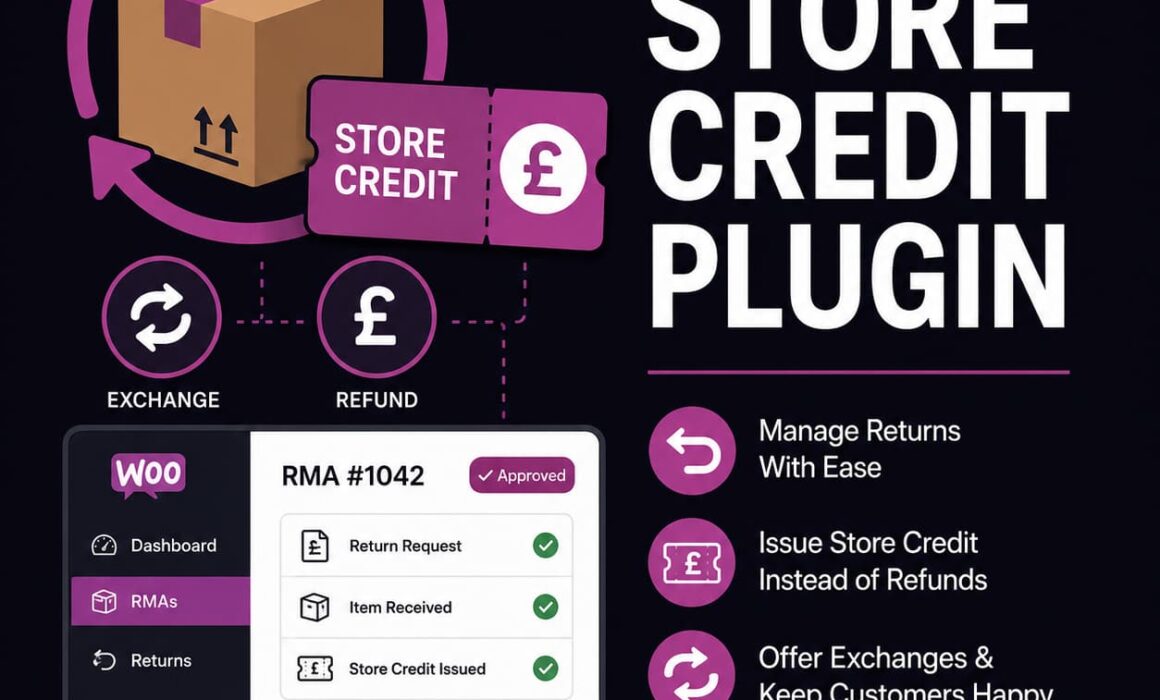
WooCommerce Store Credit Plugin: How to Turn Returns Into Retained Revenue
Returns are not just a refund problem. For a growing ecommerce store, they quickly become an operational, cash flow and customer retention problem. A WooCommerce store credit plugin gives you a way to keep value inside the business instead of sending every returned item straight back as cash. Used properly, store credit can reduce refund leakage, support exchanges, improve customer goodwill and give your team a more controlled way to manage returns.
That matters because basic refund handling in WooCommerce is not enough for serious stores. A refund closes a transaction. Store credit keeps the customer in play. When combined with a proper returns workflow, clear eligibility rules and exchange options, store credit becomes part of a return management system rather than a loose admin workaround.
Why a WooCommerce store credit plugin matters for modern ecommerce
Every store owner knows returns are part of ecommerce. The issue is not whether customers return items. The issue is how much time, money and margin each return quietly removes from the business.
In WooCommerce, the default refund tools are useful but basic. You can refund an order, adjust stock, and process payment reversals depending on the payment gateway. That is fine for the occasional return. It becomes limiting when returns become frequent, varied or operationally messy.
A WooCommerce store credit plugin changes the commercial outcome. Instead of treating every return as a straight refund, the store can issue a retained balance that the customer can spend later. That is especially useful for fashion, accessories, pet products, beauty, lifestyle, homeware and any store where sizing, colour choice, gifting or customer preference can drive returns.
The commercial difference is simple:
- A refund sends revenue out of the business.
- An exchange protects the original sale.
- Store credit keeps the customer relationship active.
- A structured returns system prevents the admin team from inventing a process every time.
This is where RMA Pro for WooCommerce is designed to help. It is not just a basic credit note tool. It combines returns, refunds, exchanges, store credit, return rules, customer portals, return labels and RMA management into one operational workflow for WooCommerce stores that need more control.
WooCommerce store credit plugin vs basic refund handling
WooCommerce can process refunds, but refund processing is only one part of the returns journey. The real work happens before and after that refund decision. Customers need to submit requests. Staff need to check eligibility. Products may need to be exchanged, inspected, restocked, partially refunded or credited. Some customers may be entitled to different return windows. Some products may need tighter controls.
Basic refund handling does not naturally support that complexity. It often leads to disconnected emails, manual notes, spreadsheet tracking and inconsistent decisions between staff members. That inconsistency can cost money.
For example, one staff member may offer a cash refund. Another may offer an exchange. Another may issue a coupon manually. None of those actions are necessarily wrong, but without a clear system, the store loses visibility and control.
A proper WooCommerce store credit plugin should do more than generate a coupon. It should fit into the return workflow, show the value available, track what has been issued, support customer communication and make it clear why the credit exists.
| Area | Basic WooCommerce Returns Plugins | RMA Pro |
|---|---|---|
| Return request handling | Often limited to simple forms or admin emails. | Structured customer return portal with RMA records and admin visibility. |
| Store credit | May rely on manually created coupons or basic credit notes. | Integrated store credit workflow connected to returns and customer outcomes. |
| Exchanges | Usually limited or handled outside the return process. | Supports exchange-led workflows to protect revenue and reduce refund loss. |
| Eligibility rules | Often too broad, with limited product or customer control. | Return rules help control eligibility, return windows and abuse risk. |
| Operational visibility | Can become fragmented across emails and order notes. | Activity logs and RMA records give staff a clearer audit trail. |
| Scalability | Suitable for light return volumes. | Built for stores that need controlled, repeatable return management. |
How a WooCommerce store credit plugin protects revenue
Refunds are sometimes unavoidable. If a product is faulty, misdescribed or the customer is legally entitled to a refund, the store needs to handle that properly. The UK government provides consumer returns guidance that store owners should understand, especially around online purchases and cancellation rights. You can review the official guidance on accepting returns and giving refunds.
But not every return needs to become a lost sale. Many ecommerce returns happen because of fit, colour, size, preference or duplicate ordering. In those cases, the customer may still want to buy from you. They just need a better route than a refund.
Store credit gives you that route. Instead of sending money back to the payment method, you can issue value the customer can use on a future order. This can be especially useful when:
- The customer likes the brand but chose the wrong size.
- The customer wants to return a gift and choose something else.
- The item is eligible for credit but not a cash refund under your policy.
- You want to encourage repeat purchase after a return.
- You want to retain margin while still giving the customer a fair outcome.
For a WooCommerce store doing meaningful order volume, even a small shift from refund to store credit can make a measurable difference. If £2,000 of monthly returns would normally be refunded, retaining even 30 percent of that as credit keeps £600 circulating inside the store. That credit may later convert into a higher value order, especially if the customer adds extra items at checkout.
Practical example: A customer returns a £65 product but accepts store credit instead of a refund. Two weeks later, they use the credit on a £92 order. The return still created admin work, but the store retained the customer and generated an additional £27 order value.
This is why RMA Pro for WooCommerce treats store credit as part of the wider RMA process. The point is not just issuing credit. The point is giving staff a controlled way to decide when credit, exchange or refund makes the most sense.
Why returns are an operational problem, not just a refund problem
Most ecommerce returns look simple from the outside. A customer sends something back. The store refunds or replaces it. Done.
Behind the scenes, it is rarely that clean. A return can involve customer service, warehouse staff, stock control, finance, shipping labels, fraud checks, customer expectations and product condition decisions. If the return is handled by email, each of those steps becomes harder to track.
A typical manual return workflow might look like this:
- The customer emails customer service.
- Staff ask for the order number.
- The customer replies later with missing information.
- Staff check the order date and product eligibility.
- Someone decides whether it should be refunded, exchanged or credited.
- The warehouse waits for the item to arrive.
- The team manually updates the order, stock and customer message.
- No one is completely sure what was promised if the customer follows up.
That is manageable at five returns a month. It is not manageable at fifty, especially during peak trading, sale periods or product launches.
A return management system for WooCommerce creates a repeatable process. Customers submit requests in a structured way. Staff see the request in context. The store can apply rules, issue store credit, process exchanges and keep activity visible.
For stores with small teams, this is often the difference between controlled admin and inbox chaos. The value is not just speed. It is consistency. When the same return types are handled the same way each time, customers get clearer answers and the business makes fewer costly mistakes.
How RMA Pro connects store credit with returns and exchanges
Store credit is most useful when it is not isolated. If it sits separately from returns, staff still have to calculate values, create coupons, update customers and keep notes manually. That leaves room for errors.
RMA Pro connects store credit to the wider return journey. A customer can submit a return request, the store can review the item, and the outcome can be handled as a refund, exchange or credit depending on the case. That makes the process more commercially flexible.
Take a mixed return. A customer orders three items:
- A jacket for £80.
- A pair of trousers for £55.
- A T-shirt for £25.
They want to exchange the trousers for a different size, return the T-shirt for store credit and keep the jacket. With a basic setup, this often turns into a messy back-and-forth email thread. Someone has to manually work out the value, create the exchange order, issue credit and update the customer.
With an advanced returns system, the workflow can be handled as part of one RMA request. Staff can see which items are involved, what value is available, what resolution applies and what action has been taken. That matters because mixed returns are common in real ecommerce. Customers do not always want one simple outcome.
This is where a WooCommerce returns and exchanges plugin becomes more useful than a single-purpose coupon tool. Store credit, refunds and exchanges need to work together because customers do not think in admin categories. They think in outcomes.
Using store credit to improve customer retention
Returns can damage customer loyalty if the process feels slow, vague or awkward. But a well-handled return can have the opposite effect. It can reassure the customer that buying from you again is low risk.
Store credit helps with retention because it gives the customer a reason to return. Instead of ending the relationship with a refund, the store creates a future purchase opportunity. That is particularly useful for stores where product discovery matters.
For example, a dog accessory store may have a customer who buys the wrong harness size. A fashion store may have a customer who likes the brand but chooses a colour that does not suit them. A homeware store may have a customer who bought a gift that was duplicated. These customers are not necessarily unhappy with the store. They need a practical route to another purchase.
A store credit workflow can support that by making the next step obvious. The customer receives credit, understands how to use it and returns to the store without needing another support conversation.
Store credit example: retaining value after a size issue
A customer buys a £48 collar but chooses the wrong size. They could request a refund, but they still want the product. The store offers either an exchange or store credit. The customer takes credit because they also want to add a lead. Their next order is £76.
Without store credit, the business may have lost the full £48 and paid the admin cost of processing the return. With store credit, the business retained the customer and created a higher value second order.
The commercial impact is not theoretical. Retention is usually cheaper than acquisition. If you have paid for the customer through Google Ads, Meta Ads, SEO or email marketing, losing them after one return is expensive. Store credit gives you a structured way to keep them engaged without forcing a cash refund as the only outcome.
Why eligibility rules matter for a WooCommerce store credit plugin
Store credit should not mean weak return controls. In fact, the opposite is true. The more flexible your returns process becomes, the more important your rules become.
Without rules, staff have to make decisions manually. That can create inconsistent outcomes. One customer gets extended credit. Another gets refused. One product is accepted even though it is outside policy. Another is rejected even though it should have been eligible. Over time, customers learn that policy depends on who answers the email.
RMA Pro helps stores use return rules to control eligibility. That can include practical conditions such as product type, order age, customer history, return windows and other criteria relevant to the store’s policy.
High-risk customer example
Suppose a customer repeatedly buys multiple sizes, wears items, then returns most of the order late. A basic returns plugin may treat that customer like everyone else. Your staff then have to notice the pattern manually.
With return rules, the store can apply tighter controls where appropriate. That might mean limiting available return methods, shortening eligibility, requiring review or preventing certain outcomes. The goal is not to punish genuine customers. It is to stop flexible returns becoming an open-ended cost.
VIP customer example
The same logic can work positively. A high-value repeat customer may deserve a more generous experience. For example, a VIP customer could receive an extended return window or be offered store credit in circumstances where a first-time customer would need manual review.
That kind of flexibility is difficult with a rigid plugin. A serious WooCommerce store does not always want one blunt return policy for every customer, every product and every region.
Return windows by zone and why they matter
Return windows are often treated as a simple number of days. In practice, geography can make that unfair or operationally awkward.
A domestic customer may be able to return an item within a few days. An international customer may face slower shipping, customs checks or regional courier delays. If your return window is too strict, you may frustrate legitimate customers. If it is too loose, you may expose the business to unnecessary stock and refund risk.
Return windows by zone give stores more operational flexibility. You can create a policy that reflects the reality of where customers are located and how long returns take to reach you.
For example:
- UK customers may have a standard return window.
- European customers may have a slightly longer window.
- International customers may need different handling due to transit times.
This matters for store credit because credit is often part of the resolution after the return is approved. If the eligibility window is wrong, the credit decision becomes messy. If the rules are clear, staff can approve or decline requests more consistently.
How return labels and Shippo support improve the workflow
A return is not complete when the customer submits the request. The item still has to come back. That is where return labels become important.
If staff manually create labels, send them by email and then update the return record separately, the process can quickly become fragmented. Customers ask where the label is. Staff check courier systems. Warehouse teams wait for parcels with limited context. Admin time creeps up.
Return label support helps connect the customer-facing process with the operational process. When return labels are part of the return management workflow, customers get a clearer next step and staff have better visibility.
RMA Pro includes return label and Shippo support to help stores streamline this part of the process. For teams already handling meaningful order volume, this can reduce repetitive admin. It also gives customers a more professional returns experience because they are not relying on a chain of manual emails.
The commercial value is straightforward. Faster return processing means products can be inspected, restocked, exchanged or credited sooner. That reduces delays and keeps the customer relationship moving.
Activity logs and visibility: the part basic plugins often miss
One of the most underrated parts of return management is the audit trail. When a customer follows up, staff need to know what happened, who approved it and what was promised.
Without activity logs, the answer may be buried in order notes, email threads, private messages or staff memory. That is not a reliable system.
Activity logs give teams visibility. They help answer practical questions:
- When was the return requested?
- Who approved it?
- Was store credit issued?
- Was an exchange selected?
- Was a return label generated?
- Has the customer already been contacted?
This is especially useful when more than one person handles customer service. If your team works across shifts, weekends or busy periods, logs reduce confusion. They also help protect the business if a customer disputes what was agreed.
For store credit, logs are particularly important because credit has value. You need to know why it was issued and what it related to. A WooCommerce store credit plugin that does not provide enough visibility can create accounting and support issues later.
Why automation matters as WooCommerce stores scale
Manual returns do not fail all at once. They fail gradually. At first, email-based returns feel manageable. Then the store grows. More orders create more returns. More returns create more support tickets. More support tickets create slower replies. Slower replies create frustrated customers. Eventually, the team is spending too much time on repetitive admin.
Automation does not mean removing human judgement. It means removing unnecessary repetition so staff can focus on the decisions that actually need attention.
In a returns workflow, automation can help with:
- Collecting structured return information.
- Applying eligibility rules.
- Showing available return methods.
- Supporting exchange and store credit decisions.
- Keeping customers informed.
- Reducing manual label handling.
- Maintaining clearer records.
The benefit is not just saving minutes. It is reducing avoidable mistakes. A missed return note, incorrect credit amount or forgotten exchange can cost more than the admin time itself. It can create duplicate work, unhappy customers and margin loss.
For serious WooCommerce stores, a plugin like RMA Pro for WooCommerce is useful because it brings those return actions into one controlled process. That is more scalable than trying to stitch together coupons, emails, order notes and manual refunds.
When store credit works better than refunds
Store credit is not always the right answer. There will always be cases where a cash refund is necessary or legally required. But there are many situations where store credit is commercially sensible and still fair for the customer.
| Scenario | Best Resolution | Why it works |
|---|---|---|
| Customer ordered the wrong size but still likes the product | Exchange or store credit | Keeps the customer buying instead of ending the sale. |
| Gift recipient wants something different | Store credit | Avoids refunding the buyer while giving the recipient choice. |
| Customer returns part of a multi-item order | Mixed refund, exchange or credit | Allows the store to handle each item based on the right outcome. |
| Customer is outside the cash refund window but still eligible for goodwill | Store credit | Provides a fair option without weakening refund policy. |
| Customer repeatedly abuses returns | Restricted return rules | Protects the business from avoidable losses. |
The key is control. Store credit should be available when it supports the customer and the business, not handed out randomly. That is why rules, logs and structured RMA handling matter.
How a customer returns portal improves the store credit experience
Customers do not want to email three times just to start a return. They want to know what they can return, what options are available and what happens next.
A returns portal improves that experience by giving customers a clear place to submit requests. It also reduces support workload because staff receive structured information rather than incomplete messages.
For store credit, the portal can make the resolution feel more legitimate. The customer is not receiving a random coupon code from a support inbox. They are moving through a proper returns process with clear outcomes.
This improves customer confidence. It also reduces the chance of customers misunderstanding the return policy. If your system can show eligible items and available options, fewer customers will submit requests that your team has to manually reject.
That is good for customer experience and good for admin workload. Nobody enjoys sending or receiving a return rejection email. Clearer eligibility at the start prevents some of those conversations from happening at all.
Why basic WooCommerce returns plugins are often too limited
Basic plugins can be fine for small stores with simple return needs. The problem is that ecommerce returns rarely stay simple as a store grows.
Common limitations include:
- Limited support for mixed return outcomes.
- Weak store credit handling.
- No meaningful rule engine.
- Poor visibility across return stages.
- Manual exchange handling.
- Limited return label workflow.
- Inconsistent customer communication.
These gaps are not just technical annoyances. They affect margin, workload and customer trust. If a plugin cannot handle real-world return scenarios, staff will build manual workarounds. Workarounds then become the real process, which defeats the point of installing a returns plugin in the first place.
RMA Pro is positioned for stores that need more than a form and a refund button. It gives WooCommerce stores a more complete operational layer for returns, exchanges and credit.
Choosing the right WooCommerce store credit plugin
When comparing options, avoid choosing purely on the phrase “store credit”. A plugin may say it supports credit, but the important question is how that credit works inside the return process.
Look for a system that can answer these questions:
- Can customers submit return requests without emailing support?
- Can staff issue store credit as part of a return workflow?
- Can the store offer exchanges as an alternative to refunds?
- Can rules control who is eligible and when?
- Can different return windows apply where needed?
- Can the team see a clear activity history?
- Can return labels fit into the process?
- Can the system support real admin workflows as the store scales?
If the answer is no, the plugin may solve a small part of the problem while leaving the operational work untouched.
Commercial test
If your team still needs a spreadsheet, manual coupon creation and long email threads to manage returns, you do not have a return management system. You have a partial tool with manual admin wrapped around it.
WooCommerce store credit plugin workflows that help serious stores
The best return workflows are clear enough for customers and flexible enough for staff. Store credit should fit into that balance.
A practical workflow might look like this:
- The customer opens the returns portal.
- They select the order and item they want to return.
- The system checks basic eligibility.
- The customer chooses from available outcomes, such as exchange, refund or store credit.
- The store reviews and approves the request.
- A return label is generated where required.
- The returned item is received and inspected.
- The agreed outcome is completed and logged.
This workflow is not complicated for the customer, but it gives the business far more control than email-based returns. It also gives staff a shared process to follow.
For example, if the customer selects store credit, the team can see that decision in the RMA context. If the customer selects an exchange, the value can be handled as part of the return outcome. If the customer requests something outside policy, rules and manual review can protect the business.
That is the practical value of using an advanced returns system rather than a basic credit plugin.
Make store credit part of a better returns strategy
A WooCommerce store credit plugin should not be treated as a standalone coupon generator. Used properly, it should be part of a wider returns strategy that protects revenue, reduces admin and gives customers a cleaner experience.
For small stores, that might mean replacing manual return emails with a structured portal. For growing stores, it might mean using rules to reduce abuse and avoid inconsistent decisions. For established WooCommerce stores, it might mean using exchanges and store credit to retain more revenue while still keeping returns fair and manageable.
The stores that handle returns well do not simply refund faster. They make better decisions. They know when to refund, when to exchange, when to issue credit and when to apply stricter rules. That is the difference between a returns process that drains the business and one that supports retention.
If your WooCommerce store is starting to outgrow manual returns, basic refund handling or loose coupon-based credit, RMA Pro for WooCommerce gives you a more complete way to manage store credit, refunds, exchanges and return workflows from one controlled system.