
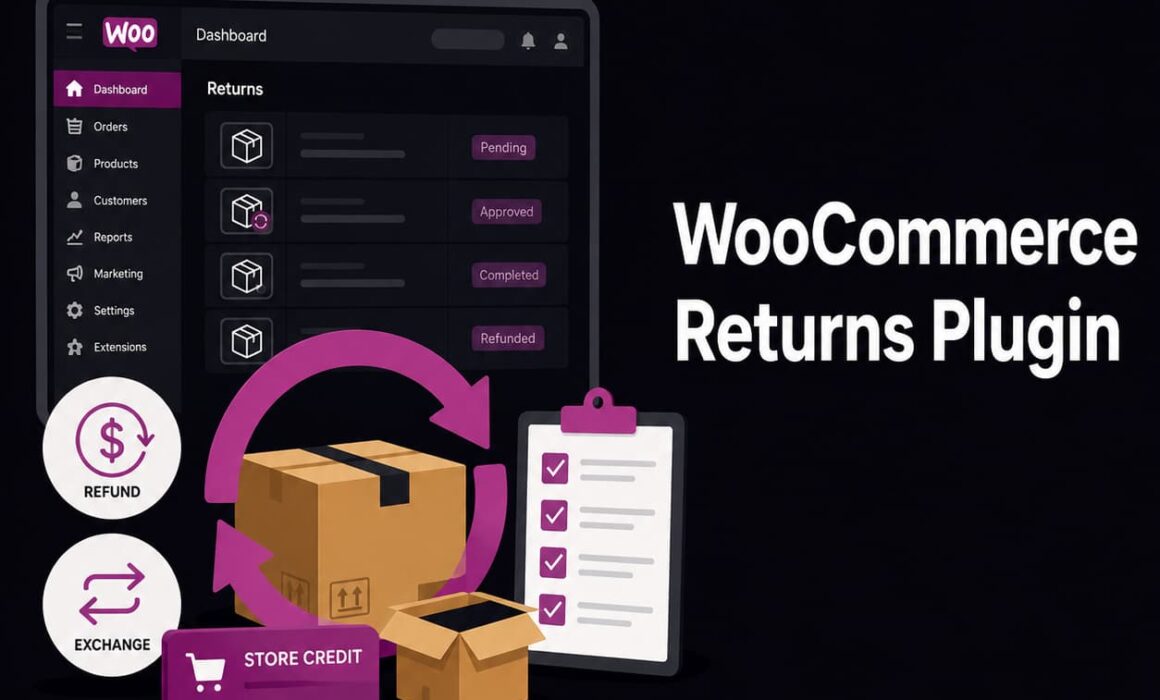
WooCommerce Returns Plugin: How to Manage Refunds, Exchanges and Store Credit Properly
A WooCommerce returns plugin should do more than let customers ask for a refund. Returns affect admin workload, stock accuracy, customer confidence, refund loss, exchange revenue, support volume and your ability to run a consistent post-purchase process.
For small stores, returns can start as a few emails and manual order notes. That works until it does not. Once return requests increase, a basic inbox-led process becomes slow, inconsistent and difficult to track. Customers chase updates, staff lose context, refunds get processed differently and exchange opportunities are missed.
That is why serious WooCommerce stores need a proper return management workflow. RMA Pro for WooCommerce is built for stores that need to manage returns, refunds, exchanges, store credit, return rules, labels and RMA activity in a more structured way.
Why a WooCommerce returns plugin matters
Returns are not just a customer service problem. They are an operational problem. Every return touches several parts of the business: support, warehouse, stock control, finance, customer retention and policy enforcement.
If your return process is handled manually, the real cost is rarely obvious at first. It appears as small fragments of wasted time:
- Support asking customers for order details that should already be available.
- Staff checking whether a product is still inside the return window.
- Manual decisions about whether a refund, exchange or credit should be allowed.
- Customers chasing because they do not know what stage their request is at.
- Warehouse teams receiving items without clear context.
- Managers struggling to see how returns are affecting revenue.
A capable WooCommerce returns plugin turns that messy process into a controlled workflow. Customers can submit requests through a returns portal. Store teams can review requests with the right order context. Rules can control eligibility. Exchanges and store credit can protect revenue. Activity logs can show what happened and when.
Commercial point: Returns are not just a cost centre. Managed properly, they can reduce admin pressure, protect revenue and improve the chance of a customer buying again.
What a basic WooCommerce returns plugin usually gets wrong
Many basic returns plugins focus on the first step: allowing a customer to submit a return request. That sounds useful, but it is only part of the job.
The difficult part is not collecting the request. The difficult part is managing what happens next. A customer may want a refund. Another may want an exchange. Another may accept store credit. One order may contain several products with different outcomes. A VIP customer may deserve a longer return window. A high-risk customer may need tighter rules.
Basic plugins often struggle because they treat returns as simple tickets. Serious ecommerce stores need a return management system that understands the operational reality behind the request.
| Area | Basic WooCommerce Returns Plugins | RMA Pro |
|---|---|---|
| Return requests | Usually provides a simple form | Provides a structured RMA request workflow |
| Refund handling | May support basic refund requests | Supports refund workflows within a wider returns process |
| Exchanges | Often limited or manually handled | Supports exchange-led resolutions for real ecommerce use cases |
| Store credit | Often missing or disconnected | Helps retain order value when credit is the better outcome |
| Rules and eligibility | Usually basic | Controls return windows, customer types, products, zones and policy logic |
| Activity history | Often minimal | Gives staff visibility over request actions and progress |
| Return labels | May require manual handling | Supports more practical label-led returns workflows |
WooCommerce returns plugin features that actually matter
Feature lists can be misleading. A plugin can claim to support returns, refunds and exchanges, but the question is whether those features help your team run the process properly.
For a store owner, the most useful features are the ones that remove repeated admin, reduce inconsistent decisions and give the customer a clearer route to resolution.
Customer returns portal
Customers submit structured requests instead of sending vague emails that staff need to decode.
Refunds and exchanges
The store can handle different resolution types without treating every return as a simple refund.
Store credit
Credit gives the business a retention route when a full cash refund is not the best commercial outcome.
Return rules
Eligibility logic helps control abuse, policy exceptions and operational edge cases.
Activity logs
Staff can see what has happened without searching through inboxes and order notes.
Return labels
Approved returns can move into the logistics stage more cleanly, with less manual instruction.
RMA Pro for WooCommerce combines these areas into a more complete returns workflow, which is what most growing stores actually need.
How a returns portal improves customer experience
A return is already a point of friction. The customer has bought something, and for some reason it has not worked out. The process after that either restores confidence or makes the problem feel worse.
Without a returns portal, customers often need to find an email address, explain the issue, provide the order number, wait for staff to reply, answer follow-up questions, then wait again. That may be acceptable for one unusual case. It is poor as a repeatable customer journey.
A returns portal gives customers a clearer route. They can start from their order, select the product, choose a return reason and request the appropriate resolution. That creates a more professional experience and gives staff better information at the start.
Before a portal
- Customer sends a vague email.
- Support asks for order details.
- Customer replies later.
- Staff manually check policy and eligibility.
- The actual return process begins after several messages.
After a portal
- Customer submits the request against the correct order.
- The store receives structured return information.
- Rules can shape what the customer is allowed to request.
- Staff can review and act with context.
That does not just save time. It makes the store feel more organised. A good WooCommerce returns plugin helps customers understand that returns are handled properly, not improvised.
Why exchanges are essential in a serious WooCommerce returns plugin
Refunds are sometimes necessary, but they are not always the best outcome. Many returns happen because the customer chose the wrong size, colour, variant or style. In those cases, the customer may still want the product. They just need a better match.
If your store only offers refunds, you may lose revenue that could have been saved through an exchange.
Practical example: mixed return and exchange
A customer orders three items. They want to exchange one item for a different size, refund another item and keep the third. A basic returns form may struggle with that. A more advanced RMA workflow can treat it as one structured request with different outcomes for different items.
This is where exchange support becomes commercially important. The store can retain revenue, keep the customer engaged and avoid forcing a refund when a replacement product would solve the problem.
A WooCommerce returns and exchanges plugin should let stores handle those outcomes cleanly, rather than asking support staff to manually rebuild the process in email.
How store credit improves retention
Store credit is not suitable for every case, but it can be valuable when used properly. It gives the customer spending power while keeping value inside the business.
For example, a customer returns a £60 product but cannot find the right replacement immediately. Instead of refunding the order back to the original payment method, the store can offer credit that the customer uses toward a future purchase.
The commercial benefit is obvious. Refunds remove value from the business. Store credit gives the store another chance to convert that value into a new order.
When store credit works well
- The customer still likes the brand but chose the wrong item.
- The preferred replacement is temporarily out of stock.
- The customer wants to wait for a new collection.
- The store wants to retain value without forcing an immediate exchange.
For ecommerce managers, store credit is useful because it creates flexibility. It sits between a refund and an exchange, giving the store another resolution option.
Return rules help prevent abuse and protect margin
A generous returns policy can increase customer confidence, but uncontrolled returns can damage margin. The answer is not to make returns difficult for everyone. The answer is to apply rules intelligently.
Return rules allow the store to control eligibility based on commercial and operational logic. That might include order age, product category, customer role, return zone, product type or other store-specific conditions.
Practical example: high-risk customer control
A customer repeatedly buys multiple sizes, uses a large percentage of each order as a temporary fitting room, then returns most of it late. The store may not want to block every return, but it may want to restrict certain resolutions or apply tighter eligibility rules.
Without rules, staff must spot that pattern manually. With rules, the store can apply more consistent control.
Practical example: VIP customer flexibility
A long-standing customer with high lifetime value may receive a longer exchange window than a standard guest customer. This is not about making the public policy messy. It is about using rules to support sensible commercial judgement.
That is why a proper WooCommerce returns plugin needs more than a return form. It needs enough control to support the way real stores balance customer service, margin and abuse prevention.
Return windows by zone make policies more realistic
A single return window is not always fair or practical. Domestic customers may receive goods quickly, while international customers may face longer delivery times and slower return shipping.
Return windows by zone help stores apply different rules based on operational reality. For example:
- UK customers may have a standard 30-day return window.
- International customers may have a longer window because transit times vary.
- Specific regions may need stricter exchange rules because return shipping is expensive.
Manual handling creates inconsistency here. Staff may extend one request and reject another without a clear pattern. A rules-based system gives the store more control and makes the policy easier to apply consistently.
Activity logs give teams proper visibility
Returns often pass through several people. Support receives the request. Warehouse staff inspect the returned item. An admin approves a refund, exchange or credit. Finance may need to reconcile the outcome. Fulfilment may need to send a replacement.
If the process is not tracked, nobody has a clear view of what happened.
Activity logs matter because they create a reliable record. Staff can see when the request was submitted, what actions were taken, which status changes happened and what still needs attention.
Operational value of activity logs
- Fewer internal questions about request status.
- Better handover between staff members.
- Clearer response when customers chase updates.
- Improved audit trail for refunds, exchanges and credit decisions.
Visibility is not a cosmetic feature. It is what stops returns from becoming a support black hole.
Return labels and shipping workflow matter
Once a return is approved, the customer still needs to send the item back. This is where many manual processes become clumsy. Staff send instructions by email, customers miss details, labels are handled inconsistently and warehouse teams receive parcels without clear context.
A return label workflow helps make the physical side of returns more predictable. Shipping platforms such as Shippo support return label workflows for ecommerce shipping operations. Their documentation explains how return labels can be generated and used in shipping processes: Shippo returns documentation.
For WooCommerce stores, the key point is not the label alone. It is the connection between the approved request, the customer instruction and the operational handling of the returned item.
How automation helps WooCommerce stores scale returns
Automation should not mean removing judgement from returns. Some cases need human review. The goal is to automate the repeatable parts so staff can focus on the decisions that actually require attention.
A growing store should not need staff to manually check the same basic points for every request:
- Is the order inside the return window?
- Is the product eligible?
- Is the customer allowed to request an exchange?
- Is store credit available for this request?
- Has the customer selected the right item?
- Has a label or instruction been issued?
With a more advanced returns workflow, those checks become part of the system. Staff still review requests, but they are no longer rebuilding the process from scratch every time.
This is why a serious WooCommerce returns plugin becomes more valuable as order volume grows. The benefit is not only faster handling. It is less inconsistency, fewer missed steps and better control over revenue-impacting decisions.
Choosing the right WooCommerce returns plugin for a serious store
When comparing return plugins, do not only ask whether the plugin allows return requests. Ask how it handles the real situations your store faces.
- Can customers submit returns through a clear portal?
- Can the store manage refunds, exchanges and store credit?
- Can rules control eligibility?
- Can different customers or zones have different return windows?
- Can staff see a clear activity history?
- Can the workflow support return labels?
- Can the process scale beyond a handful of manual emails?
If the answer is mostly no, the plugin may be fine for collecting requests, but weak as a return management system.
RMA Pro for WooCommerce is designed for store owners who need more than a simple refund request form. It gives WooCommerce stores a more complete system for returns, exchanges, store credit, rules, labels and request visibility.
Build a WooCommerce returns workflow that protects time, trust and revenue
The right WooCommerce returns plugin should make returns easier for customers and more controlled for the business. It should reduce admin, support sensible exchange handling, give staff clear visibility and help the store retain value where possible.
Returns will never be the most exciting part of ecommerce, but they are one of the areas where process quality matters most. A weak workflow quietly costs time and margin. A strong workflow makes the store easier to run and more professional to buy from.
If your store is ready to move beyond basic refund requests and build a more complete returns process, RMA Pro for WooCommerce gives you a practical way to manage refunds, exchanges, store credit, return rules, labels and RMA requests in one more capable system.