
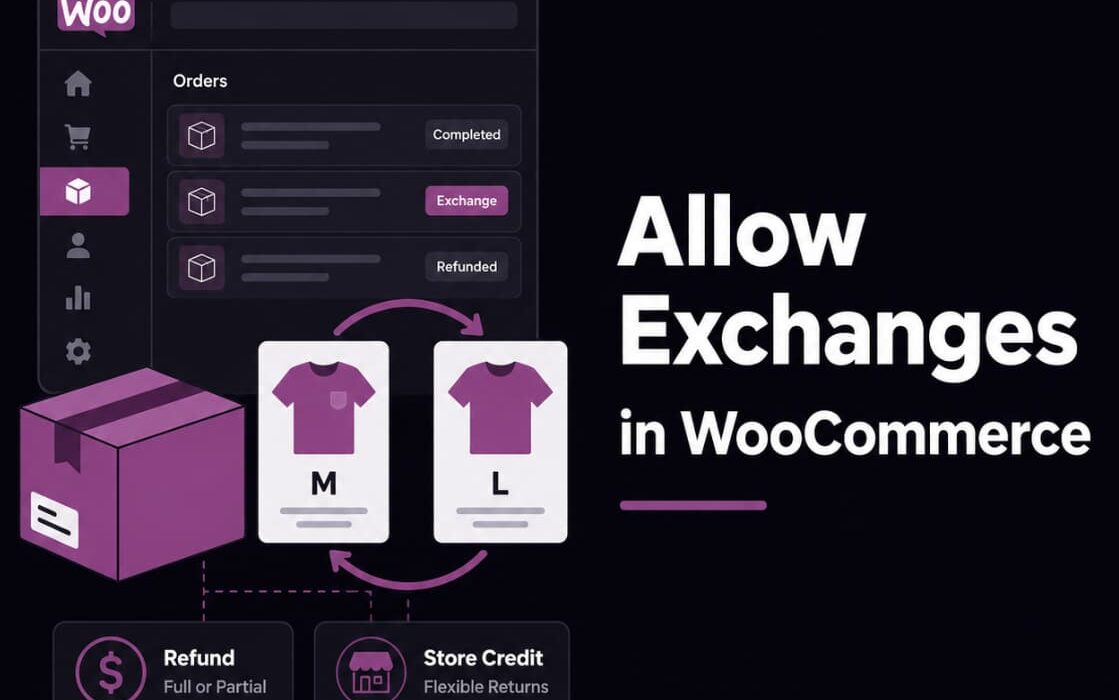
How to Allow Exchanges in WooCommerce Without Creating an Admin Nightmare
Learning how to allow exchanges in WooCommerce sounds like a customer service improvement. In reality, it is an operational decision. The moment a customer wants a different size, colour, variant, or replacement item instead of a refund, your store needs a workflow that protects stock accuracy, staff time, customer trust, and revenue.
Without a proper system, exchanges quickly become a patchwork of support emails, manual order edits, coupon codes, stock checks, and notes scattered across WooCommerce. It works for a handful of requests. It becomes fragile once your store is handling exchanges every week, or every day.
That is where a dedicated RMA Pro for WooCommerce workflow matters. Rather than treating an exchange as a refund with a side note, it lets stores manage exchanges as a proper post-purchase resolution, alongside refunds, store credit, rules, return windows, return labels, activity logs, and customer self-service.
Why stores need to allow exchanges in WooCommerce properly
Returns are not just about sending money back. They are about resolving a failed purchase while keeping the customer, the stock, and the revenue as intact as possible.
For many ecommerce stores, particularly fashion, accessories, footwear, homeware, and product lines with sizes or variants, an exchange is often the most sensible outcome. The customer may like the product, just not the chosen version. If the only route you offer is a refund, you turn a recoverable order into lost revenue.
Commercial point: A good exchange process does not simply make returns nicer. It gives the store another chance to keep the sale instead of closing the order with a refund.
WooCommerce itself supports refund handling inside orders, but running an exchange process usually needs more than a refund button. Stores need to decide:
- Which orders are eligible for exchange.
- Which items can be exchanged and within what return window.
- Whether customers can choose replacement products themselves.
- What happens if the replacement is cheaper or more expensive.
- Whether the remaining value becomes a refund or store credit.
- How staff track the request, status, notes, labels, and final resolution.
When you allow exchanges in WooCommerce without a structured system, each of those decisions ends up being made manually. That creates inconsistencies. One customer gets a flexible answer. Another gets refused. One exchange is recorded properly. Another exists only in an inbox thread. Stock gets reserved too early, too late, or not at all.
A serious return management process needs to turn those decisions into repeatable workflow.
Why basic WooCommerce returns plugins often struggle with exchanges
Many returns plugins are built around a simple idea: let the customer request a refund, let the admin approve or reject it. That can be fine for very small stores with low volumes. It becomes limited once your returns process needs nuance.
Exchanges introduce complexity because the return is no longer a one-way financial transaction. You are dealing with the original item, a replacement item, price differences, possible shipping charges, stock availability, customer choice, and fulfilment timing.
| Capability | Basic WooCommerce Returns Plugins | RMA Pro |
|---|---|---|
| Refund requests | Usually supported | Supported with structured admin workflow |
| Product exchanges | Often limited, manual, or missing | Built for exchange requests and replacement item handling |
| Mixed refund and exchange in one request | Rarely handled cleanly | Designed for more realistic mixed resolutions |
| Store credit remainder | Usually not integrated | Can support credit-led retention workflows |
| Return rules | Basic or unavailable | Eligibility logic, operational controls, and abuse prevention |
| Return windows by zone | Normally absent | Useful for location-specific return policies |
| Activity logs | Often minimal | Clear request history and admin visibility |
| Return labels and shipping support | May be absent or bolted on | Supports more complete label-led returns workflows |
The weakness of a basic plugin is not that it fails at refunds. It is that it treats every return as a simplified ticket. Serious stores need a return management system for WooCommerce that understands how exchanges affect revenue, fulfilment, customer experience, and staff workload.
How to allow exchanges in WooCommerce without relying on manual workarounds
There are three broad ways stores tend to handle exchanges:
- Manual support handling: the customer emails in, staff check the order, agree the exchange, edit stock or create a replacement order manually.
- Basic returns form: the customer submits a request, but staff still decide and execute most of the exchange behind the scenes.
- Structured RMA workflow: the customer uses a portal, the store applies rules, the exchange is tracked properly, and admin actions are tied to the request.
The first option is manageable at tiny scale. The second may look automated, but often still creates the same operational drag. The third is where a plugin such as RMA Pro for WooCommerce becomes commercially useful.
1. Customer submits the request
The portal guides the customer through the return or exchange process instead of sending them to email support.
2. Rules control eligibility
The request can be shaped by order age, customer type, product rules, return windows, and store policy.
3. Admin reviews with context
Staff see the request, selected resolutions, labels, history, and relevant order detail in one place.
4. Exchange is completed cleanly
The resolution is recorded properly, reducing side conversations and missing operational steps.
That is the difference between merely offering exchanges and being able to allow exchanges in WooCommerce at scale without the process fraying around the edges.
Allow exchanges in WooCommerce while protecting revenue
The strongest commercial reason to offer exchanges is simple: they can preserve value that would otherwise leave the business as a refund.
Imagine a customer buys a £65 jacket in medium. It fits too tightly. If the store only offers a refund route, the order ends at £0 retained revenue and the customer may buy the large elsewhere. If the store offers a clean exchange into a large, the customer gets the product they wanted and the business retains the original sale.
This matters even more when stores have already paid for acquisition. Losing the revenue after conversion is painful enough. Losing the customer relationship as well is worse.
Where exchanges are especially valuable
- Size-sensitive products such as clothing, collars, harnesses, footwear, and fitted accessories.
- Variant-led catalogues with colours, capacities, finishes, or personalised options.
- Seasonal collections where a replacement order needs to be handled quickly before stock moves.
- Stores using paid social or search acquisition where protecting post-purchase value matters.
An advanced returns system should make exchange a real resolution option rather than a customer service improvisation. That is why a WooCommerce returns and exchanges plugin needs to account for the full decision, not just create an admin note saying “customer wants a different size”.
Mixed requests: exchange one item, refund another
Real returns are rarely neat. A customer might place a three-item order and want:
- One item exchanged for a different size.
- One item refunded because it is no longer wanted.
- One item kept.
This is a common example of why stores need more than a basic exchange form. A mixed return request creates a blend of logistics and financial outcomes. If staff have to manually split that across emails, order notes, and spreadsheets, errors become likely.
Practical example: mixed exchange and refund
A customer orders a £48 top, a £55 skirt, and a £22 accessory. They want the top exchanged for another size, the skirt refunded, and the accessory kept. A capable returns system should let that sit within one controlled request, rather than forcing your team to reconstruct the logic manually.
For a store owner, the commercial benefit is not merely that the form looks tidy. It is that the request reflects the way customers actually behave. Your admin team sees the whole picture. The customer receives a resolution that matches what they asked for. The store avoids processing the wrong amount or misunderstanding the intended outcome.
How the returns portal improves customer experience
Customers do not enjoy contacting support to ask whether they are “allowed” to return something. They want clarity. They want to see their order, select the relevant item, choose the issue, and understand the available resolution.
A returns portal does not remove customer service. It removes the repetitive, low-value layer of customer service that happens before a proper decision can even be made.
Without a portal
- Customer emails “I need to swap this for a small”.
- Staff ask for order number.
- Customer replies later.
- Staff check dates, items, and policy.
- Staff explain what can happen next.
- Only then does the actual returns process start.
With a controlled returns portal
- Customer starts from their order.
- Eligible items are shown clearly.
- Available reasons and resolutions are guided.
- The request arrives with the information staff need.
That reduces time to first useful action. It also makes your return policy feel organised rather than negotiable. For WooCommerce stores, that matters because confidence after purchase influences whether a customer will risk ordering again.
When you allow exchanges in WooCommerce through a structured portal, you are not just automating a form. You are designing a customer journey that feels deliberate.
How RMA Pro reduces returns admin workload
Returns admin becomes expensive when every request must be interpreted from scratch. Staff are forced to answer the same questions repeatedly:
- Is this order inside the return period?
- Is this product excluded?
- Is the customer requesting a refund, exchange, or store credit?
- Has a label been sent?
- What was already agreed?
- Has the replacement order been handled?
RMA Pro for WooCommerce is designed to make that easier to manage. It brings the return request, customer selections, rules, resolution path, labels, and history into a single workflow.
Operational impact
- Less inbox chasing for basic return details.
- Fewer one-off staff judgements on eligibility.
- Clearer handling of exchange-led requests.
- Better visibility over what has happened and what remains outstanding.
- A repeatable process new staff can follow without tribal knowledge.
As the number of returns grows, consistency becomes more valuable than speed in one isolated case. A slightly slower but reliable workflow is better than a fast but undocumented chain of emails that no one can audit later.
Rules help control eligibility and prevent abuse
Stores should be customer-friendly. They should not be endlessly exploitable.
Returns rules matter because not every request should receive the same answer. A new, full-price order inside the standard return period is not the same as a repeatedly returned discounted item from a known high-risk customer. A VIP account may deserve more flexibility than a guest buyer with a history of unusual requests. A product type with hygiene, customisation, or final-sale restrictions may need tighter logic.
Why manual teams struggle with this
When policy lives mainly in staff memory, it becomes inconsistent. One team member might approve something another would reject. A support agent trying to be helpful may create a precedent the business never intended. A customer who pushes hard enough gets a better outcome than a quiet customer who follows the process.
Rules help bring policy into the system itself.
Practical scenario: high-risk customer controlled through rules
A customer has repeatedly bought multiple sizes, kept one, and returned the rest outside the intended usage pattern. Rather than leaving staff to notice manually every time, a more advanced rules framework can restrict or shape available return resolutions for that type of case. The aim is not to punish legitimate buyers. It is to stop abuse becoming a silent margin leak.
This is where an advanced returns system starts to pay for itself. It gives the store practical control over how generous it is, when, and to whom.
VIP flexibility: extended return windows without rewriting your whole policy
Not every customer segment needs the same post-purchase experience. Some stores may want to offer more flexibility to trade buyers, members, ambassadors, wholesale accounts, or genuinely high-value repeat customers.
That creates a difficult balance. If you publish one policy for everyone, it may be too rigid for valuable relationships. If staff manage exceptions manually, the process becomes messy and hard to control.
Practical scenario: VIP customer with an extended return window
A long-standing repeat customer receives a 45-day exchange window while standard customers receive 30 days. The store can support that decision in a controlled workflow rather than relying on a support note that says “usually allow this customer longer”.
For ecommerce managers, the point is simple: rules let you offer commercial nuance without losing operational consistency.
How exchanges protect revenue better than refunds alone
Refunds close the loop. Exchanges reopen it in a way that may keep the customer satisfied while protecting the original order value.
That does not mean every return should become an exchange. Some customers genuinely need their money back. However, when the reason for return is size, fit, colour choice, variant preference, or similar expectation mismatch, exchange is often the more useful outcome for both sides.
| Return situation | Refund-only outcome | Exchange-led outcome |
|---|---|---|
| Wrong size, customer still wants product | Revenue leaves the business | Revenue can remain with a replacement item |
| Colour not as expected, another variant preferred | Customer may reorder elsewhere | Store keeps the relationship and solves the issue |
| Gift recipient wants a different style | Original buyer receives the refund | Recipient remains engaged with the brand |
Exchange options create a commercially sensible middle ground between “keep what you bought” and “take all your money back”. That is why stores asking how to allow exchanges in WooCommerce are usually solving a margin question as much as a customer service one.
Store credit can retain value when an exact exchange is not right
Sometimes an exchange is not the cleanest path. The replacement item may be unavailable. The customer may want time to choose something else. The returned item may be cheaper or more expensive than the replacement they are considering.
Store credit gives the business another retention mechanism. Rather than defaulting to a cash refund, the value can remain available for a future order where your policy and customer agreement support that approach.
Practical scenario: store credit retains revenue
A customer returns a £72 dress and cannot find the correct replacement size in stock. Instead of taking a refund immediately, they accept store credit and later use it toward a new collection launch. The business has not forced the issue, but it has preserved the opportunity to turn a return into future revenue.
A mature returns workflow should allow stores to think in terms of resolution strategy, not just refund processing. Refund, exchange, and store credit each serve a different commercial purpose. Good returns software should help staff offer the right one in the right case.
Return windows by zone add operational flexibility
One return window does not always make sense for every order. Stores shipping domestically and internationally can face very different delivery timelines. A 14-day policy measured rigidly from order date may be reasonable for one region and impractical for another.
Return windows by zone help stores reflect those operational differences more fairly. For example:
- UK customers may have a standard return window.
- International customers may need longer because transit times are less predictable.
- Specific zones may receive tailored exchange eligibility based on shipping cost or delivery constraints.
Without a system that can account for those differences, staff end up handling exceptions manually. That creates both inconsistency and avoidable friction.
For stores that trade across markets, operational flexibility matters. The returns workflow should support the policy the business actually needs, not force the business to flatten everything into one crude rule.
Activity logs improve visibility when several people touch the request
Returns are rarely handled by one person from start to finish. Support may receive the original query. Warehouse staff may inspect the parcel. An admin may approve the resolution. Finance may need to know what was refunded or credited. Fulfilment may need to release an exchange order.
If the history sits across inboxes, notes, and memory, nobody has a reliable view of what happened.
Activity logs help solve that. A request history gives the team a clear trail of actions, decisions, and status changes. This is useful when:
- A customer chases for an update.
- A different staff member takes over the ticket.
- A refund or exchange appears delayed.
- An admin wants to review how a request reached its final outcome.
Operational point: Visibility is a feature. If your returns process cannot explain itself later, it is harder to manage, train, audit, and improve.
Return labels and Shippo support make the workflow more practical
A returns request is only half the process. The item still needs to move back through the physical world. That means labels, addresses, shipping expectations, and staff knowing whether the customer has been given the next step.
Return label support helps turn an approved return into an actionable process rather than another message that someone must manually draft. Shippo supports return label workflows and reverse-logistics options, which makes it a relevant operational reference for stores building a more organised returns process. Shippo’s returns documentation outlines return label generation options for supported carriers.
For a WooCommerce store, the benefit is straightforward:
- The returns process moves forward faster.
- Staff spend less time sending repeated shipping instructions.
- Customers receive a clearer next step.
- The exchange or refund process becomes easier to track end-to-end.
Labels do not make policy decisions. They make approved decisions easier to execute. Combined with rules, exchange handling, and request tracking, that is far more useful than a standalone label step.
Why automation matters as stores scale
At low volume, stores often underestimate returns complexity because the founder or one trusted admin can hold the entire process in their head. That stops working when volume rises, staff change, or multiple returns arrive on the same day with different edge cases.
Automation matters because returns are repetitive, but not identical. A good system reduces the repetitive parts while preserving human judgement where it genuinely matters.
Automate the repeatable
- Eligibility logic.
- Available resolution paths.
- Return windows.
- Information collection.
- Request status handling.
Keep humans focused on the decisions
- Inspecting unusual requests.
- Reviewing high-value cases.
- Handling exceptions with proper context.
- Balancing policy against customer value.
That distinction is important. The purpose of a return management system for WooCommerce is not to remove your team from the process. It is to stop your team wasting attention on tasks that should already be organised.
Where manual exchange handling starts to break
Stores tend to notice they have outgrown manual exchanges only after the pain is already obvious. Typical signs include:
- Support asking for order numbers that customers already provided elsewhere.
- Replacement items being agreed but not fulfilled promptly.
- Refunds processed when an exchange was intended.
- Customers chasing because nobody can see the request status quickly.
- Repeated debates about whether an item is eligible.
- Managers unable to tell how many returns are refunds versus exchanges versus store credit.
These are not customer service failures in isolation. They are process failures. Once that becomes clear, the argument for structured exchange handling becomes much stronger.
How RMA Pro helps serious WooCommerce stores run exchanges properly
RMA Pro is useful because it treats exchanges as part of a wider returns operation rather than as a niche add-on. It is built for stores that need more control than a simple request form can provide.
Exchange-focused resolution
Customers can be guided toward the right exchange path, not forced through a refund-first workflow.
Rules and eligibility controls
Stores can apply commercial logic rather than treating every return identically.
Store credit support
When a full cash refund is not the best retention outcome, store credit can keep value in the business.
Return windows by zone
Policies can reflect shipping reality rather than pretending every location behaves the same.
Activity logs
Teams can see how requests have progressed instead of piecing the story together manually.
Return label workflows
Approved returns are easier to move into the physical logistics stage cleanly.
This is particularly valuable for ecommerce businesses that are past the “just reply manually” stage but still want control. They do not need an overbuilt enterprise stack. They need a capable WooCommerce-native return and exchange workflow that reflects real store operations.
Allow exchanges in WooCommerce with a process built to retain value
To allow exchanges in WooCommerce properly, stores need to think beyond the checkbox level. The question is not simply, “Can a customer ask for an exchange?” The better question is, “Can our store handle that exchange consistently, profitably, and visibly once volume grows?”
A strong exchange workflow should reduce avoidable refunds, improve customer confidence, prevent return handling from living in scattered inboxes, and give the store more control over eligibility, labels, credit, and operational exceptions.
That is exactly why RMA Pro for WooCommerce exists. It gives serious WooCommerce stores a more complete way to manage refunds, exchanges, store credit, rules, labels, and request visibility without building fragile workarounds around the order screen.