
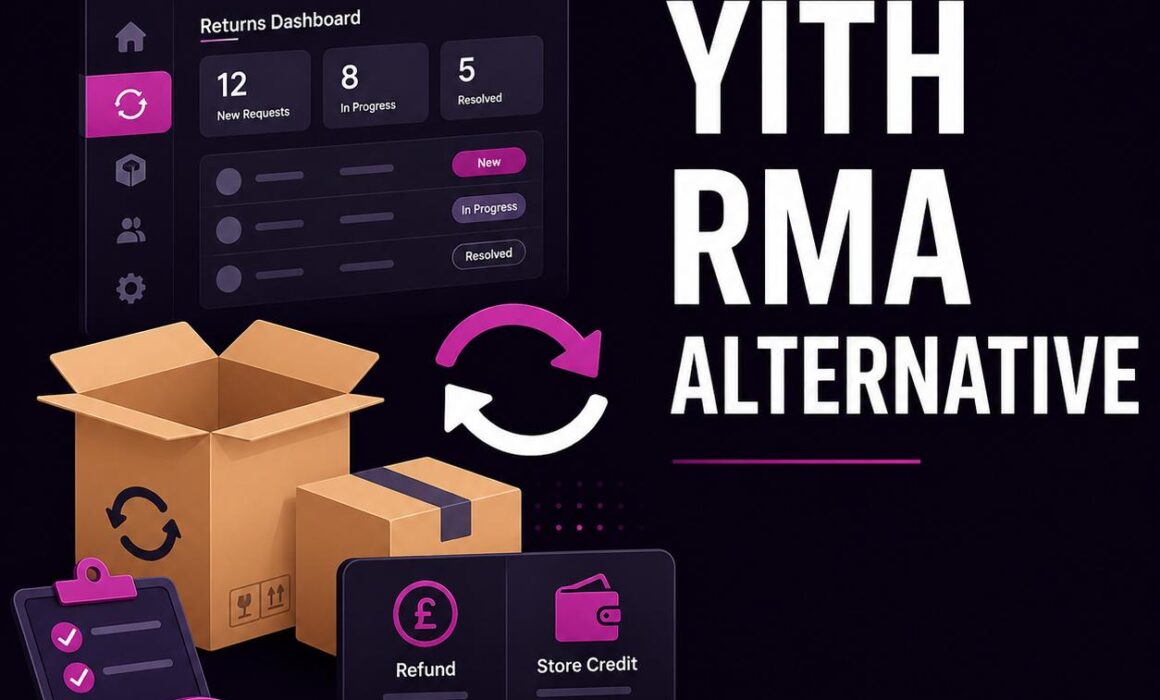
Looking for a YITH RMA Alternative? Here’s Why Serious WooCommerce Stores Move to RMA Pro
Returns management becomes a serious operational problem long before most WooCommerce stores realise it. What starts as a few refund requests quickly turns into admin overload, customer frustration, lost revenue, manual email chains, exchange confusion, abuse issues, and inconsistent policies.
That is usually the point where store owners start searching for a more advanced WooCommerce returns plugin and discover that many basic RMA systems simply do not scale well operationally.
If you are currently looking for a YITH RMA alternative, there is a good chance you have already hit some of those limitations. Maybe you need better automation. Maybe you want exchanges instead of just refunds. Maybe your returns workflow has become difficult to manage internally. Or maybe your current system simply feels too rigid for the way your store actually operates.
For growing WooCommerce stores, returns are not just customer service tickets. They are operational workflows that directly affect revenue retention, admin time, customer satisfaction, and long-term profitability.
Why WooCommerce Returns Become Difficult to Manage
Returns are easy to underestimate because the first few are usually handled manually. A customer emails in, someone checks the order, a refund is processed, and the problem appears solved.
That process breaks down when order volume increases. The issue is not just the number of return requests. It is the number of decisions hidden inside each request. Is the item eligible? Is the customer inside the return window? Should this be a refund, exchange, store credit, or manual review? Has this customer returned too many items already? Does the product category have different rules?
Common operational problems WooCommerce stores face
- Customers asking for exchanges, refunds, and store credit in the same request
- Support teams manually checking return eligibility
- Different return policies for different products or customer types
- High-risk customers abusing return policies
- Manual return label handling
- No visibility into return activity history
- Refunds causing unnecessary revenue loss
- No structured returns portal for customers
- Admin teams buried in repetitive tasks
When those checks sit inside inboxes, spreadsheets, and staff judgement, the process becomes inconsistent. One customer gets approved quickly. Another waits two days. One staff member offers store credit. Another refunds immediately. Over time, that creates customer service issues and unnecessary margin loss.
This is where many basic WooCommerce returns plugins begin to struggle. They provide a return form, but they do not always give the store enough control over the operational workflow behind that form.
Why Many Store Owners Start Looking for a YITH RMA Alternative
Plugins like YITH RMA can be suitable for stores with simple returns requirements. However, many growing ecommerce businesses eventually need more flexibility, more automation, and better operational control.
The reason store owners search for a YITH RMA alternative is rarely because they want another plugin for the sake of it. It usually happens because the current process has become too manual, too restrictive, or too difficult to manage as the store grows.
Serious WooCommerce stores usually need returns systems that can handle:
- Advanced rule logic
- Exchange workflows
- Store credit retention strategies
- Eligibility automation
- Multi-scenario returns handling
- Operational visibility
- Customer segmentation
- Workflow scalability
This is exactly where RMA Pro for WooCommerce positions itself differently.
Rather than treating returns as simple refund forms, RMA Pro approaches returns as a complete operational management system for WooCommerce stores. That distinction matters because a return is rarely just one action. It is a sequence of checks, decisions, customer updates, admin actions, and financial outcomes.
Basic WooCommerce Returns Plugins vs RMA Pro
| Feature | Basic WooCommerce Returns Plugins | RMA Pro |
|---|---|---|
| Customer Returns Portal | Limited or basic forms | Dedicated structured returns portal |
| Exchange Handling | Often limited | Advanced exchanges with workflow support |
| Store Credit Workflows | Basic or unavailable | Integrated store credit and wallet workflows |
| Rules Engine | Limited conditions | Advanced IF/THEN rule system |
| VIP / High-Risk Logic | Rarely available | Fully configurable rules |
| Return Windows by Zone | Usually unavailable | Supported through zone rules |
| Activity Logs | Minimal visibility | Detailed activity tracking and history |
| Automation | Limited | Designed for operational automation |
| Return Labels | Manual workflows | Shippo support and label workflows |
Returns Are Not Just Refunds Anymore
A refund is only one possible outcome of a return request. For many stores, treating every return as a refund is the fastest way to lose revenue that could have been retained.
In real ecommerce operations, customers may want a different size, a replacement product, a partial refund, store credit, or a combination of resolutions. The customer does not think in terms of admin workflows. They just want the problem solved quickly and clearly.
Store owners, however, need more than a simple approval button. They need:
- Policy enforcement
- Fraud prevention
- Reduced admin workload
- Retention strategies
- Workflow consistency
A simple refund-based system no longer solves the operational side of returns management. It may process the request, but it does not necessarily protect margin, improve retention, or reduce the admin burden.
This is one of the main reasons many WooCommerce stores move toward a more advanced returns system like RMA Pro for WooCommerce.
How RMA Pro Reduces Admin Workload
Admin time is one of the hidden costs of returns. It does not always show up clearly in profit reports, but it affects the business every day.
Every manual return request creates small tasks: check the order, check the date, check the product, check the customer history, reply to the customer, update the status, issue the refund, handle the label, and make sure everyone knows what happened.
Without automation, staff spend hours:
- Checking eligibility manually
- Reviewing policies
- Approving requests
- Handling customer emails
- Creating coupons manually
- Managing exchange communication
- Tracking return progress internally
The commercial problem is not just staff time. It is also the inconsistency that manual work creates. If two members of staff handle returns differently, customers receive different outcomes and the business loses control of its own policy.
Example workflow automation
A customer submits a return request through the portal. RMA Pro can help structure the process by:
- Checking whether the order falls within the return window
- Checking product eligibility
- Applying customer-specific rules
- Detecting whether the customer is VIP or high-risk
- Calculating available resolutions
- Creating the return request
- Logging key actions
- Improving admin visibility
That level of structure becomes valuable as stores scale because the returns process becomes repeatable. Staff are not starting from scratch every time a request lands.
How Exchanges Help Protect Revenue
A refund solves the customer’s problem, but it also removes the order value from the business. For many WooCommerce stores, that is the real cost of a weak returns process. The customer may have been happy to keep buying from you, but the workflow pushed them straight into a refund instead of an exchange.
This is especially common in fashion, footwear, accessories, personalised products, and size-led ecommerce. The issue is often not that the customer no longer wants the product. They may simply need a different size, colour, fit, or replacement item.
That is where exchange handling becomes commercially important. A good exchange workflow gives the customer a clear route to solve the problem while helping the store retain the sale.
Real-world example: Mixed refund and exchange request
A customer orders three clothing items:
- One item needs a size exchange
- One item is refunded
- One item is converted to store credit
This is a normal ecommerce scenario, but it can be awkward for basic returns plugins because the request is not a single clean refund. It has multiple items, multiple outcomes, and multiple financial implications.
RMA Pro is designed for these real ecommerce scenarios rather than simple single-outcome refunds. That gives the store more flexibility while reducing the chance that staff have to move the request into emails, notes, or manual workarounds.
The commercial benefit is straightforward: fewer unnecessary refunds, more retained revenue, and a cleaner customer experience when the customer still wants to buy from you.
Store Credit Helps Retain Revenue
Store credit is not just a convenience feature. Used properly, it is a retention tool.
If a customer receives a refund, the money leaves the business and the relationship may end there. If the same customer receives store credit, there is a stronger chance they come back, browse again, and place another order.
This matters most in stores where customers often buy by style, size, season, or preference. A return does not always mean the customer is unhappy with the brand. It may simply mean the product was not the right fit.
RMA Pro includes integrated store credit and wallet functionality that allows stores to build retention directly into the returns workflow.
Why store credit matters
- Keeps revenue inside the business
- Encourages repeat purchases
- Improves customer lifetime value
- Reduces refund losses
- Creates smoother customer experiences
For growing WooCommerce stores, even a modest shift from refunds to store credit can make a noticeable difference over time. It is not about refusing refunds where they are required. It is about giving the store more resolution options so every return does not automatically become lost revenue.
That is one reason many businesses looking for a WooCommerce returns plugin eventually prioritise advanced store credit handling.
Rules Matter More Than Most Stores Expect
Return policies are easy to write but harder to enforce consistently. The more products, customers, regions, and exceptions you have, the more difficult it becomes to apply the same logic every time.
Without rules, admin teams end up manually interpreting policies on every request. That creates delays and inconsistent decisions.
RMA Pro includes advanced IF/THEN rule workflows that allow stores to automate eligibility and control return behaviour more intelligently.
Example: High-risk customer management
A customer has a history of excessive returns. They may not be doing anything fraudulent, but the behaviour still creates cost and operational risk.
Instead of allowing every request to pass through the same workflow, rules can:
- Restrict available resolutions
- Force manual review
- Disable free returns
- Apply stricter conditions
This gives the store control without forcing staff to remember every exception manually.
Example: VIP customer handling
A high-value repeat customer may deserve more flexibility. For example, a VIP customer might receive:
- Extended return windows
- Priority exchanges
- Enhanced flexibility
- Store credit incentives
These operational differences are difficult to manage through basic return forms. They become far easier when rules are built into the return management process.
Why Return Windows by Zone Matter
A single return window is not always practical. Domestic and international customers do not experience the same delivery times, return postage delays, or logistical constraints.
For example:
- Domestic customers may receive 30 days
- International customers may receive 45 days
- Specific zones may require extended shipping allowances
If your policy does not reflect those operational differences, you either become too strict for some customers or too generous for others.
RMA Pro includes return windows by zone, allowing stores to build more realistic policies around shipping and logistics. This helps reduce manual exceptions while keeping the customer experience fairer across different delivery regions.
Customer Experience Is a Major Factor
Returns are one of the most sensitive parts of ecommerce because the customer is already dealing with a problem. If the process is slow, unclear, or email-heavy, frustration builds quickly.
Customers want:
- Clear processes
- Fast responses
- Easy tracking
- Simple submission workflows
- Minimal confusion
The operational benefit of a returns portal is that it gives customers a guided route instead of asking them to explain everything manually by email.
The structured returns portal inside RMA Pro for WooCommerce is designed to improve the customer experience while also reducing support workload.
Instead of relying on scattered email chains, customers can use a proper returns portal built specifically for WooCommerce returns workflows. That helps the customer understand what to do next and helps the store capture the information it needs from the start.
Activity Logs Improve Operational Visibility
When a store is small, it is usually obvious who handled a return and what happened. As the team grows, that visibility disappears quickly unless the system records it properly.
Without proper logging, stores quickly lose track of:
- Who approved returns
- What actions were taken
- When status changes occurred
- How resolutions were handled
- Why specific decisions were made
RMA Pro includes detailed activity logs that improve accountability and operational clarity.
This becomes especially valuable for:
- Multi-staff environments
- Customer disputes
- Support management
- Auditing workflows
- Scaling operations
The benefit is not just record keeping. It is confidence. If a customer questions a decision, or a member of staff needs to check what happened, the information is available inside the workflow rather than buried in inboxes.
Return Labels and Shippo Support
Return labels are another area where manual processes quickly become messy. If staff are creating labels separately, emailing them manually, and updating records afterwards, every return adds avoidable admin work.
RMA Pro supports return label workflows and Shippo integration to help streamline this process more effectively.
This helps stores:
- Reduce manual admin
- Improve return processing speed
- Create cleaner workflows
- Improve customer experience
- Standardise operational handling
For stores handling regular return volume, this kind of workflow improvement matters. It removes small repetitive tasks that otherwise accumulate into a larger operational burden.
Why Automation Matters as WooCommerce Stores Scale
Manual processes usually fail gradually. At first, they are manageable. Then they become annoying. Eventually, they become the reason orders, returns, and customer messages start backing up.
The problem is not just time. It is consistency.
Manual returns handling introduces:
- Human error
- Inconsistent decisions
- Slower customer responses
- Internal confusion
- Policy drift
Automation helps standardise the returns process while keeping workflows manageable. It gives the store a repeatable structure rather than forcing staff to rebuild the process manually every time.
This is why many stores eventually move from basic plugins toward more advanced systems designed specifically for operational scalability.
RMA Pro Is Built for Serious WooCommerce Stores
Not every WooCommerce store needs advanced returns management from day one. A small store with low return volume may be able to manage with simpler tools.
But serious ecommerce stores eventually reach a point where returns become operationally critical. At that stage, the store needs more than a form. It needs control, visibility, automation, and flexible resolution options.
That is the point where exchanges, store credit, rules, activity logs, return labels, and a proper returns portal become far more important than simple refund handling.
RMA Pro for WooCommerce is designed specifically for those operational realities.
What makes RMA Pro different?
- Designed around operational workflows, not just refunds
- Built for scalability and automation
- Strong exchange and store credit handling
- Advanced rules and eligibility logic
- Improved admin visibility
- Structured returns portal
- Better support for real ecommerce scenarios
- Focused on reducing operational workload