
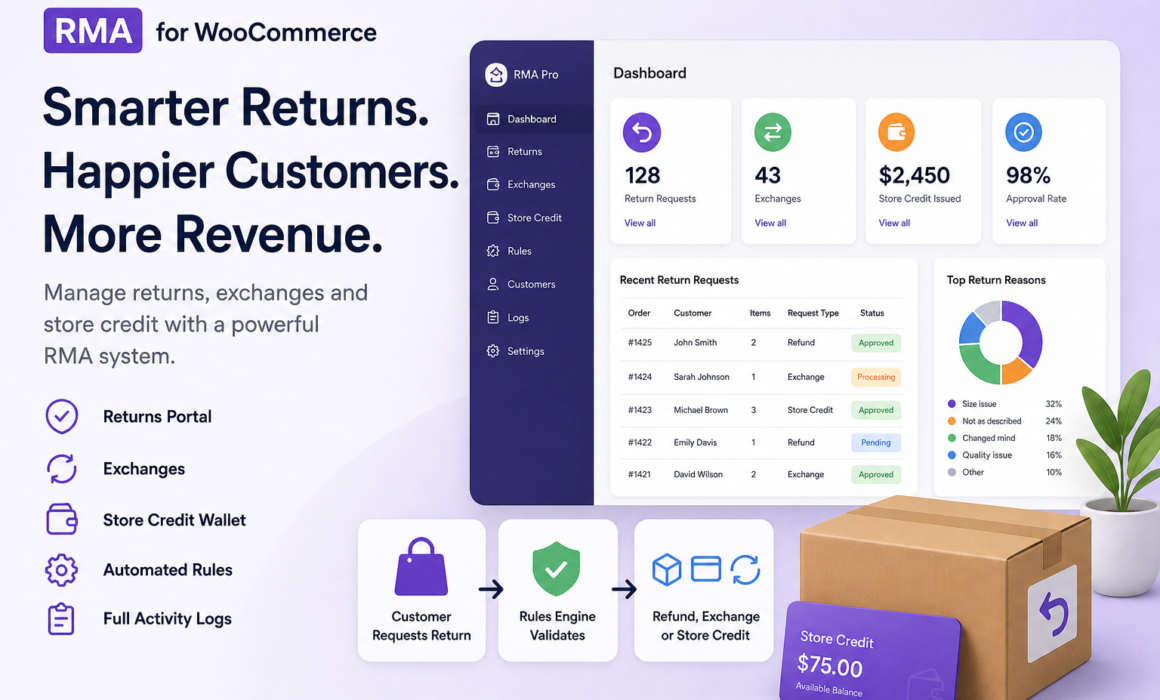
RMA for WooCommerce – Fix Returns, Exchanges and Store Credit
RMA for WooCommerce – Fix Returns, Exchanges and Store Credit
If you are handling customer returns manually in WooCommerce, you already know the pain.
Customers email support. They want a mix of refunds and exchanges. You are checking policies manually. Every return becomes a one-off decision.
This is where most stores break. Not at sales – at returns.
Returns are operationally heavy, easy to abuse, and directly impact profit. Yet most stores are still running them through email threads, spreadsheets, or basic plugins that only cover refunds.
That is not a returns system. That is damage control.
What RMA Means in Ecommerce
RMA – Return Merchandise Authorisation – is not just a label or form.
A proper RMA process is a structured workflow that controls how returns are requested, approved, and processed.
- Customers submit returns through a returns portal
- Each item is handled individually
- The system enforces your return rules
- Outcomes are controlled – refund, exchange, or store credit
- Everything is logged and trackable
If any of those are missing, you do not have a real RMA system.
Why Most WooCommerce Return Systems Fail
Email-Based Returns
- No structure
- No audit trail
- High support workload
Basic Returns Plugins
- Only handle refunds
- No exchange logic
- No rule automation
Manual Decision-Making
- Inconsistent policies
- Easy to exploit
- Slows down operations
The issue is not WooCommerce itself. It is the lack of a system built for real-world return scenarios.
What a Proper Returns System Should Do
A working RMA setup needs to handle complexity without adding manual work.
Structured Customer Returns
- A dedicated returns portal
- Customers select items and reasons
- Clear status updates
Flexible Resolutions
- Refund
- Exchange
- Store credit
- Or a mix of all three
Rule-Based Decisions
- Automatically approve or reject returns
- Flag high-risk behaviour
- Adjust policies by customer type
Automation
- Reduce back-and-forth emails
- Trigger actions based on rules
- Keep workflows consistent
Full Visibility
- Track every return
- Log actions
- Monitor patterns
Without this, returns will always be reactive.
Real-World Scenarios Most Stores Struggle With
Mixed Return Requests
A customer returns 3 items:
- 1 refund
- 1 exchange
- 1 store credit
Most systems cannot handle this cleanly.
A proper RMA system processes each item individually, while still keeping everything in one request.
High-Risk Customers
Some customers repeatedly:
- Buy multiple sizes
- Return most items
- Cost more than they generate
Without rules, these slip through.
With a rule engine, you can:
- Restrict refund options
- Force store credit
- Require manual approval
VIP Customers
Your best customers should not get standard treatment.
You may want:
- Extended return windows
- Faster approvals
- More flexible exchange options
A proper system applies this automatically.
Store Credit as a Retention Tool
Refunds lose revenue. Store credit keeps it.
Used properly, store credit can:
- Increase repeat purchases
- Reduce refund losses
- Improve customer lifetime value
This is covered in more depth here: [link to store credit strategies]
Basic Returns Plugins vs Advanced Systems
| Feature | Basic Plugin | Advanced RMA System |
|---|---|---|
| Returns portal | Limited or none | Full customer portal |
| Per-item handling | No | Yes |
| Exchanges | Usually missing | Built-in |
| Store credit | Basic or none | Wallet system |
| Rule automation | No | Yes |
| Abuse prevention | No | Yes |
| Activity logs | Limited | Full tracking |
| Mixed return types | No | Yes |
Most plugins solve one part of the problem. Advanced systems solve the workflow.
Manual Returns vs Automated Returns
| Process | Manual | Automated |
|---|---|---|
| Time per request | High | Low |
| Consistency | Poor | Controlled |
| Customer experience | Slow | Structured |
| Error risk | High | Reduced |
| Scalability | Limited | Scales with orders |
Manual returns work at low volume. They break quickly as you grow.
How RMA Pro Fits Into This
RMA Pro for WooCommerce is built around the idea that returns need structure, not just forms.
It introduces a full RMA workflow inside WooCommerce.
Returns Portal
Customers submit returns without contacting support directly.
Per-Item Resolutions
Each item can be:
- Refunded
- Exchanged
- Converted to store credit
Rule Engine
Automatically control:
- Who gets refunds
- Who gets store credit
- When returns are allowed
Exchange Handling
Generate exchange orders without manual intervention.
Store Credit Wallet
Track and reuse credit instead of losing revenue.
Return Windows by Zone
Control eligibility based on shipping location.
Activity Logs
Keep a full audit trail for every return action.
This moves returns from reactive support into a controlled system.
Common Mistakes When Handling Returns
Treating All Customers the Same
Different customers should have different rules.
Defaulting to Refunds
You are giving money away instead of retaining it.
Ignoring Exchanges
Exchanges are often the best outcome but hardest to manage manually.
No Central Returns Portal
Email-based returns do not scale.
No Visibility
If you cannot track return patterns, you cannot improve them.
Best Practices for WooCommerce Returns
- Use a dedicated returns portal instead of email
- Offer store credit strategically, not just refunds
- Automate decisions with rules where possible
- Handle returns at item level, not order level
- Track and review return data regularly
For a full breakdown of structuring your process: [link to returns guide]
You can also compare available tools here: [link to WooCommerce returns plugins]
And understand resolution strategies here: [link to exchanges vs refunds]
Final Thought
Returns are not just a support task. They are a profit lever.
Handled badly, they drain time and revenue. Handled properly, they improve retention and customer experience.
If your current setup involves manual decisions, limited plugins, or email-based workflows, it will not scale.
A structured RMA system is the difference between reacting to returns and controlling them.
Try RMA Pro
If you want a proper returns system inside WooCommerce – one that handles exchanges, store credit, and automation without manual overhead – RMA Pro for WooCommerce is built for that.
Start with the returns process you already have. Then replace the parts that are costing you time and money.